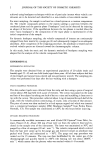
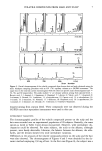
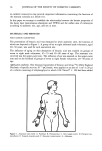
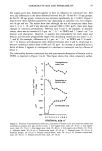
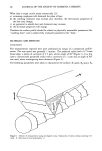
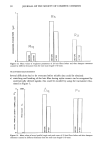
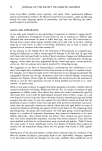
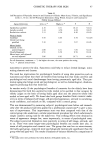
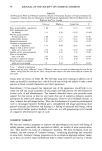
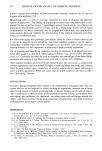
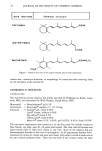
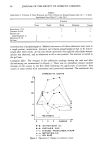
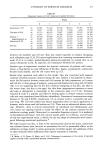
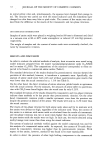
PROFILOMETRY OF HAIR 29 Figure 2. Scheme of measurement using pyramidal stylus. Dislocation of stylus during scanning (vertical), $ . Direction of scan (horizontal), ---. (}xm), Rq (}xm), Pc (peaks/cm) and Aq (for definition see (3)). Aq is a measure for profile length, Pc for peak density. The suppression of waves while determining roughness was either done by electronic filters (4) or by treating unfiltered profiles by digital filtering software (5). SAMPLE PREPARATION Most of the hair fibers tested were obtained from small strands cut above the scalp behind one of the ears and marked according to the direction of growth. Single hair fibers were fixed to microscope slides: a) the glass slides were placed on top of checkered paper, glass edges being parallel to the lines on the paper b) the tip of the fiber was fixed to the slide by adhesive tape c) the other end was loaded with a clothes peg weighing 6.2 grams (constant preten- sioning force) the hair was adjusted parallel to the slide edges d) two drops of nail lacquer fixed the hair to the slide in case of later treatments the hair was fixed over its whole length by a thin film of nail lacquer in the case of vertical measurements two (or several) drops of lacquer fixed neighboring segments -- 1 mm distance--of the fiber (6) e) to determine the extent of swelling of hair fibers caused by aqueous media, the fibers

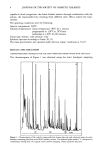
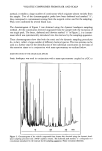
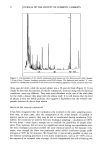
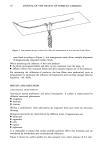
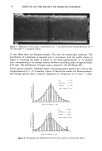
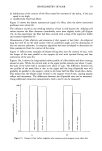
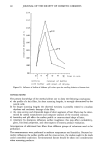
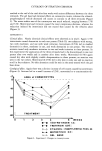
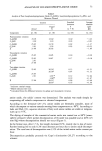
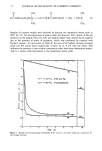
30 JOURNAL OF THE SOCIETY OF COSMETIC CHEMISTS Figure 3. Instrumental set-up to adjust hair fibers for measurement of cross sections of hair fibers. were fixed according to Figure 3 this arrangement easily allows straight alignment of longitudinally expanded swollen fibers. When measuring the influence of hair care products ß the fibers investigated before and after in vitro treatment were the same, or ß different fibers were evaluated before and after repeated regular use of the products. For measuring the influences of products, the hair fibers were randomized prior to measurement to randomize the influence of temperature and humidity changes (relative humidity --60-80%). RESULTS AND DISCUSSION LONGITUDINAL MEASUREMENTS Interrelation between profilometric and optical investigations. A surface is characterized by different structural phenomena: ß roughness ß waviness ß contour Within a profilometer these phenomena are separated from each other by electronic filtering. Biological specimens are characterized by different levels of organization too: ß molecules ß organelles ß cells ß organs ß organisms It is reasonable to expect that surface profiles somehow reflect this hierarchy and are modulated by biorhythms and environmental influences. Figure 4 shows the surface profile of a hair scanned over a short distance of 0.4 mm.
Purchased for the exclusive use of nofirst nolast (unknown)
From: SCC Media Library & Resource Center (library.scconline.org)