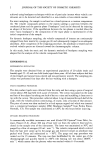
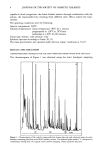
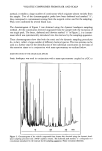
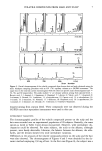
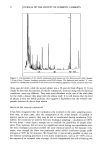
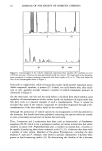
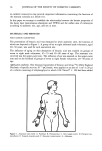
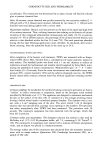
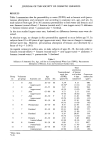
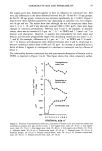
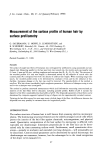
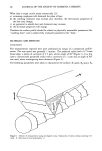
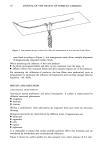
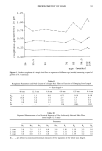
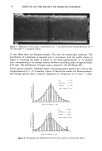
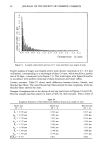
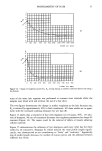
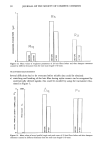
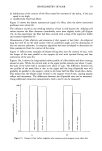
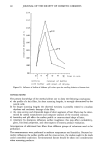
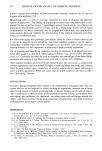
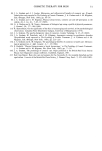
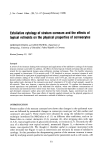
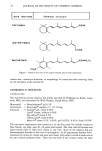
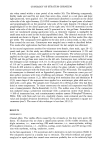
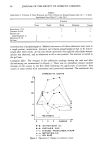
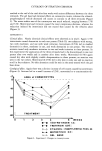
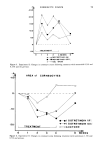
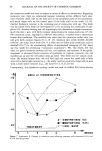
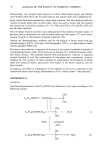
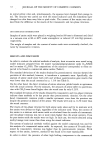
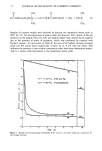
PROFILOMETRY OF HAIR 39 b) falsification of the contour of the fiber caused by inertness of the stylus, if the scan speed is too high c) insufficiently fixed hair-fibers. Figure 15 shows the almost symmetrical signal of a fiber, after the above mentioned problems were solved (6). The influence of pH on the swelling behavior of hair is well known (9). Alkaline pH values increase the fiber diameter considerably more than slightly acidic pH (Figure 16). In this experiment the fiber had been covered with a drop of the respective buffer and scanned repeatedly (6). Determination of fiber ellipticity and orientation of short segments of hair fibers. An elliptical long hair will lie on the slide surface with an undefined angle, and the dimensions of the two axes are unknown. A computer algorithm has been developed to determine the three parameters from the contour of the scans. Figure 17 reflects some examples of ellipses fitting best into the contour of scan, with the longer of the axes parallel to the support (a) and with optimal fitting and free orientation of the axes (b). Figures 18a, b shows the longitudinal surface profile of a fiber before and after twisting around its axis. While the vertical scale in the upper profile extends over about 14 •m, the scale of the lower half is extended over about 27 •m. The difference between the two profiles of the same fiber is that in the upper half the long ellipsoidal axes will probably lie parallel to the support, while in the lower half the fiber winds like a helix. This means that the ellipses stand vertical to the support every 8 mm, causing regular valleys and mountains. The differences between the ellipsoidal axes can be measured. Using additional transverse measurements, both a and b can be measured. o L rv' G.. I. fl Z lOO Z / // '-' I / // [ I / : // I / "// ø I s B Figure 15. Changes of hair surface roughness after treatment with shampoo (every other day).

40 JOURNAL OF THE SOCIETY OF COSMETIC CHEMISTS 114 112 11o ß • 108 184 -H 102 100 98 •1 • •1 • m • time in min wetting removal of buffer with buffer and onset of drying F•ure 16. InfluenceofbuffersofdifferentpH values upontheswelling behaviorofhuman hair. CONCLUSIONS The present knowledge of the method allows one to draw the following conclusions: a) the profile of a hair fiber, for short scanning lengths, is strongly determined by the cuticle cells b) for longer scanning lengths the observed waviness is possibly related to circadian rhythms and stochastic damage of the fiber c) the cross section and ellipsoidal shape of short segments of hair fibers may be deter- mined by careful measurement and computer analysis of the recorded contours d) humidity and pH affect the surface profile or cross-sectional shape of hairs e) treatment by shampoos influences surface roughness this may affect combability, gloss, frictional properties, and other aspects of sensory product evaluation. Investigations of additional hair fibers from different groups of volunteers need to be performed. The measurements were performed at ambient temperature and humidity. Because hu- midity influences the surface profile and the cross section, the studies ought to be made under controlled conditions. Environmental factors should be taken into consideration when screening products.
Purchased for the exclusive use of nofirst nolast (unknown)
From: SCC Media Library & Resource Center (library.scconline.org)