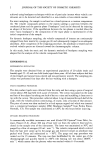
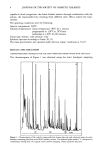
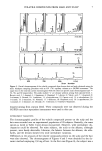
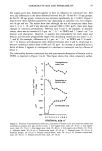
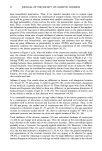
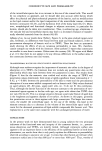
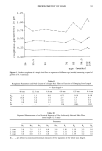
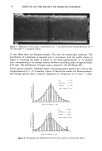
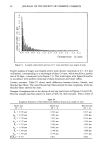
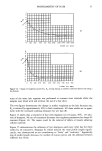
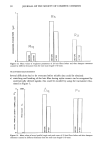
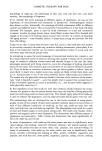
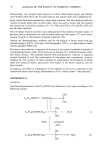
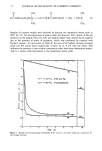
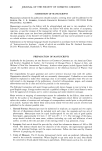
4 JOURNAL OF THE SOCIETY OF COSMETIC CHEMISTS capable of chiral recognition: the chiral chelates interact through coordination with the solutes, the enantioselectivity resulting from different steric effects toward the enan- tiomers. The operating conditions were the following: Injector temperature: 240øC Column temperatures: initial temperature: 40øC for 1 minute programmed to 120øC at 20øC/min isothermal at 120øC for 80 minutes Carrier gas: helium, inlet pressure 1 bar Splitless injection according to Grob (10,11) The mass spectrometer was operated under electron impact conditions at 70 eV. RESULTS AND DISCUSSION CHROMATOGRAPHIC PROFILES OF THE VOLATILE COMPOUNDS FROM HUMAN HAIR AND SCALP The chromatogram of Figure 1 was obtained using the static headspace sampling 110 2,O 3p min. Figure 1. Chromatogram of the volatile compounds from human hair and scalp obtained using the static headspace sampling procedure and a FFAP capillary column. The darkened peaks marked "a" correspond to contaminants arising from the surgical cotton used for sampling. Flame ionization detection.

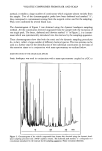
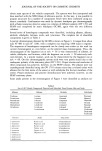
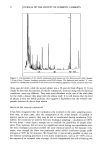
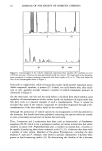
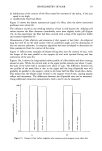
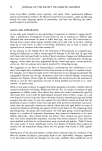
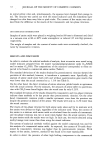
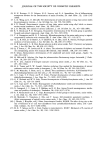
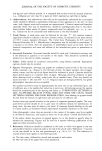
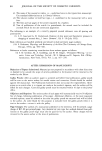
VOLATILE COMPOUNDS FROM HAIR AND SCALP 5 method it exhibits a large number of constituents which originate almost entirely from the sample. Two of the chromatographic peaks have been darkened and marked "a" they correspond to contaminants arising from the surgical cotton used for the sampling. They were confirmed by several blank runs. The chromatogram of Figure 2 was obtained using the dynamic headspace sampling method. All the constituents detected originated from the sample with the exception of one single peak. The latter, darkened and likewise marked "a" in Figure 2, is a contam- inant which was systematically introduced into the mixture by the sampling apparatus. These chromatograms show that both the static and the dynamic sampling procedures do, in fact, collect a large number of different chemical species. The two systems can be used in a further step for the identification of the individual constituents on the basis of the retention times or in conjunction with mass spectrometry as outlined below. IDENTIFICATION OF THE MOLECULAR SPECIES Static headspace was used in conjunction with a mass spectrometer coupled to a GC to 10 20 30 min. I I I Figure 2. Chromatogram of the volatile compounds from human hair obtained using the dynamic head- space sampling procedure and a FFAP capillary column. The darkened peak marked "a" corresponds to a contaminant introduced in the mixture,by the,sampling,aopazarus. Flame ionization,detect4on.
Purchased for the exclusive use of nofirst nolast (unknown)
From: SCC Media Library & Resource Center (library.scconline.org)