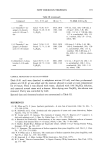
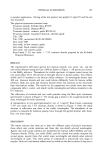
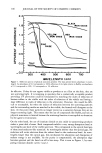
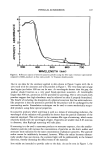
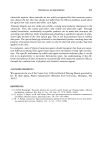
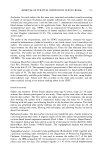
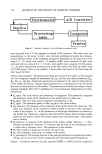
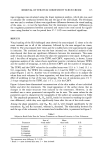
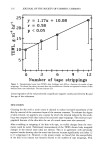
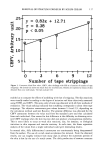
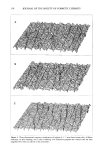
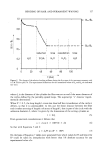
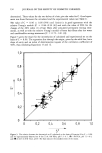
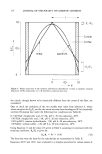
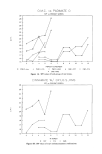
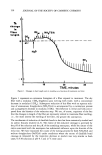
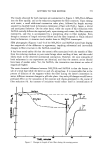
PHYSICAL SUNSCREENS 107 I..O z o i- z I..O 13:: o 400 500 600 WAVELENGTH {nm ) 700 Figure 2. Reflectance spectra of selected sunscreen powders using the fiber optic remittance spectrometer compared to BaSO 4 standard. a) Zinc oxide powder. b) Titanium dioxide powder. Our in vivo data for the ointment applied to skin shown in Figure 3 agree with the in vitro work with the ointment and with powders in Figure 1. The very sharp optical gap that begins just below 400 nm can be seen. At wavelengths shorter than the gap, the product should function as a very good broad-spectrum sunscreen. At wavelengths longer than 400 nm, protection will be provided by scattering. The in vitro results with powders suggest that high absorbance may be achieved on skin if properly formulated. The benefit of including the absorption of a physical sunscreen that has semiconductor- like properties is that the protection provided by the product will be unchanged by the surrounding media. Formulation techniques can be used to create aesthetically accept- able products using these optical properties. In sunscreen products where scattering is used as a means of attenuating radiation, the wavelength of the radiation will generally be shorter than the particle diameters of the material employed. This will result in the common Mie type of scattering, which varies relatively slowly with the wavelength of light. If particles are smaller than 0.03 microns in diameter, then Rayleigh scattering will take place. If scattering is to be used in sunscreen products to attenuate exposure, then the smaller- diameter particles will increase the concentration of particles on the skin's surface and attenuate more radiation for the same concentration of physical sunscreen. The particle radius cannot be indefinitely decreased, however. When the radius becomes substan- tially smaller than one micron, the scattered light will be preferentially in the forward direction, thereby deceasing the effectiveness of the material. Iron oxides are intended to provide color to the skin. As can be seen in Figure 1, the

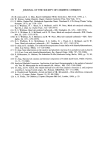
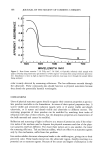
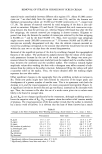
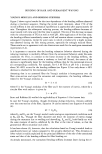
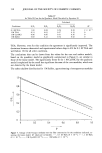
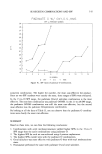
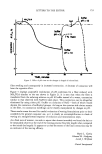
108 JOURNAL OF THE SOCIETY OF COSMETIC CHEMISTS W Z rn 0 z w t.2 0.8 0.6 0.4 0.2 b 0 I ß I , I , I , I I I • I • I I 300 400 500 600 700 WAVELENGTH (nm) Figure 3. Rosa Cream contains 7.5% TiO2 and 7.5% ZnO. a) Opt{cally infinitely thick sample with quartz coverslip using remittance spectrometer. b) One mg/cm 2 on human skin using remittance spectrom- eter. Absorbance is twice as high as expected because radiation must pass twice through the sample before being analyzed. color is easily detected by measuring reflectance. The low reflectance extends through the ultraviolet. These compounds also should function as physical sunscreens because they absorb the potentially harmful wavelengths. CONCLUSIONS Users of physical sunscreen agents should recognize their common properties as particu- late powders insoluble in the formulation. In terms of their optical properties they 1) scatter visible and ultraviolet radiation equally well, or 2) scatter visible and absorb ultraviolet, or 3) scatter and absorb visible and ultraviolet to different extents. The scattering properties of these powders can be modified by matching their index of refraction with that of their vehicles, but the absorption properties are characteristic of the bulk material and cannot be modified. Reflection and scattering of light is effective as a means of protection only if the refrac- tive index of the medium used to disperse the physical sunscreen and that of the phys- ical sunscreen itself are different. The closer these indices are to one another, the lower the screening efficiency. Talc and barium sulfate, which are effective as sunscreen agents only by this mechanism, suffer from this problem. Iron oxides exhibit electronic absorption bands in the visible region, giving rise to their perceived color. These bands extend into the ultraviolet region, thereby resulting in a potential use as sunscreen agents. Because of the nature and degree of absorption in the
Purchased for the exclusive use of nofirst nolast (unknown)
From: SCC Media Library & Resource Center (library.scconline.org)