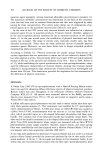
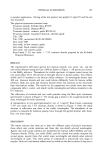
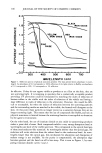
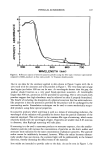
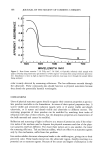
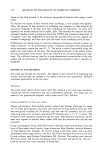
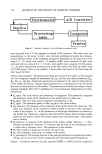
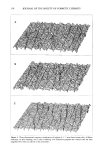
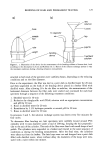
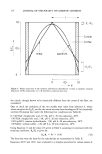
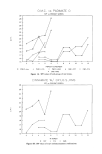
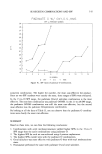
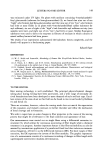
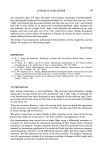
118 JOURNAL OF THE SOCIETY OF COSMETIC CHEMISTS Figure 4. Three-dimensional computer visualization of replicas (6 X 3 mm) from human skin. a) Before treatment b) after washing and c) after scrubbing. For illustrative purposes the vertical scale has been magnified five times in relation to the horizontal.

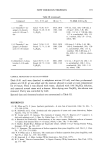
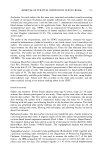
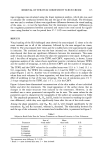
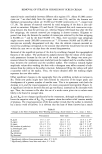
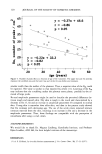
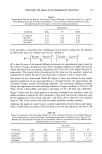
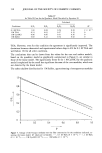
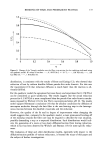
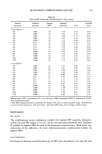
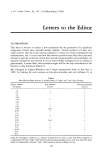
REMOVAL OF STRATUM CORNEUM BY SCRUB CREAM ! 19 material varies considerably between different skin regions (15). About 95,000 corneo- cytes cm -2 are shed daily from the upper inner arm (16), and for the forearm and forehead corresponding values are 30,000 and 50,000 corneocytes cm -2, respectively (17, 18). The amount of material removed by serial stripping of the skin is also sub- jected to variations. Kligman (15) and Zesch (19) reported that each consecutive strip- ping removes less than the previous one, whereas Tregear (20) found that after the first few strippings, the amount removed per stripping is almost constant. Kligman re- ported that from the forearm the number of corneocytes removed by the first stripping is 80,000 cm -2 and by the third 50,000 (15). Thus, three successive tape strippings might remove nearly 200,000 corneocytes cm -2. If between 30,000 and 95,000 cor- neocytes are normally desquamated each day, then the stratum corneum material re- moved by scrubbing corresponds to the amount that otherwise would have become lost within the next two to six days from the normal desquamation. Removal of the superficial portion of the skin by scrubbing changed the topographical features of the surface. The profilometry analysis showed that the values of the ampli- tude parameters decrease by the use of the scrub cream. The change was more pro- nounced when the comparisons were made between the washed and the scrubbed surface than between the untreated and the scrubbed surface. The tendency towards higher amplitude values after washing the skin with a detergent may reflect removal of sub- stances from the valleys in the surface structure. Substances filling the valleys will yield a smoother relief on the replica. Thus, the values obtained after the washing might represent the true skin surface. Other significant changes in the topography from the scrubbing include an increase in Rn. These new peaks might have been formed by reduction of the larger peaks and development of a greater number of smaller ones. This is in agreement with both the decrease in •a and the visual appearance of a more pronounced microprofile (Figure 4). A significant correlation between Rn and age was found, inasmuch as Rn decreases with age. Thus, the increase in Rn after the use of a scrub cream gives rise to values more likely to be found in younger skin. Aa and Rsk do not change significantly by the treatments, although scrubbing tends to lower the negative value of Rsk. Rsk is negative when the surface relief consists mainly of plateaus. The visual appearance of the skin surface reveals that the surface is traversed by a lattice work of furrows. It is obvious that the base of these furrows has a much Table II Changes in the Skin's Topography After Washing and Using a Scrub Cream (n = 11, mean _-4- S.D.) Pretreatment After wash After scrub R• (•tm) 17.5 Rq (•tm) 22.5 Ry (•tm) 115.4 Rn (number of peaks/cm) 24.1 K• (wavelength, }xm) 151.6 A• (radians) 0.73 Rsk (skewness) - 0.31 R•c (kurtosis) 2.96 +- 2.9 18.0 _-4- 2.8 15.9 _-4- 2.p,b -+ 4.3 22.6 _-4- 3.4 20.0 -+ 2.5 b _-4- 17.0 119.8 _-4- 13.9 108.7 -+ 11.0 • -+ 3.3 27.0 -+ 3.7 31.3 -+ 5.2 •'• _+ 21.8 141.4 _-4- 16.2 129.8 -+ 18.3 •'• -+ 0.10 0.80 _-4- 0.13 0.77 -+ 0.11 _-4- 0.06 -0.34 -+ 0.12 -0.37 _-4- 0.12 _-4- 0.18 3.06 _-4- 0.27 3.13 _-4- 0.27 • Significantly different from pretreatment value, P 0.05. Significantly different from after-wash value, P 0.05.
Purchased for the exclusive use of nofirst nolast (unknown)
From: SCC Media Library & Resource Center (library.scconline.org)