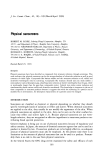
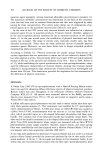
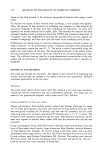
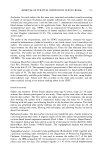
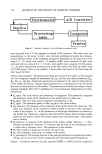
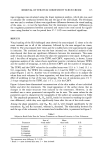
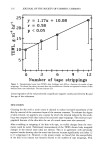
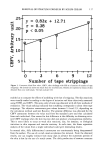
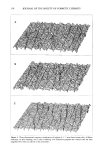
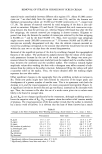
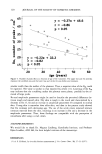
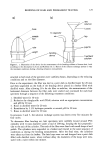
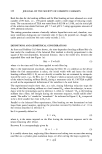
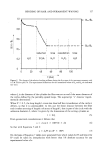
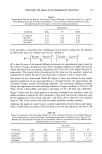
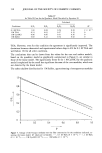
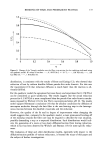
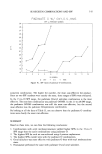
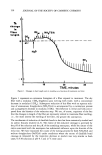
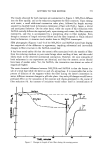
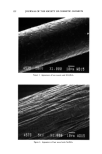
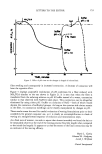
LETTERS TO THE EDITOR 151 The results obtained for both reactants are summarized in Figure 2. NH4TGA diffuses into the fiber rapidly, and as the reduction progresses the fiber contracts. Upon rinsing with water, a small additional contraction takes place, followed by length recovery assisted by disulfide bond re-formation (treatment of hair with H202). Again, a trivial and anticipated behavior. On the other hand, while the course of hair reduction with NaTGA initially follows the expected path, upon rinsing with water, the fiber contracts extensively, and this is accompanied by a precipitous drop in fiber modulus. Even though a measure of length recovery follows and the fiber responds to H202-induced bond re-formation, it remains much weaker than its NH4TGA counterpart. SEM photographs (Figures 3 and 4) of the NH4TGA- and NaTGA-waved hair display the magnitude of the difference in appearance, implying substantial and irreversible changes in fiber structure in the NaTGA-waved hair. It has been noted earlier (6) that the osmotic effect associated with the transfer of fiber from the reducing medium to pure water brings about swelling of hair, and this could likely result in the observed incremental contraction. However, the ionic strengths of both reductants in our experiment are identical, and thus the osmotic action should have been of similar order. Yet, for NaTGA, the contraction was almost an order of magnitude higher. The main chemical difference between NH4TGA and NaTGA is that the former is a salt of a weak base while the latter is a salt of a strong base. It is conceivable that in the process of dilution of the reagents within the fiber during the latter's immersion in water, different transient changes in pH take place. Any such pH changes would have a profound effect on the ionization of the cysteine side chains generated in the course of fiber reduction (4). An increase of ionization would reflect itself in intensification of N&TGA ! H20 ' _ _%. • •XNH4TGA "•m •' mm' emro I TIME, minute• Figure 2. Changes in length of hair fiber during the waving process.

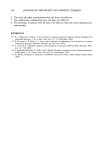
152 JOURNAL OF THE SOCIE• OF COSMETIC CHEMISTS Figure 3. Appearance of hair waved with NH4TGA. •D15 4573 K4jF Y• ,t•'•' 10•'• WO 15 Figure 4. Appearance of hair waved with NaTGA.
Purchased for the exclusive use of nofirst nolast (unknown)
From: SCC Media Library & Resource Center (library.scconline.org)