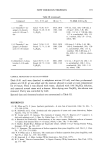
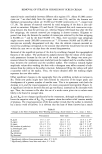
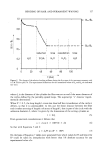
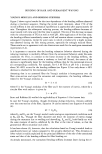
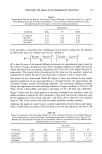
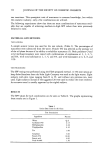
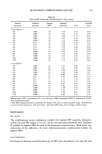
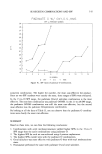
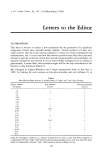
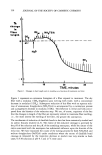
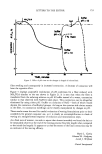
BENDING OF HAIR AND PERMANENT WAVING 129 during the reoxidation process. The new bending stiffness of the reoxidized fiber Bro can be related to the initial bending stiffness of the fiber B o as B• = C Bo (10) where C is a variable to describe the reoxidation efficiency for the bending stiffness after a given treatment. Substituting Equation 10 into Equation 9 leads to s c = 1 - Bre/(C Bo) (11) B•e was obtained by determining the bending stiffness remaining at the end of the final rinsing process, and B o was estimated graphically by extrapolating the curve of the time-dependent initial bending stiffness B(t) to t = 0 (see Figure 2). The primary aim of the investigation was to prove the equality of the experimentally determined fiber bending set and the set predicted from bending stiffness changes: S c '- S • (12) implying that a plot of calculated versus expeimental set values should generate a straight line through the origin with a slope of unity, yielding with Equation 11 for the interrelation of set and bending experiment results: s • '-- 1 - B•e/(C B o) (13) where C is unknown. C was treated as a variable that had to be optimized, assuming it to be constant, that is independent of the reducing conditions. This assumption parallels the previous obser- vations (3,4) that the degree of restoration of the extensional modulus after reduction and reoxidation is largely insensitive to the reducing conditions. The relation between the calculated sets for various values of C with the actual sets was examined by means of an origin linear regression method. The value of C was varied to obtain a value as close as feasible to unity for the regression coefficient, i.e., for the slope of the regression line. The confidence limits of the optimized value of C were estimated from the 95% confidence limits of the regression coefficient. The result is given in Table I. In order to check the justification of this approach, C was also estimated experimentally for two reducing conditions. Hair specimens were cut into halves. On one part of the hair the initial stiffness B o was determined. The other half was subjected without being deformed to the reduction/reoxidation sequence and subsequently its new stiffness B•o Table I Values for C = B•o/Bo Obtained Experimentally and Calculated on the Basis of the Linear Regression Between Experimental and Calculated Set Data (_+ 95% confidence limits) Conditions Experimental C Calculated C 0.3 M TGA, pH 9 1 MTGA, pH8.4 0.96 - 0.03 0.94 + 0.06 0.96 -+ 0.05

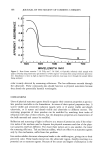
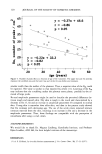
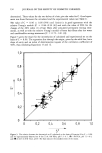
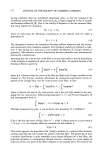
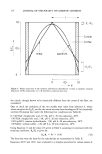
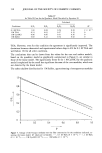
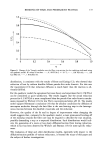
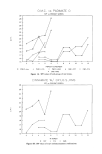
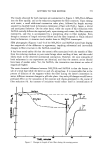
130 JOURNAL OF THE SOCIETY OF COSMETIC CHEMISTS determined. These values for the two halves of a hair give the value for C. Good agree- ment was found between the calculated and the experimental values (see Table I). The value of C = 0.96 --- 0.05 (95% conf. limits) is in good agreement with the relative Young's moduli [C = 0.86-0.94 (4)] and with the value of 90% for the change of the 20% index (1) of hair fibers after simulated permanent waving treat- ments, as well as with the relative Young's moduli of horse hair fibers after hot water and urea/bisulfite setting treatments [C = 0.72-1.01 (3)]. Figure 3 gives the result for the interrelation of calculated and experimental set on the basis of C = 0.96. The regression line through the origin, given by the solid line, has a slope of unity and an index of determination (square of the correlation coefficient) of 96%, thus validating Equations 13 and 12. 1,0 0,8 0,6 0,2 ß I [ 1 [ 0 0,2 0,6 0,8 1,0 Figure 3. The relation between the theoretical set S' calculated on the basis of Equation 9 for C = 0.96 and the experimentally observed set S e for (O) 0.3 M TGA, pH 7.5-9.7, 6}) ! M TGA, pH 7.5-8.4, and (O) 0.025-0.8 M TGA, pH 9. The bars indicate the standard errors of the means.
Purchased for the exclusive use of nofirst nolast (unknown)
From: SCC Media Library & Resource Center (library.scconline.org)