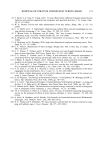
BENDING OF HAIR AND PERMANENT WAVING 139 (11) H. D. Weigmann, L. Rebenfeld, and C. Dansizer, Kinetics and temperature dependence of the chemical stress relaxation of wool fibers, Text. Res. J., 36, 535-542 (1966). (12) C. E. Reese and H. Eyring, Mechanical properties and structure of hair, Text. Res. J., 20, 743-750 (1950). (13) R. R. Wickett, Kinetic studies of hair reduction using a single fiber technique,J. Soc. Cosmet. Chem., 34, 301-316 (1983). (14) K. W. Herman, Hair keratin reaction, penetration and swelling in mercaptan solution, Trans. Farad. Soc., 59, 1663-1671 (1963). (15) R. R. Wickett and B. G. Barman, Factors affecting the kinetics of disulfide bond reduction, J. Soc. Cosmet. Chem., 36, 75-86 (1985).

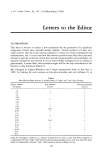
j. Soc. Cosmet. Chem., 41, 141-146 (March/April 1990) The effect of various sunscreen combinations on a product's SPF value TIM MEADOWS, Tanning Research Laboratories, Daytona Beach, FL 32118. Received February 9, 1990. Synopsis Lotions with varying combinations of sunscreens were tested for their SPF values. Homosalate, oxybenzone, and octyl salicylate were used at varying levels in combination with padimate O and octyl methoxycinna- mate. As expected, the greater the concentration of sunscreen, the higher the SPF value. But surprisingly, in the mid-SPF ranges the most effective and economical way to achieve the desired SPFs came from combinations not commonly employed. INTRODUCTION It is generally known that there are few hard and fast rules on how to achieve a specific SPF level for a particular lotion. The formulator usually starts with a "best guess" on the percentage of sunscreens (like 7% padimate O and 3% oxybenzone, for a 15 SPF) and adjusts the formula accordingly from the actual SPF test results. We also know that the degree and area of absorbance of a sunscreen lotion, when determined by most instrumental analysis, does not correlate to the actual performance of the product when applied to the skin. There are in vitro methods of determining SPF values, but each of these methods exhibits some form of shortcoming when compared to actual human SPF testing (1- 3). There are many factors that affect a product's SPF value. The effect that different sol- vents have upon the wavelength of maximum absorption of sunscreens is well known and documented for many oils (4). This effect is seldom reflected in a finished formula- tion, especially for lotions with an SPF greater than 15. The effect of a solvent is only realized at high percentages. In most instances, this solvent effect actually supresses the formulation's SPF vaue rather than boosting it. In both cases, this is due to the solvent's effect on the physical characteristics of the formulation rather than to any shifting of the UV absorbance maximum of the sunscreens in the lotion. The combination of sunscreens also has an effect on a product's SPF value. Combina- tions are used to give a product broader protection than can be achieved by using only 141
Purchased for the exclusive use of nofirst nolast (unknown)
From: SCC Media Library & Resource Center (library.scconline.org)