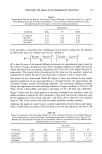
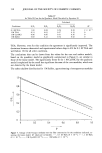
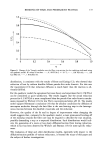
J. Soc. Cosmet. Chem., 41, 123-139 (March/April 1990) Bending relaxation properties of human hair and permanent waving performance F.-J. WORTMANN, Deutsches Wollj'brschungsinstitut, D-5 I Aachen, Federal Republic of Germany, and N. KURE, KAO Corporation Tokyo Laboratories, 2-I-3 Bunka Sumida-ku, Tokyo 131, Japan. Received May 4, 1988. Synopsis The bending properties of human hair were investigated under various conditions related to those applied during a permanent waving process. Permanent set values were calculated from fiber bending stiffnesses in the reduced and reoxidized states on the basis of linear viscoelastic theory as expressed by Denby's equation and shown to be in agreement with the bending set measured for fiber loops. The analysis of the difference between the change of the bending stiffness and that of the extensional stress during reduction suggests that a non-uniform Young's modulus distribution is induced in the fiber during the reducing step. The evalua- tion of two simple types of distributions (linear and quadratic) leads to results that are consistent with the experimental data, giving sensible estimates for the local moduli of the reduced fiber at the fiber core and at the surface. The results show that only for severe reducing conditions does the reductant reach the fiber core in a sufficient concentration to substantially reduce the local modulus. INTRODUCTION As shown by the reviews of Gershon et al. (1) and Robbins (2), the chemistry of the permanent setting process and the changes in the chemical and physical properties of human hair with a reducing treatment have been widely studied, and the basic chemical mechanism of permanent set as due to the cleavage and the subsequent recombination of sulfur cross links has generally been accepted. However, studies on the mechanisms connecting the chemical reaction between a reducing agent and the hair fiber material, occurring on a molecular level, with the macroscopic set of a hair in a curl of a perma- nent wave are still lacking comprehensiveness. One possible approach to this subject, from the macroscopic point of view, is to relate fiber set to physical quantities, like the extensional and bending modulus, character- izing the mechanical properties. This kind of study has been undertaken by DeJong (3) for wool and in a previous paper by one of the authors (4) for human hair, applying linear viscoelastic theory to the extensional properties of hair fibers treated under setting conditions. In both studies, good correlations were found between the actual set and the theoretical set, calculated from the extensional moduli of the treated fibers. 123

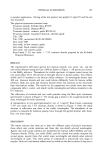
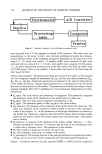
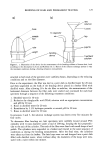
124 JOURNAL OF THE SOCIETY OF COSMETIC CHEMISTS However, while DeJong (3) found that the extensional fiber stiffnesses accurately ac- count for the extensional set of wool induced by hot water or urea/bisulfite treatments, we observed systematic deviations between prediction and experiment when trying to predict fiber bending set from extensional hair fiber stiffnesses after reduction and reox- idation (4). This result was interpreted not so much as an indication for the invalidity of the rules of linear viscoelasticity for the prediction of fiber set, but rather as a phenom- enon generated by a distribution of degrees of reduction and hence of Young's moduli in a reduced fiber. In consequence, the present study is directed at the measurement of the bending prop- erties of human hair during reduction and reoxidation, to prove, on the basis of the bending performance of a hair and of the principles of linear viscoelasticity, that fiber bending set can accurately be predicted. The source of the differences between the bending and the extensional properties, that is a distribution of Young's modulus in a reduced hair fiber, is discussed on the basis of model calculations. EXPERIMENTAL All experiments were carried out on chemically untreated Japanese hair [taken from the head of one of the authors (N.K.)] at room temperature. 2-cm lengths were cut from the tip and root ends of the sample hairs that were subsequently rinsed in methylene chloride, in distilled water, and then allowed to dry in air. Virtually straight fibers were chosen and cut into halves. For each set of experiments, one of these paired spec- imens was subjected to the measurement of bending stiffness and the other one to that of bending set. The bending stiffness of hair specimens was measured by applying the balanced fiber method described by Scott and Robbins (5,6) using the simple device shown in Figure la. The body of the device was made of PVC, and both the hook and the weights were made of 1-mm diameter stainless steel. To read the horizontal width between the legs of a suspended fiber, denoted as w (see Figure la), a piece of plastic ruler, cut to 30-mm length, was glued to the main stand of the device. For the continuous measurement during a succession of different treatment conditions, the solution exchange system, shown in Figure lb, was used. The bending device was placed in a beaker of 60-ml volume, and two pipettes were attached inside the beaker with their fine tips down. A funnel of 70-ml volume was connected through a tap to the wide tip of one of the pipettes, where the fine tip was fixed at about 1-cm from the bottom of the beaker. To the wide tip of the other pipette, the fine end of which was attached just a little below the edge of the beaker and at the position of the intended surface level of the solutions, an aspirator was connected. The exchange of the solution was carried out by suction at the surface in parallel with an inflow of new solution from the funnel at the bottom of the beaker. The rate of one complete exchange was set empirically to about 30 s, to take place without any serious pertubations of the fiber that would affect the measurement. Before the bending measurement, the diameter of a hair specimen was determined microscopically in water. To give reasonably sized readings and in order to keep the bending strain averaged for the cross-section of the fiber always below 1%, the weights
Purchased for the exclusive use of nofirst nolast (unknown)
From: SCC Media Library & Resource Center (library.scconline.org)