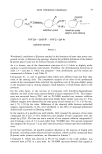
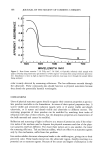
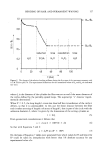
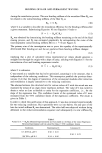
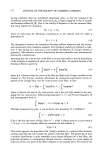
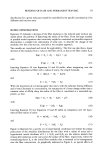
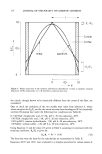
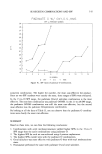
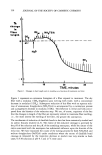
BENDING OF HAIR AND PERMANENT WAVING 133 distribution for a given reductant would be controlled by the specific interrelation of its diffusion and reaction rates. MODEL CONSIDERATIONS Equation 23 demands a decrease of the fiber modulus in the reduced state without any claims about the pathway of E(p) along the radius of the fiber. From the large number of possible model equations that intuitively might be considered as plausible empirical descriptions, a straight line relationship of some sort, to describe the change of the modulus over the cross-section, certainly is the simplest approach. Two models are considered and tested for applicability. The first one describes a linear decrease of the modulus from a value in the fiber core E c to that at the fiber surface E s as E(p) = E s + (E c - Es)(1 - p) (24) with E'(p) = -(E½- E) (25) Inserting Equation 24 into Equations 19 and 20 yields, when integrating over the radius of a hypothetical fiber with a radius of unity, the simple formulas: B = •r[Ec/4 - (E• - Es)/5] (26) and E = E½ - 2/3(Ec - E s) (27) With the hypothesis of a reducing agent that reacts with the substrate during diffusion and is hence decreased in concentration, the assumption of a linear change rather than a constant value of dE/dp along the radius of the fiber is considered as a reasonable ap- proach, so that E(p) = E s + (E• - Es)(1 - p2) (28) with E'(p) = -2(E½ - Es)P (29) Inserting Equation 28 into Equations 19 and 20 yields on integration over the hypo- thetical fiber radius of unity: B = •r[V4E½ - V6(E½ - E)] (30) and E = E c - V2(E c - E s) (31) Figure 4 illustrates for a specific set of experimental conditions (see below) the planar projections of the modulus distributions for the fiber with a radius of unity and a hypothetical cuticle thickness of 0.1 r. Ec/E o and Es/E o are the relative moduli that remain after reduction at the core and at the surface of the fiber, respectively, where the normalizing factor Eo is the initial fiber modulus that is assumed to be homogeneous over the fiber cross-section. As graphically indicated in Figure 4, no special effects of

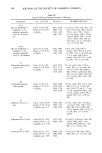
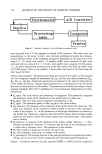
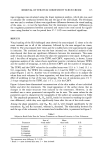
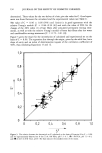
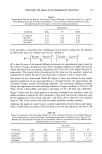
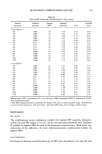
134 JOURNAL OF THE SOCIETY OF COSMETIC CHEMISTS '- r -- o 1,0 - 0,5 - Ec/Eo CuficJe Corfex Es/Eo I I , t 0 0,5 1,0 Figure 4. Planar projections of the modulus distributions described by a linear or quadratic equation (Equations 24/28), respectively, for 1 M Cys-HC1 as reductant (see text). the cuticle, though known to be chemically different from the cortex of the fiber, are considered. Data to check the usefulness of the two models were taken from reference 4, where values are given for Ere/E o and for the initial recovery from bending set R e for chemically untreated European hair under the following four conditions (see Table II): 0.3 M TGA: thioglycollic acid, 0.3 M, pH 9, 20 min reduction, 20øC 1 M TGA: thioglycollic acid, 1 M, pH 9, 20 min reduction, 20øC 1 M Cys-HCI: cysteine hydrochloride, 1 M, pH 8, 40 min reduction, 20øC 1 M Sulfite: sodium sulfite, 1 M, pH 6.4, 40 min reduction, 20øC Using Equation 13 and the value of C given in Table I, assuming its invariance with the reducing conditions, Bre/B o is given by Bre/B o = R e X 0.96 (32) The data that were the basis for the calculations are summarized in Table II. Equations 26/27 and 30/31 were evaluated in a simplex procedure for various values of
Purchased for the exclusive use of nofirst nolast (unknown)
From: SCC Media Library & Resource Center (library.scconline.org)