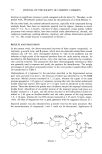
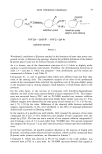
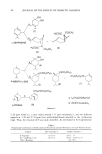
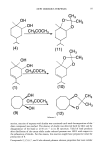
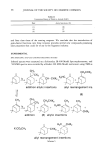
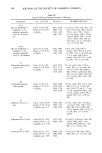
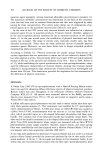
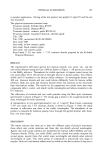
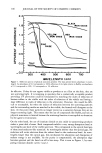
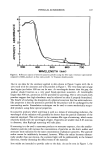
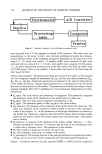
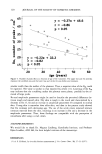
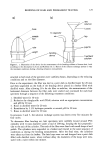
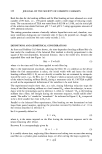
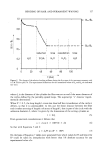
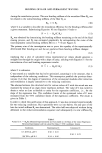
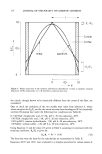
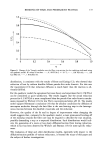
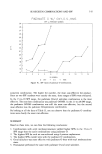
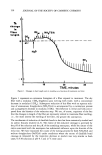
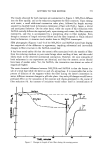
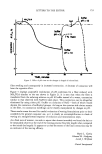
126 JOURNAL OF THE SOCIETY OF COSMETIC CHEMISTS Both the data for the bending stiffness and for fiber bending set were obtained on a total number of 89 hairs, i.e., 178 paired samples under a wide range of reducing condi- tions. The concentration of TGA was varied from 0.025 M to 1.0 M, and the initial pH of the solution was altered between pH 7.5 and pH 9.7 using appropriate amounts of 25 % ammonia solution. The testing procedure ensures a basically infinite liquor/hair ratio and, therefore, con- stant conditions during any one treatment step. It has to be pointed out, though, that under practical conditions this ratio rarely exceeds 2:1 (1). DEFINITIONS AND GEOMETRICAL CONSIDERATIONS As Scott and Robbins (5,6) have shown, the time-dependent bending stiffness B(t) of a hair under the conditions of the balanced fiber method is directly proportional to the square of the time-dependent, horizontal distance, that is the width w(t), between the suspended fiber ends (see Figure la): B(t) = F w2(t)/8 (1) where t is the time and F the force applied to each fiber leg. Due to the experimental procedure, allowing the fiber 30 s to stabilize on the device before the first measurement is taken, the initial width w(0) and hence the initial bending stiffness B(0) = Bo are not directly accessible but are estimated by extrapola- tion of the curve, e.g., for B(t), to t = 0. Figure 2 shows a typical curve for the change of the relative bending stiffness B(t)/Bo during a treatment cycle (0.3 M TGA at pH9) as well as the experimental definitions of the variables to be used below. The experimental results show that, as a rule, rinsing following reduction stops the decay of the fiber bending stiffness at a level termed B•e, where the subscript, in accor- dance with the terminology used in reference 4, refers to "reduced." B•o is the bending stiffness that a fiber, left straight during the treatment sequence, would exhibit after- wards. The suffix "ro" stands for "reoxidized." As indicated in Figure 2, B•o is expected to be a little smaller but close to Bo (3,4). Parallel to the balanced fiber experiments, fiber bending set was determined on hair loops from paired samples, applying the procedure reviewed by Gershon et al. (1) in the version described in reference 4. Set S is generally defined as S = e/e o (2) where E o is the strain imposed on the fiber during the treatment sequence and • the strain remaining after release. Recovery R is correspondingly given by R = ! - S (3) It is readily shown that, neglecting fiber diameter and taking into account that setting one fiber on a cylinder gives numerous loops, set after cutting the loops is given by s e = d•/• (4)

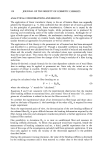
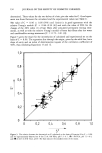
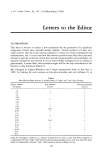
BENDING OF HAIR AND PERMANENT WAVING 127 1,0 0,8 0,6 0,4 0,2 I ß % ß H20 reducfion eeede e ß ß ß ß ß e j I I I I I I I rinse reoxid(]fion rinse TGA H20 H202 H20 i i i i i i i i 0 20 /+0 60 80 100 "- Bro/Bo '"- Br•/Bo f[min] Figure 2. The change of the relative bending stiffness during the five steps of the treatment sequence with 0.3 M TGA at pH 9.0. The experimental definitions for the normalized values of Bre and Bro are indicated (see text). where dc is the diameter of the cylinder the fiber was set on and d the mean diameter of the circles defined by the partially opened loops. The superscript "e" denotes "experi- mentally determined." When S e • 0.5, the loop length 1 covers less than half the circumference of the circle it defines, so that d is unmeasurable. In this case the linear distance between the fiber ends is taken as string of length a of an arc of length 1, that is part of the circle with the unknown diameter d, where 1 is given by the dimensions of the setting cylinder as: 1 = •rdc (5) From geometrical considerations it follows that a = dsin(1 X 180ø/(•r x d)) (6) So that with Equations 5 and 4: a = ddS e sin (S e X 180 ø) (7) On the basis of Equation 7 tables were generated from which values for S e and hence for R e could be taken by interpolation with better than 1% absolute accuracy for any experimental value of a.
Purchased for the exclusive use of nofirst nolast (unknown)
From: SCC Media Library & Resource Center (library.scconline.org)