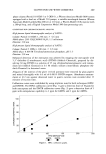
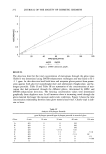
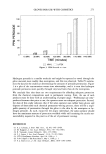
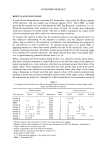
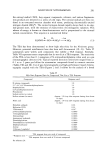
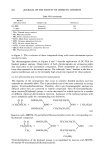
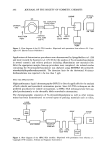
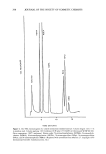
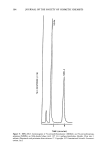
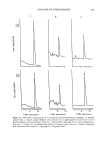
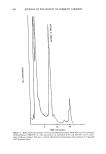
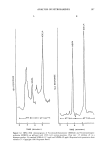
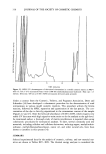
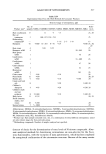
GLOVES FOR USE WITH COSMETICS 269 phase column (Partisil 10 ODS-3 or 5 ODS-3), a Waters Associates Model 6000 system equipped with a dual set of Model 510 pumps, a variable wavelength detector (Waters Associates Model Lambda Max 480 set at 210 nm), a Waters Model 6 UK injector with a 200-•tl loop, and a Digital Corporation Model 380 data processing unit. CONDiTiONS FOR CHROM^TO(3R^VH•C ^N^rYSES High-pressure liquid chromatographic analysis of GMTG.' Column.' Partisil 10 ODS-3, 250 mm X 4.6 mm Mobile phase: 20% CH3CN/80% H20 1.2 ml/minute Detection.' 210 nm High-pressure liquid chromatographic analysis of AMTG: Column: Partisil 50DS-3, 100 mm X 4.6 mm Mobile phase.' O. 005 M Tetrabutylammonium phosphate, pH 3.5 Detection.' 210 nm Enhanced detection of the mercaptan was achieved by trapping the mercaptide with 5,5'-dithiobis-(2-nitrobenzoic acid) (DTNB) (Aldrich Chemical), prepared by dis- solving 30 mg DTNB in a solution of 25 mg ethylenediaminetetraacetic acid tetraso- dium salt (Aldrich Chemical) in 0.1 M tribasic sodium citrate/dibasic phosphate (Al- drich Chemical) in deionized water. Aliquots of the interior of the glove (1.0-ml portions) were removed by glass pipette and mixed thoroughly with 4.0 ml of 0.003% DNTB reagent. Absorbance measure- ments at 412 nm against deionized water in quartz cuvettes were recorded after 15 minutes of reaction time. Calibration curves were established by using triplicate runs for both techniques (HPLC and DNTB). The HPLC calibration curves (Fig. 1) gave a detection limit of 10 ppm for both mercaptans and the DNTB calibration curves (Fig. 2) gave a detection limit of 5 ppm with extrapolation capability to 2 ppm for GMTG and 3 ppm for AMTG. lOO .,a:: 8o -- .,a:: 6o 0 '• 4.0 0 0 20 I 50 100 150 200 PPM MERCAPTAN AMTG GMTG Figure 1. HPLC calibration graphs. 250

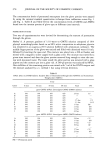
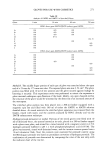
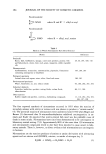
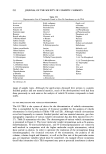
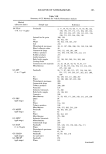
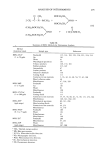
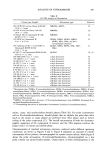
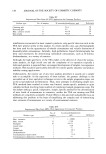
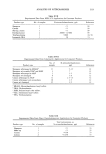
270 JOURNAL OF THE SOCIETY OF COSMETIC CHEMISTS The concentration levels of permeated mercaptans into the glove portion were assayed by using the external standard quantitation technique from calibration curves Fig. 1 and Fig. 2. Table II and Table III list the concentration levels of GMTG and AMTG found into the interior portion of glove type at different time intervals. PERMEATION STUDIES Two sets of experimentation were devised for determining the amount of permeation through the gloves. Method A. A pressure gradient of 1:10 water to GMTG solution composed of 19% glyceryl monothioglycolate based on an 80% active composition in anhydrous glycerin was dissolved in an aqueous pH 8 solution buffered with ammonium carbonate. The middle finger portion of the glove was excised and filled with aleionized water (10 ml), followed by knotting the open end. The mixture was placed into a 200-ml beaker and stirred with a magnetic stirrer capped with a glass cover. The mixture was stirred for a given time interval and then the glove portion removed long enough to rinse the exte- rior with aleionized water. The water inside the glove portion was removed with a glass pipette and the contents put into a glass vial. A 200-•1 portion was analyzed by HPLC. One milliliter of the remaining portion was mixed with 5 ml of the DNTB reagent and the mixture analyzed by u.v. method 1 but using 410-nm detection. Table II HPLC Direct & DTNB Indirect Analysis Data of Glycerylmonothioglycolate (GMTG) and Ammonium Thioglycolate (AMTG) Time Glove 0 min 10 min 30 min 60 min Final PN ppm GMTG (HPLC direct)/ppm GMTG (DNTB indirect) A 0/0 0/0 0/0 0/0 24 hrs 31/ B 0/0 0/0 0/0 0/0 C 0/0 0/0 0/0 0/0 D 0/0 0/0 0/0 0/0 2.5 hrs / 2 E 0/0 0/0 0/0 0/0 2.5 hrs /4.15 F 0/0 0/0 0/0 0/0 17 hrs 60/ G 0/0 0/0 0/0 0/0 21 hrs 0/0 H 0/0 0/0 0/0 0/0 21 hrs 0/0 I 0/0 0/0 0/0 0/0 43 hrs 0/0 ppm AMTG (HPLC direct)/ppm AMTG (DNTB indirect) A 0/0 0/0 0/0 0/0 24 hrs 5/ B 0/0 0/0 0/0 0/0 17 hrs 0/0 C 0/0 0/0 0/0 0/0 17 hrs 5/ D 0/0 0/0 0/0 0/0 19 hrs 18/ E 0/0 0/0 0/0 0/0 F 0/0 0/0 0/0 0/0 17 hrs 5/ G 0/0 0/0 0/0 0/0 21 hrs 0/0 H 0/0 0/0 0/0 0/0 I 0/0 0/0 0/0 0/0 PN = Permeation noted
Purchased for the exclusive use of nofirst nolast (unknown)
From: SCC Media Library & Resource Center (library.scconline.org)