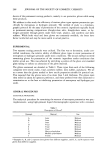
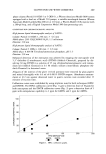
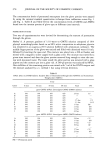
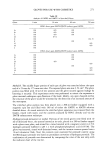
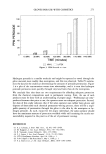
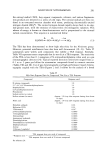
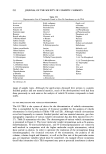
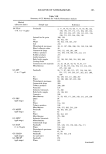
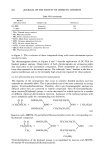
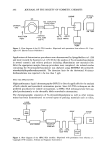
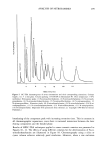
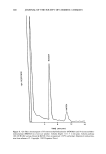
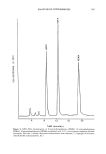
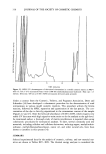
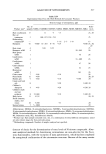
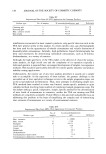
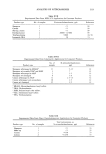
GLOVES FOR USE WITH COSMETICS 273 100 80 60 40 20 10 MIN 30 MIN 60 MIN 420 MIN 960 MIN 1140 MIN 1440 MIN TIME (minutes) • VINYL i• LATEX Figure 3. PPM Peroxide vs. time. Hydrogen peroxide is a smaller molecule and might be expected to travel through the glove material more readily than mercaptans, and this was observed. Table IV summa- rizes the data for the studies at determining the amounts of peroxide permeation. Figure 3 is a plot of the concentration versus time relationship, and it is seen that hydrogen peroxide permeates more quickly through vinyl and latex than do the mercaptans. We conclude first that there are two requirements for affording adequate protection from the chemical compositions used in permanent waving. First, the use of such products must be done with an understanding of proper usage. "Professional use only" products forewarn that prior to use, the operator must use adequate protection. Second, the data of this study indicates that if the salon operator uses rubber latex gloves and disposes of them after each chemical permanent-waving process, there will be a negli- gable quantity of permeation through the glove to the skin by the mercaptan or hy- drogen peroxide. As such, except for the atopic individual, the salon operator should have the maximum amount of protection available while still retaining the tactile ma- nuverability required in the practice of the art of permanent waving. REFERENCES (1) A. J. Lehman, J. Amer. Med. Assoc., 12, 842-845 (1949). (2) M. Rapaport, J. Am. Acad. Dermatol., 9(5), 739-742 (1983). (3) R. Yamasaki, Contact Dermatitis, 11(4), 255 (1984). (4) F. J. Storrs, J. Am. Acad. Dermatol., 11(1), 74-85 (1984). (5) CT?A Developments Newsletter, April 18, 1990, p. 3. (6) F-D-C Reports ("The Rose Sheet"), May 3, 1990, p. 3. (7) F. J. Storrs et al.,J. Am. Acad. Dermatol., 20(6), 1038-1045 (1989).

j. Soc. Cosmet. Chem., 41, 275-281 (September/October 1990) A range-finding method for approximating sunscreen efficacy and substantivity using guinea pigs JAMES J. KREUZMANN and EDWIN V. BUEHLER, Hill Top Biolabs, Inc., P.O. Box 429501, Cincinnati, OH 45242. Received January 3, 1990. Synopsis A method for approximating sunscreen efficacy using shaved/depilated guinea pigs was explored. Sun- screen-treated and untreated sites are irradiated with UVA or UVB radiation. For UVA experiments the guinea pig's responsiveness is heightened by orally administered 8-methoxypsoralen. Three untreated sites receive slightly different radiation doses covering a range centered around the expected M.E.D. Irradiation levels for sunscreen-treated sites are those for untreated sites multiplied by the sunscreen's expected protec- tion estimate. When corresponding treated and untreated sites develop a comparable erythema, the sun- screen is considered to be functioning at the expected protection estimate. If erythema levels are different, the qualitative directional deviation from the expected protection estimate is indicated. UVB testing of nine sunscreen formulations (including 8% homosalate) having known SPFs from 3 to 36 gave results in general agreement with expected protection levels. Additionally, use of the UVA method or incorporating a test of sunscreen wash-off resistance is demonstrated. The method is useful for providing rapid early guidance for formulation adjustments prior to more expen- sive and time-consuming human clinical testing. INTRODUCTION The several adverse effects of ultraviolet (UV) radiation on human skin have been well documented, although the interactive effects of the varying wavelengths are not com- pletely understood. It is clear, however, that the shorter wavelengths of ultraviolet radiation (UVB = 290-320 nm) have the highest levels of energy and are responsible for the most apparent and visible effects of overexposure. In addition to the immediate sunburn response, there is considerable experimental data to implicate long-term inten- sive exposures as resulting in skin cancer (1,3) and/or photo-aging effects (4). It is also recognized that in conjunction with other environmental exposures, UV light can pro- duce both phototoxic and photoallergic reactions (1,2). Less well known is the suppres- sive effect of UV radiation on immune function (5). With the increasing use of com- mercially available sunscreens, mostly effective in the UVB range, there is a growing concern that more intensive exposures to UVA may produce these and perhaps other adverse effects (5- 7). It is anticipated that these concerns will be addressed by the manufacturers of consumer 275
Purchased for the exclusive use of nofirst nolast (unknown)
From: SCC Media Library & Resource Center (library.scconline.org)