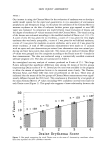
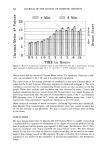
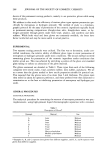
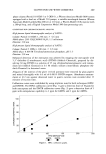
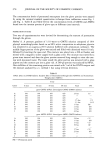
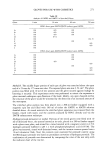
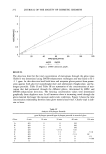
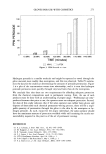
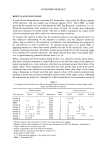
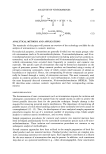
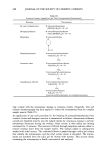
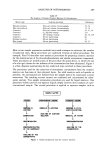
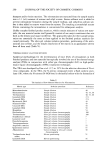
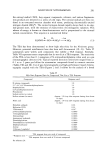
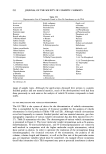
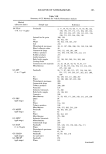
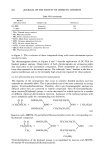
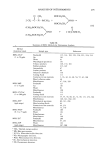
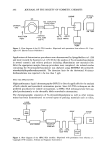
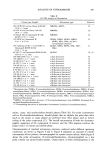
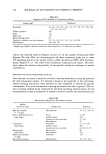
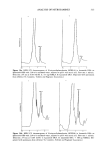
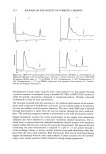
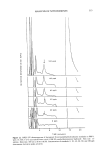
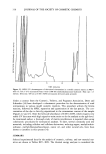
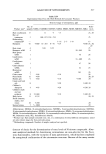
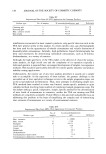
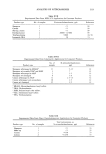
280 JOURNAL OF THE SOCIETY OF COSMETIC CHEMISTS the data at each skin site it is possible to visualize not only the success or failure of a material as a sun protector but also the general margin by which this result has oc- curred. With one exception, the guinea pig trials were successful in confirming the clinical "sun protection factors" of the nine materials tested under static conditions. Sample H, which was shown by the clinical trial to have a protection factor range of 17.1-20.2, was shown by the guinea pig to have a protection estimate of no greater than 15. Although this was not a confirmation of the human SPF value, it was an acceptable approximation of the formulation's potential. In addition, when trials were repeated using the same test material, the results were comparable. Guinea pig wash-off data for a second material, Sample E, using a target value of 8, showed no protection under these conditions (Trial II). Since the initial clinical SPF finding was 6.7, a second trial for wash-off in the guinea pig was conducted using a more realistic target value of 6 (Trial III). This trial again showed no protective capa- bility by this material at this value, suggesting that if this material was substantive in water, its screening ability, after wash, should be characterized by a lower SPF. A clinical reevaluation (Trial II) resulted in a lower SPF (4.9) under wash-off conditions. Although no follow-up animal testing was carried out, these clinical data confirmed the trend predicted by the guinea pig. For purposes of evaluating the data obtained in the guinea pig, we did not choose to adopt the system as described in the OTC monograph (14). In the human, an SPF is calculated by determining the quotient of MED (treated) + MED (untreated) and depends upon the subjective evaluation of the opposing test sites. With the guinea pig, we evaluate and compare the parallel sites only. By doing this we feel that the results will be conservative and will not overestimate the efficacy of the test material. Although experience is limited with UVA protection and wash-off, it is also apparent that the guinea pig is useful for these evaluations. In all instances the data would have been supportive for further evaluation in the human. CONCLUSIONS It is clear that the guinea pig will yield well-defined, reproducible responses to both ultraviolet B irradiation and to ultraviolet A irradiation if the animals are properly sensitized. The procedure is inexpensive and readily manipulated in a laboratory envi- ronment. Because of these characteristics, it serves as an excellent predictive model to indicate or confirm sunprotection estimates in new or reformulated preparations under both static and wash-off conditions where the cost of clinical testing may preclude such investigations in humans. It shows promise as a substitute for the human testing of UVA sunscreens where the use of psoralen compounds is required. In addition, an animal model of this nature used to show protection correlation between formulations comprised of similar raw materials can provide data without other preclinical safety data, thus circumventing the need for larger batteries of toxicological assays required for "new formulations."

SUNSCREEN EFFICACY 281 ACKNOWLEDGMENTS The experimental materials were kindly supplied by Dr. Paul Silber of Mary Kay Cos- metics, Inc., Dallas, Texas, and Mr. Bill Durkin of Chattem, Inc., Chattanooga, Ten- nessee. The evaluation of the sun protection factors established at Hill Top Research, Inc., was conducted by Mrs. Janet Powell. REFERENCES (1) J. A. Parrish, "Responses of Skin to Visible and Ultraviolet Radiation," in Biochemistry and Physiology oftheSkin, L. A. Goldsmith, Ed. (Oxford University Press, New York, 1983), pp. 713-733. (2) W. L. Morison, J. A. Parish, and J. H. Epstein, Photoimmunology, Arch. Dermatol., 115, 350-355 (1979). (3) P. D. Forbes, R. E. Davies, and F. Urback, Ageing, environmental influences, and photocarcino- genesis, J. Invest. Dermatol., 73, 131-134 (1979). (4) L. H. Kligman, F. J. Akin, and A.M. Kligman, Prevention of ultraviolet damage to the dermis of hairless mice by sunscreens, J. Invest. Dermatol., 78, 181-189 (1982). (5) M. L. Kripke, Immunosuppressive effects of ultraviolet (280-322 nn) radiation and psoralen plus ultraviolet (320-400 nn) radiation in mice, J.N.C.I., 69, 171-173 (1982). (6) L. H. Kligman, F. J. Akin, and A.M. Kligman, The contributions of UVA and UVB to connective tissue damage in hairless mice, J. Invest. Dermatol., 84, 272-276. (7) P. T. Strickland, Photocarcinogenesis by near-ultraviolet (UVA) radiation in sencar mice, J. Invest. Dermatol., 87, 272-275 (1986). (8) K. Kaidbey and R. W. Grange, Comparison of methods for assessing photoprotection against ultravi- olet A in vivo, J. Am. Acad. Dermatol., 16, 346-353 (1987). (9) J. W. Stanfield, P. A. Feldt, E. S. Csortan, and L. Krochmal, Ultraviolet A sunscreen evaluation in normal subjects,J. Am. Acad. Dermatol., 20, 744-748 (1989). (10) M. Turkoglu, A. A. Sakr, J. L. Lichten, E. V. Buehler, andJ. J. Kreuzmann, An in-vivo assessment of the sun protection index, Cosmetics and Toiletries, 104, 33-38 (1989). (11) S. L. Yankell, G. N. Martin, H. Piechuta, W. A. Hockett, and M. M. Dolan, Solar simulator sunscreen evaluation in guinea pigs, J. Soc. Cosmet. Chem., 21, 607-611 (1970). (12) G. B. Whitman, E. E. Leach, V. A. DeLeo, J. L. Fleiss, B. Conetta, and L. C. Harber, Compara- tive study of erythema response to UV radiation in guinea pigs and humans, Photochem. Photobiol., 42, 399-403 (1985). (13) F. J. Akin, A. P. Rose, III, T. M. Chamness, and E. Marlowe, Sunscreen protection against drug- induced phototoxicity in animal models, Toxic. Appl. Pharmacol., 49, 219-224 (1979). (14) OTC Panel, Sunscreen drug products for over-the-counter human use, Fed. Reg., 43, 38206-38269 (1978). (15) E. A. Newman and R. D. Parker, A device for irradiating guinea pig skin with ultraviolet light, Fd. Cosm. Toxicol., 23, 683-687 (1985). (16) R. Roelandts, N. Sohrabvand, and M. Garmyn, Evaluating the UVA protection of sunscreens, J. Am. Acad. Dermatol., 21, 56-62 (1989). (17) D. J. Cripps, N.J. Lowe, and A. B. Lerner, Action spectra of topical psoralens: A reevaluation, Brit. J. Dermatol., 107, 77-82 (1982).
Purchased for the exclusive use of nofirst nolast (unknown)
From: SCC Media Library & Resource Center (library.scconline.org)