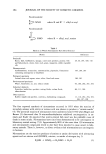
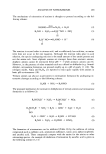
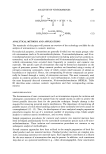
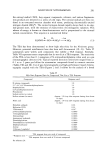
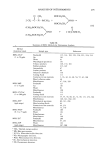
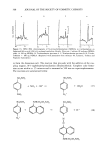
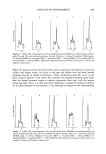
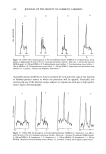
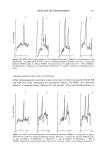
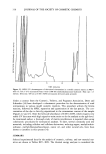
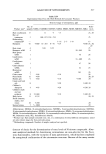
ANALYSIS OF NITROSAMINES 285 The mechanism of nitrosation of amines is thought to proceed according to the fol- lowing scheme: slow 2HONO v N203 q- H20 R2NH q- N203'--•R2•+NO q- NO• H R2• + NO • R2NNO q- H + H (2) (3) (4) The reaction is second order in nitrous acid, and at sufficiently low acidities, an amine term does not occur in the rate equation. Although the reaction takes place in acid solution, the species undergoing reaction is the small amount of free amine present and not the amine salt. Since aliphatic amines are stronger bases than aromatic amines, aliphatic amines cannot be nitrosated below pH = 3 while aromatic amines can (9). However, in the presence of other materials such as a chloral or aldehydes (e.g. formal- dehyde), nitrosamine formation can proceed readily up to a pH of nearly 11 (10). The nitrogen oxides, N203 and N204, are reported to react quite rapidly with amines in basic pH environments (10). Tertiary amines can also act as precursors in nitrosamine formation by undergoing ni- trosative cleavage according to the following scheme: R2NR + NO•----)R2NNO (5) The proposed mechanism for nitrosative dealkylation of tertiary amines and nitrosamine formation is as follows (3): R2NCH2 Rt q- N203 •)R2qqCH2 Rt q- NO• NO R2•CH2 Rt q- NO•---)R2N -• CHR • + N20 q- H20 NO R2N = CHR t + H20---)R2NH + RtCHO R2NH q- N203 • R2NNO q- HNO 2 (6) (7) (8) (9) The formation of nitrosamines can be inhibited (Table II) by the addition of certain compounds such as sulfamic acid, ammonium sulfamate, tannic acid, alpha-tocopherol, and ascorbic acid. These compounds compete with the amine for the nitrite or other nitrosating species. An example of inhibition of nitrosation by ascorbic acid is given in the following scheme (3,11):

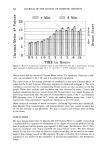
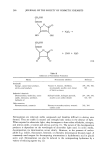
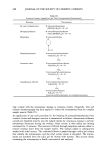
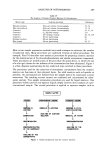
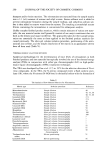
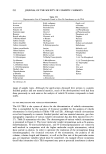
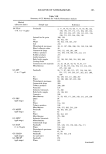
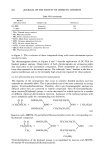
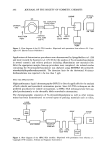
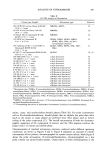
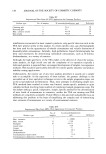
286 JOURNAL OF THE SOCIETY OF COSMETIC CHEMISTS CH2OH CHOH HO OH -3- N203 --- CH2OH CHOH ø T + 2NO + H20 (lO) Table II Inhibition of Nitrosamine Formation Matrix Nitrosamine inhibitor Reference Foodstuffs Sausage, canned meat products, Vitamin E, thiamin, riboflavin, 295, 296, 300, nitrite-cured products nicotinamide, ascorbic acid, extract 301 of black tea leaves Industrial chemicals Dinitroanilines, herbicides, amine oxides, lubricants, antifreeze, hydraulic oil Sulfonyl halides, hydrogen peroxide, ascorbic acid, carbon dioxide 297, 298, 299, 302, 303 Other matrices Pharmaceuticals, cosmetics Primary & secondary amines, aromatic 302, 304 sulfonic acids Nitrosamines are relatively stable compounds and therefore difficult to destroy once formed. They are stable in neutral and strongly basic media in the absence of light. When exposed to ultraviolet light, they decompose to form either aldehydes, nitrogen, and nitrous oxide, or amine and nitrous acid (eq 11). The nature of the decomposition products is dependent on the wavelength of ultraviolet light used. In acidic media, decomposition via denitrosation occurs slowly. However, in the presence of nucleo- philes (e.g. iodide, thiocyanate, bromide, or chloride), denitrosation becomes rapid. A commonly used reagent for decomposing nitrosamines is hydrobromic acid in glacial acetic acid. Nitrosamines can also be reduced to the corresponding hydrazines by a variety of reducing agents (eq 12).
Purchased for the exclusive use of nofirst nolast (unknown)
From: SCC Media Library & Resource Center (library.scconline.org)