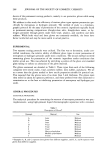
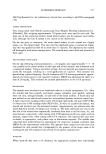
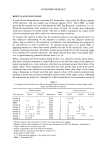
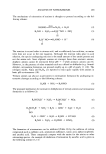
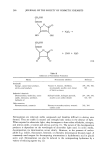
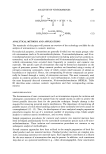
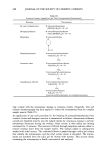
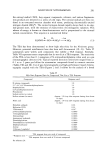
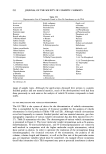
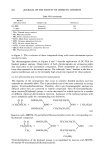
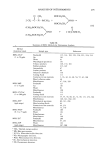
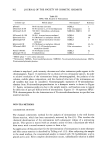
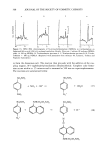
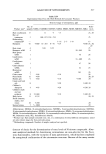
ANALYSIS OF NITROSAMINES 287 ! RCH2NNO hl• •' RCH + R'CH + N2 o o ! I LiA 1H 4 RCH2• RCH2NNO & R' / NNH2 (11) (12) ANALYTICAL METHODS AND APPLICATIONS The remainder of this paper will present an overview of the technology available for the analysis of nitrosamines in cosmetic matrices. For analytical purposes, nitrosamines are generally divided into two major groups: vola- tile nitrosamines (such as N-nitrosodimethylamine, N-nitrosodiethylamine, and N-ni- trosodipropylamine) and nonvolatile nitrosamines (including polar and low polarity ni- trosamines, such as N-nitrosodiethanolamine and N-nitrosomethylstearylamine). Non- volatile nitrosamines have occurred more frequently in cosmetics and cosmetic raw materials. The specific types of nitrosamines that may be formed are dependent on the types of precursors present. Many cosmetic products are formulated using a variety of nitrogen-containing compounds, many of which contain small amounts of amines as by-products or impurities. Hence, the corresponding N-nitroso compounds can poten- tially be formed through a variety of nitrosation reactions. The most commonly used amines in cosmetic products include di- and triethanolamine, both of which can yield the most frequently detected nitrosamine, N-nitrosodiethanolamine (NDELA). Table III describes some common cosmetic ingredients and their corresponding nitrosa- mine(s). SAMPLE PREPARATION The determination of trace contaminants such as nitrosamines requires the isolation and subsequent concentration of the analyte from the sample matrix in order to achieve the lowest possible detection limit for the particular technique. Sample cleanup is also required for removing potential matrix interferences. The importance of monitoring all possible sources of errors when handling analytes at these extremely low levels cannot be overemphasized (12-15). Thus, the development of trace analytical sample preparation procedures requires the use of a minimum number of processing steps, blank sample analysis to monitor matrix interferences, and recovery studies. Sample preparation procedures for cosmetic and cosmetic raw material matrices have been developed predominantly for the nonvolatile nitrosamine species such as N-nitro- sodiethanolamine. These isolation and concentration procedures are common to any subsequent analytical methodologies. Several common approaches have been utilized in the sample preparation of both fin- ished product and raw material matrices. Finished product matrices are complex mix- tures containing numerous raw material types. Each ingredient contributes as a diluent for the trace amount of nitrosamines that may be present. In addition, each constituent may also act as a potential interferent (e.g., when chromatographed, these constituents

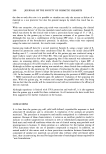
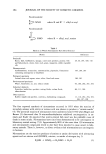
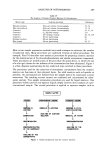
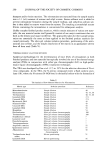
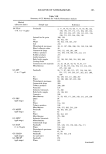
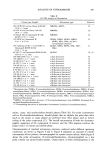
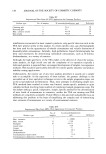
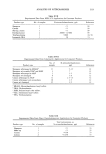
288 JOURNAL OF THE SOCIETY OF COSMETIC CHEMISTS Table III Common Cosmetic Ingredients and Their Corresponding Nitrosamine(s) Precursor Nitrosamines Di- and triethanolamine Diisopropanolamine Morpholine Dimethylstearamine Lauramine oxide Stearalkonium chloride N-nitrosodiethanolamine (HOH2CCH2)2N - N = O N-nitrosodiisopropanolamine (CH3CHOHCH2)2N - N = O N-nitrosomorpholine O () N I N=O N-nitrosomethylstearylamine CH3(CH2)i7N - N = O I CH 3 N-nitrosomethyldodecylamine CH3(CH2)• •N - N = O I CH 3 N-nitrosomethyltetradecylamine CH3(CH2)•3N - N = O CH 3 N-nitrosobenzylmethylamine C6HsCH2N - N = O I CH3 N-nitrosodimethylamine (CHj)2N - N = O N-nitrosomethylstearylamine (see dimethylstearamine) may co-elute with the nitr0samine, leading to erroneous results). Frequently, silica gel column chromatography has been applied to isolate the nitrosamines from the complex sample matrix (Table IV). An application of one such procedure (1) for isolating N-nitrosodiethanolamine from cosmetic lotion and shampoo matrices is summarized as follows: Ammonium sulfamate crystals are dissolved directly into the sample matrix by continuous mixing to prevent nitrosamine formation during the workup. Ethyl acetate is then added and mixing continued for 15 minutes. This mixture is filtered through anhydrous sodium sulfate to remove residual water from the sample matrix. The sodium sulfate is subsequently washed with ethyl acetate. The combined tiltrate is passed through a silica gel column that adsorbs the nitrosamines, and the ethyl acetate eluent is discarded. The nitrosa- mines are desorbed from the silica gel by elution with acetone. This acetone eluent containing the nitrosamines is finally concentrated and analyzed.
Purchased for the exclusive use of nofirst nolast (unknown)
From: SCC Media Library & Resource Center (library.scconline.org)