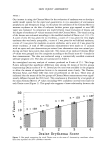
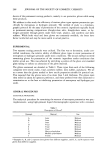
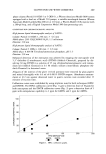
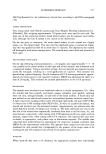
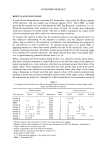
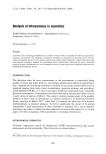
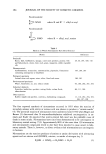
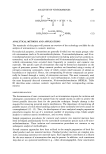
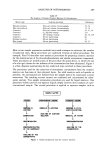
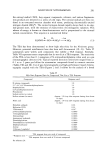
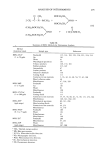
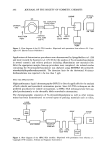
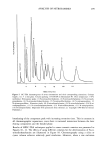
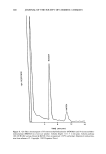
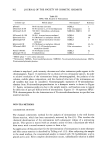
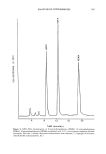
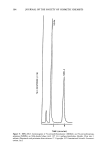
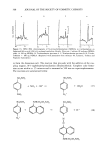
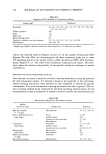
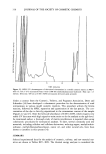
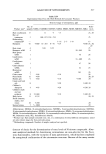
ANALYSIS OF NITROSAMINES 289 Table IV The Analysis of Finished Product Matrices for Nitrosamines Matrix type Isolation procedure References Shampoo products Silica gel column chromatography 19, 29 Hair-care products Silica gel column chromatography 25, 26 Cosmetics Silica gel column chromatography 42, 43, 95 Cosmetics C•8 Sep-Pak cleanup 275 Cosmetics Ion-exchange cleanup 28, 30, 105 Cosmetics Solvent partitioning 66 Shampoo products Solvent partitioning 32 Skin creams Solvent partitioning 29, 32 More recent sample preparation methods have made attempts to minimize the number of analytical steps. Many procedures are condensed versions of earlier procedures. For example, Fine (16) describes trace analytical procedures for preparing cosmetic matrices for the determination of N-nitrosodiethanolamine and similar nitrosamine compounds. These procedures are modifications of the procedure discussed above, in which the use of a silica gel column for the isolation of the nitrosamines has been eliminated. Figure 1 is a flow diagram summarizing the key analytical steps involved in these procedures. The procedures used for the extraction of nitrosamine contaminants from the cosmetic matrices are functions of their physical forms. For solid matrices such as lipsticks or powders, the nitrosamines are isolated from the sample matrix by consecutive acetone extractions. The resulting acetone extracts are combined and concentrated for subse- quent analysis. Two sample preparation procedures are used for liquid matrices. One procedure widely used for non-aqueous liquids simply involves direct analysis of a pre- concentrated sample. The second procedure is applied to aqueous samples such as Figure 1. Sample preparation steps for cosmetic matrices.

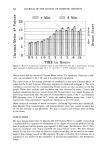
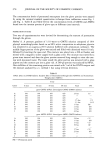
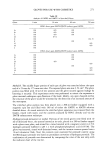
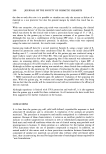
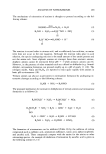
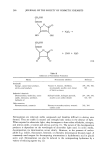
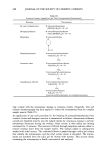
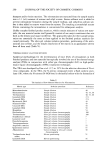
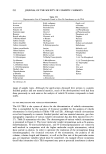
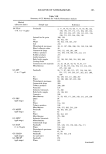
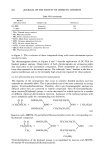
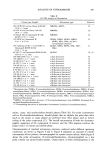
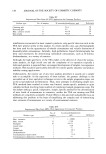
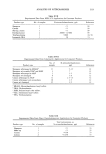
290 JOURNAL OF THE SOCIETY OF COSMETIC CHEMISTS shampoo and/or lotion matrices. The nitrosamines are extracted from the sample matrix into a 1:1 (v/v) mixture of acetone and ethyl acetate. Excess sulfamic acid is added to prevent nitrosamine formation during the sample workup, and anhydrous sodium sul- fate is then added to remove water from the system. The resulting acetone/ethyl acetate tiltrate containing the nitrosamines is concentrated for subsequent analysis. Unlike complex finished product matrices, which contain mixtures of various raw mate- rials, the raw material matrix itself generally consists of one major constituent that acts both as the diluent and major interferent. The approaches taken for their sample prepa- ration are essentially the same as those applied to the finished product matrices dis- cussed previously. The silica gel column isolation procedure, partitioning of the nitro- samines into solvent, and the simple dissolution of the matrix in an appropriate solvent have all been used (Table V). THERMAL ENERGY ANALYZER METHODS Analytical methodology for the determination of trace levels of nitrosamines in both finished products and raw materials has typically involved the use of the thermal energy analyzer (TEA) in conjunction with either gas chromatographic (GC) or high-perfor- mance liquid chromatographic (HPLC) separation techniques. The TEA was developed by Fine et al. (17) in 1974 for the selective detection of N-ni- troso compounds. In the TEA, the N-nitroso compound enters a flash catalytic pyro- lyzer (18), where the N-nitroso (N-NO) bond is thermally broken with the formation of Table V The Analysis of Raw Material Matrices for Nitrosamines Matrix type Isolation procedure References Monoethanolamine Diethanolamine Triethanolamine Lauramide DEA Cocamide DEA Myristamide DEA Stearamide DEA Cocamide DEA Lauramide DEA Morpholine Diethanolamine Triethanolamine Stearalkonium chloride Lauramine oxide Dimethylstearamine Triisopropanolamine Amphoteric matrices Quaternium matrices Alkanolamines Triethanolamine lauryl sulfate Lauramide DEA Simple Simple Simple Simple Simple Simple Simple Simple Simple dilution dilution dilution dilution dilution dilution dilution dilution dilution Simple dilution Silica gel column chromatography Silica gel column chromatography Silica gel column chromatography Silica gel column chromatography Silica gel column chromatography Silica gel column chromatography Silica gel column chromatography Silica gel column chromatography Cation exchange & silica gel column chromatography Solvent partitioning Solvent partitioning 48 48, 55, 60 48, 55, 60 274 274 49 49 5O 5O 54 108 108 7 7 7 7 52 53 30 51 56
Purchased for the exclusive use of nofirst nolast (unknown)
From: SCC Media Library & Resource Center (library.scconline.org)