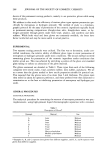
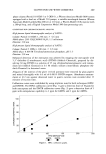
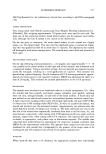
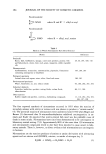
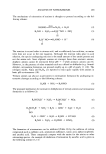
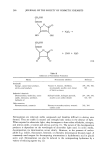
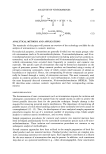
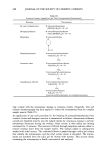
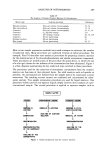
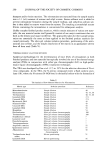
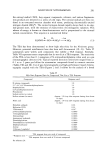
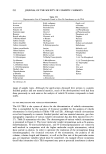
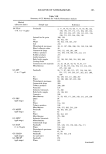
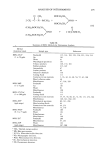
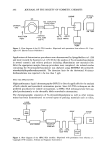
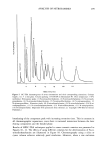
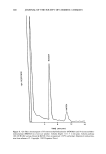
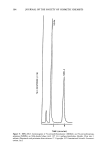
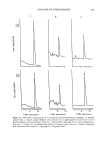
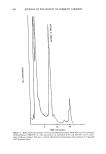
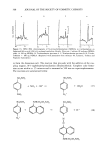
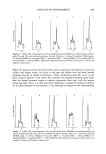
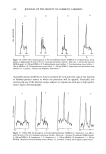
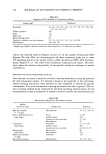
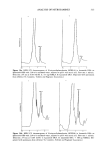
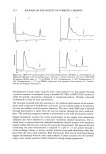
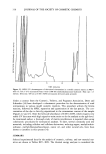
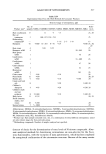
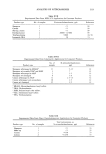
ANALYSIS OF NITROSAMINES 291 the nitrosyl radical ('NO). Any organic compounds, solvents, and various fragmenta- tion products are removed in a series of cold traps. The nitrosyl radicals are then oxi- dized in an evacuated reaction chamber with ozone, producing electronically excited nitrogen dioxide (NO2*). The excited nitrogen dioxide rapidly decays back to its orig- inal ground state, with the emission of characteristic electromagnetic radiation. This release of energy is known as chemiluminescence and is proportional to the nitrosyl radical concentration. This sequence is summarized below: A 03 - hv R2NNO-• 'NO = NO2* • NO 2 (13) The TEA has been demonstrated to show high selectivity for the N-nitroso group. However, potential interferences have also been well documented (19-23). Table VI summarizes some widely used compounds that exhibit a TEA response. Similarly, Table VII represents some compounds that do not elicit a TEA response. The sensitivity of the TEA is less than 0.1 nanogram of N-nitrosodimethylamine when used as a gas chromatographic detector (24). Typical reported detection limits have ranged from ca. 0.1 to ca. 5 parts per billion for nitrosamine compounds found in cosmetic matrices (Tables VIII and IX). Use of gas chromatography and high-performance liquid chroma- tography coupled with the TEA (Figures 2 and 3) allows for the analysis of a broad Table V! Mole Basis Response Ratio for Compounds That Give a TEA Response Compound Response ratio a N-nitroso compounds 1.0 2,2', 4,4', 6,6'-Hexani trod iphenylamine 1.4 Isopentylnitrite 1.0 d, l-Cyc lohexylaminenit rite 1.0 Pentylnitrite 1.0 Sodium nitrite (in water) 1.0 Sodium nitrate (in water) Approx. 1.0 (very slow response lasting from hours to days) Nitric acid Approx. 1.0 (very slow response lasting from hours to days) Dimethyl sulfoxide 0.03 Hydrazine (95 %) 0.03 5-Nitrouracil 0.017 p-Nitrosodiphenylamine 0.0050 3-Nitrophthalimide 0.0030 Nitromethane 0.0018 Ammonium hydroxide 0.0016 Dimethylglyoxime 0.0010 Dimethylamine hydrochloride 0.0009 Diphenylcarbazone 0.0007 Aniline 0.0003 2-Nitroso- 1-naphthol 0.0002 ' Response ratio = See reference 20. TEA response from one mole of compound TEA response from one mole of N-nitroso compound

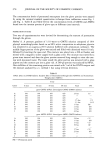
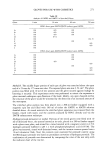
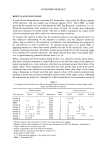
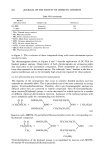
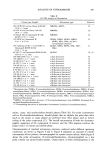
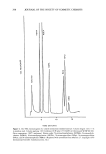
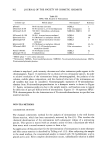
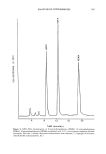
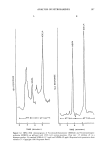
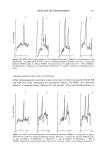
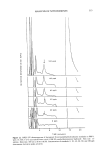
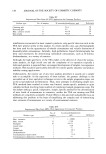
292 JOURNAL OF THE SOCIETY OF COSMETIC CHEMISTS Table VII Representative List of Compounds Found to Give No Interference on the TEA Acetic acid Ethyl carbamate Oxalic acid Acetone Ethylene glycol n-Pentane Acetonitrile Fluorobenzene Phenylhydrazine Alizarin red Gasoline d,l-Phenylalanine Ammonia (gas) Glycerol p-Phenylazoaniline Benzene d-Glucose Phosphoric acid Benzyl salicylate Glutamic acid Propane 2-Butoxyethanol n-Hexane Pyridine Carbon dioxide Hydrogen Quinine Carbon disulfide Hydroquinone Sodium acetazolamide Carbon monoxide 8-Hydroxyquinoline Sulfadiazine Carbon tetrachloride Inosine Sulfanilic acid Chloral hydrate d,l-Isoleucine Tetrahydrofuran Chlorobenzene Methane (gas) Theophylline 1-Chloropropane Methyl acetate Toluene 2-Chloropropane N-Methyl bisacrylamide 2,4,6-Trichlorophenol Cyclohexane 2-Methylbutane 2,2,4-Trimethylpentane Cyclopentane Methyl formamide d,l-Tryptophan 1,2-Dichloroethane Methyl isobutyl ketone Urea 2,3-Dichloropropane Methyl orange Uric acid Diethyl ether Methyl red Urethane Dimethylamine Naphthalene Water p-Dioxane Nitrogen Xylene Diphenylamine Nitrobenzene Ethyl acetate o-Nitrotoluene See reference 20. range of sample types. Although the applications discussed here pertain to cosmetic finished product and raw material matrices, much of the developmental work had been done previously in such areas as the analysis of volatile N-nitroso compounds in food- stuffs. GC-TEA APPLICATIONS FOR VOLATILE NITROSAMINES The GC-TEA is the system of choice for the determination of volatile nitrosamines. This is exemplified by the quantity of literature available for the analysis of volatile nitrosamines in food products (Tables VIII and IX). Although volatile nitrosamines occur less frequently in cosmetic finished product and raw material matrices, gas chro- matographic separation of various volatile nitrosamines has also been reported (22,25- 27). Table X summarizes this data. The chromatogram of various volatile nitrosamines is presented in Figure 4. The lower molecular weight nitrosamines such as N-nitroso- dimethylamine, N-nitrosodiethylamine, and N-nitrosodipropylamine are relatively well resolved in comparison with the higher molecular weight nitrosamines, which show partial co-elution. In order to optimize the resolution of the nitrosamines being chromatographed, the chemical structure of the nitrosamine, the polarity of the column, column length and diameter, as well as the flow rate of the particular carrier gas, are important variables which must be considered. An example of how nitramines (recall that nitramines elicit TEA responses) may pose as potential interferents is shown
Purchased for the exclusive use of nofirst nolast (unknown)
From: SCC Media Library & Resource Center (library.scconline.org)