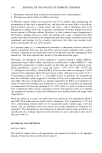
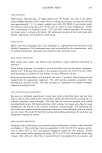
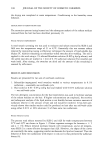
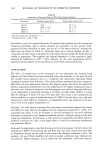
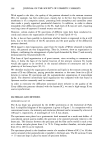
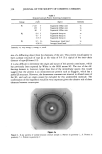
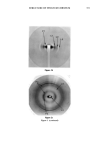
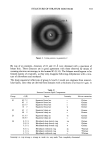
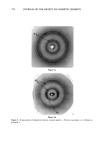
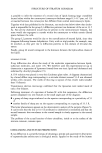
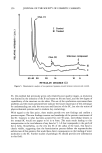
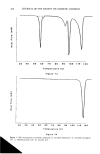
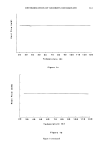
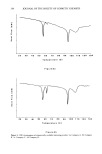
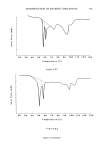
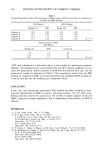
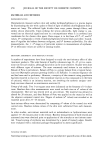
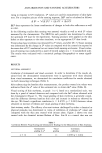
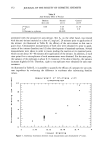
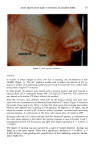
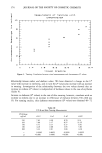
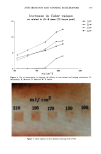
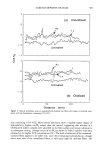
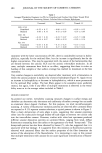
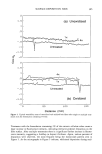
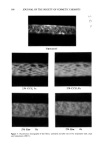
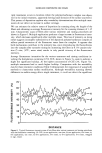
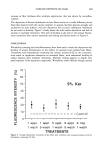
352 JOURNAL OF THE SOCIETY OF COSMETIC CHEMISTS Grouop P3 consists essentially of a wide non-isotropic band, varying between 9.6 and 9.3 A at the equatorial and meridianal diameters. This band is similar to that typically obtained with soft keratin. Since 1933, it has been supposed that soft keratin is o•-keratin, although no firm exper- imental confirmation has been obtained. o•-Keratin is characterized by the diameter of the o• helix (9.8 •) and the pitch of the helix (5.1 •). The 5.1-• band was absent from the patterns obtained with the SC here (although, as we shall see later, it is present in the callus) in addition, the 9.5 • band varied from 9.6 to 9.3 • and was always smaller than the values attributed to the o• structure. These two observations suggest that, in the normal SC, keratin is in the [3 form, contrary to what has been accepted for more than 50 years. Nonetheless, in the callus (Figure 3), the band at 5.1 • is clearly visible and the diffuse band is found at 9.8 •. This indicates that the keratin is in o• form. It is thus reasonable to suppose that the supramolecular form of keratin depends on the keratinization pro- cess as a result, it would be interesting to examine the situation in pathologic epi- dermis (hyperkeratosis, psoriasis, etc.) or in aged subjects with dry skin, as the type of keratin present has a strong influence on water-binding capacity. STRATUM CORNEUM LIPIDS The results of the delipidation studies of SC specimens gave rise to the classification shown in Table II. The corresponding diffraction patterns are shown in Figures 4a and 4b. The diffraction spectra are highly complex and contain a great deal more information concerning structure than those previously obtained by classical methods. One of the fundamental characteristics is the diffraction anisotrophy obtained when the X-ray beam is directed parallel to the surface of the SC. In contrast, using a beam perpendicular to the plane of the SC, the rings obtained indicate that the molecular organization in this plane is isotropic. Our results suggest the presence of several types of lipid, which, nonetheless, display a common feature, i.e., the lipid layers are, in general, oriented parallel to the plane of the SC, or in other words, parallel to the corneocyte planes. This conclusion is derived from the position of the diffraction arcs (corresponding to layer reflection, range 65-15 •) located on the equator and those of the arcs (typical of interlayer reflections, range 6-2 •) located on the meridian. As mentioned in the preceding paragraph, X-ray diffraction theory allows us to evaluate the size of the crystallite that is the source of the diffraction (Scherrer's formula). This assessment of the size of the crystallites giving rise to the phenomena listed in Table II shows that only the group L 1 diffraction patterns are compatible with the dimensions of the intercorneocyte spaces (0.05 to 0.1 •m) (13). The wide arcs of group L1 would correspond to the diffraction of the X-rays by a system of bilayers with a thickness of 62.7 and 45 •. It is noteworthy that these values, determined with a high degree of accuracy for a given sample, can fluctuate when specimens of different origins are exam- ined.

STRUCTURE OF STRATUM CORNEUM 353 Figure 3. Callus patterns in geometry//. By way of an example, distances of 62 and 43 fk were obtained with a specimen of breast skin. These distances are in good agreement with those observed by means of scanning electron microscopy in the human SC (8, 14). The bilayers would appear to be formed mainly of ceramides, as they only disappear following delipidation with a mix- ture of chloroform and methanol. The sharp equatorial reflections of group L2 and L3 would not originate from intercel- lular lipids, since they are derived from domains with a thickness of at least 0.3 Ixm. It Table II Stratum Corneum Lipid Components Group d (•) Aspect Intensity Solvent extraction L 1 62.7// Equatorial broad arc s Ch/met 45 // Equatorial broad arc s Ch/met 22.6// Equatorial broad arc s Ch/met 14 // Equatorial broad arc w Ch/met L2 42 // Equatorial sharp arc w Hexane 40 // Equatorial sharp arc s Hexane L3 33.5 l/ Equatorial sharp arc vs Ch/met 16.8// Equatorial sharp arc s Ch/met L4 6.2//ñ Meridianal sharp dotted ring vw Ch/met 5.8//ñ Meridianal sharp dotted ring s Ch/met 5.2//ñ Meridianal sharp dotted ring w Ch/met 4.6//ñ Meridianal reinforced ring m *Ch/met 4.1//ñ Meridianal reinforced ring vs *Ch/met 3.7//ñ Meridianal reinforced ring s *Ch/met Intensity: vs, very strong s, strong w, weak vw, very weak *not completely eliminated.
Purchased for the exclusive use of nofirst nolast (unknown)
From: SCC Media Library & Resource Center (library.scconline.org)