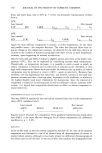
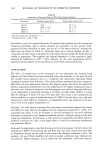
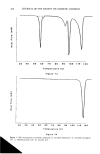
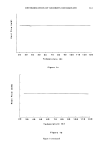
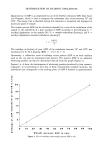
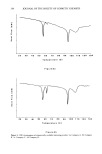
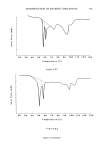
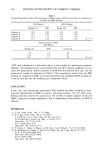
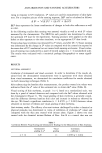
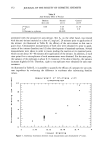
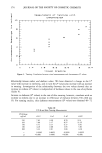
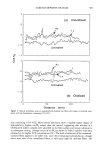
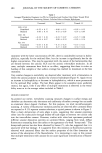
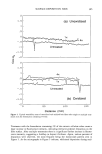
366 JOURNAL OF THE SOCIETY OF COSMETIC CHEMISTS Table I Ascorbyl Dipamitate Content of Commercially Available Cosmetic Whitening Powders: A Comparison of the DSC and HPLC Methods DSC Method HPLC Method Weight (%) RSD Weight (%) RSD Company A 18.2 2.88 20.4 2.80 Company B 20.4 0.83 19.9 1.85 Company C 14.5 1.72 14.7 1.60 Company D 22.7 2.60 23.9 0.20 (N = 3) Known amounts of ADP DSC Method Weight (%) RSD % Recovery 9.8 2.9 98 24.2 2.9 97 49.7 O.7 99 (N = 3) 108øC and is broadened to the extent that it is not suitable for quantitative purposes. However, the endotherm that occurs between 56 ø and 58øC remains unaffected, so it is useful for quantitation. Known amounts of ADP were dry-blended with talc, and the quantitative results are indicated in Table I. The quantitative results from the DSC method are compared in Table I to results obtained by the published HPLC method (6). It can be seen that the two methods give comparable values. CONCLUSION A fast, easy, and reproducible quantitative DSC method has been developed to deter- mine the concentration of ADP in cosmetic whitening powders. The 56ø-58øC endo- thermic peak was used for the quantitation. The method is simple compared to GC and HPLC, requires no sample preparation, and is independent of the stability of ADP in solution. REFERENCES (1) C. Fox, Cosmet. Toilerr., 103, 31-35 (1988). (2) H. E. Jass, Cosmet. Toilerr., 94, 52-53 (1979). S.S. Bleechen, J. Soc. Cosmet. Chem., 28, 407-412 (1977). H. H. Daute and J. Frucht, Ger. Ofj•n., 2,744,987 (1977). Chem. Abstr., 91, 27318a (1979). JP, 77 79,032 (July 1972). Chem. Abstr., 87, 157011y (1977). (3) Y. Tomita, A., Hariu, C. Mizuno, and M. Seiji, J. Invest. Dermatol., 75, 379-382 (1980). (4) H. Takashima, H. Nomura, Y. Imai, and H. Mima, Am. Pe•. Cosmet., 86, 29-36 (1971). JP, 81 161,314 (December 1981). Chem. Abstr., 96, 205218f (1982). JP, 82 14,587 (1982). Chem. Abstr., 96, 200107j (1982).

DETERMINATION OF ASCORBYL DIPALMITATE 367 JP, 59 10,505 (January 1982). Chem. Abstr., 100, 161685a (1984). JP, 59 10,505 (January 1982). Chem. Abstr., 101, 177273w (1984). JP, 59 65,007 (April 1984). Chem. Abstr., 101, 116584b (1984). JP, 60 78,912 (May 1985). Chem. Abstr., 103, 109772z (1985). JP, 60 23,307 (February 1985). Chem. Abstr., 103, 27082k (1985). JP, 61 100,509 (May 1986). Chem. Abstr., 105, 102354x (1986). (5) K. Yamaoka, M. Matsui, Y. Saito, and T. Sato, Effect of ointments and ointment bases on stability of ascorbic acid dipalmitate, Chem. Abstr., 97, 60908q (1982). (6) T. S. Vicente, E. H. Waysek, and W. M. Cort, Determination of ascorbyl palmitate by HPLC, JAOCS., 62, 745-747 (1985). (7) C. Inagaki, C. Okita, and N. Arakawa, Vitamins (Japan), 47, 229-232. Chem. Abstr., 79, 29188j (1973). (8) H. Tanaka and Y. Histani, Ester of ascorbic acid with higher fatty acid, Chem. Abstr., 68, 96104q (1986). (9) Chem. Abstr., 66, 7965 lg (1967). Chem. Abstr., 67, 34067a (1967). Chem. Abstr., 68, 16170v (1968). Chem. Abstr., 72, 65444d (1970).
Purchased for the exclusive use of nofirst nolast (unknown)
From: SCC Media Library & Resource Center (library.scconline.org)