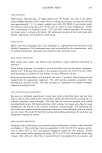
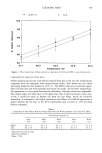
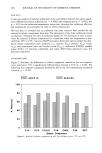
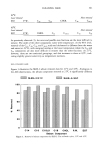
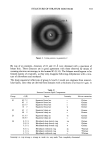
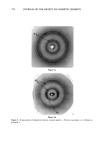
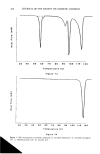
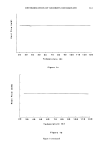
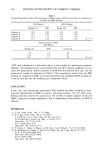
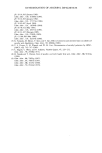
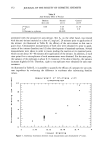
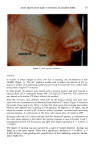
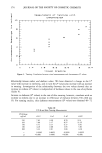
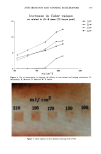
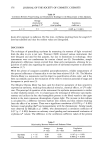
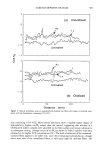
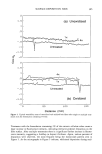
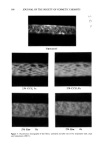
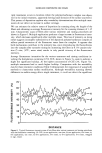
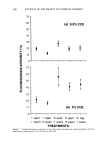
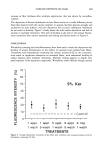
ANTI-IRRITANTS AND TANNING ACCELERATORS 375 15 10 Increase in Color values as related fo UV-B dose (72 hours posf) 00 150 200 250 rnJ/crn^2 Figure 4. Use of chromometer in assessing the efficacy of anti-irritants and tanning accelerators. N. Muizzuddin, K. Marenus, D. Maes and W. P. Smith. mJ cm 2 210 195 170 130 106 Figure 5. Dose response of skin darkness (tanning) with UV-B.

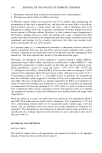
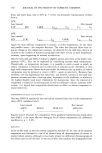
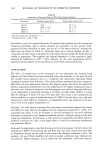
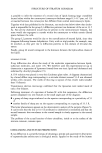
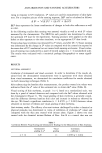
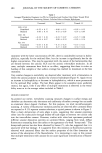
376 JOURNAL OF THE SOCIETY OF COSMETIC CHEMISTS Table IV Correlation Between Visual Scoring and Chromameter Readings for the Measurement of Skin Darkness Average chromameter Average Correlation grading/• L* visual grading coefficient r n = 9 5.5 2.3 0.895 (p 0.001) hours after exposure to radiation. By this time, erythema resulting from the single UV dose has subsided and thus the redness values are disregarded. DISCUSSION The technique of quantifying erythema by measuring the amount of light re-emitted from the skin in vivo is not new. Tronnier (1969) reviewed various instruments that were designed and used for this purpose, but due to limitations in technology, these instruments were too cumbersome for routine clinical use (6). Nevertheless, simple photoelectric reflectance meters evolved from these early instruments, allowing for ac- quisition of useful data regarding the quantitation of erythemal responses to ultraviolet radiation (1,7). With the advent of computer-controlled spectrophotometers, reliable measurement of the spectral reflectance of human skin in vivo has been achieved (5,8-10). The Minolta Chroma Meter is a noninvasive tool for objective quantification of skin color, and it has been successfully used in the estimation of the relative irritation potential of soaps and detergents in patch tests (3). The Minolta Chroma Meter has been used for objective assessment of skin sensitivity expressed as erythema, resulting from physical stimulus, chemical effects, or UV radia- tion. The principal of operation of the instrument for erythema measurements is similar to other erythema meters (13). It is based upon the technique of reflectance spectropho- tometry and utilizes the fact that hemoglobin present in the blood vessels in the upper dermis is the main cutaneous chromophore of green light. The increase in skin redness is calculated by a difference between baseline skin redness and skin redness resulting from the effect of an irritant. There was a significant correlation of 0.678 (p 0.001) between visual grading (Aa*) and measurements with the chromameter. Similar results were observed by Babulak et al. (1986), who demonstrated a correlation coefficient of 0.97 (p 0.003) between an arbitrary visual grading and instrumental evaluation of erythema (a* values). The difference in the correlation coefficient values of the present Table V Relationship Between Redness and Darkness Values Average Average Correlation a* value l/L* value coefficient r Erythema n = 16 6.08 0.03 Tanning n = 16 9.89 0.014 0.167 (p = 0.02) 0.898 (p 0.00 l)
Purchased for the exclusive use of nofirst nolast (unknown)
From: SCC Media Library & Resource Center (library.scconline.org)