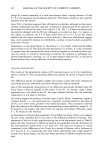
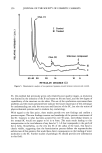
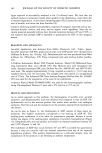
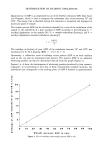
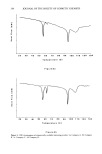
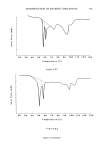
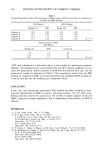
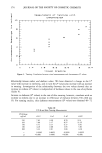
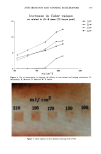
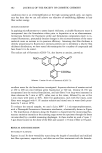
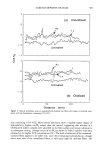
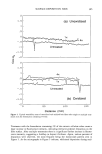
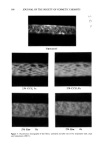
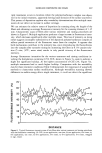
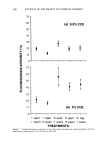
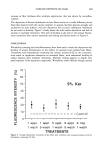
SURFACE DEPOSITS ON HAIR 389 increase in film thickness after multiple applications that was shown by microfluo- rometry. The deposition of keratin hydrolysate on hair fibers results in a totally different picture from that observed with the cationic polymer. It appears that Ker deposits strongly and exclusively on scale surfaces, and once deposition has occurred, subsequent treatments do not result in buildup. Figure 5 clearly shows the scale surface deposition and lack of increase in multiple treatments. This lack of buildup is also seen in the average fluores- cence intensities after various treatment and rinsing procedures shown in Figure 8. CONCLUSIONS Wettability scanning and microfluorometry have been used to study the deposition and buildup of several formulations on the surface of untreated and oxidized hair fibers. Treatments with formulations containing the cationic polymer CCE in two concentra- tions result in significant adsorption on untreated fibers, with substantial buildup of surface deposits after multiple treatments. Multiple rinsing appears to desorb only small amounts of the deposited compounds. Wettability shows definite though uneven 7O 6O 5O 4O 3O 5% Ker ILl LIJ 20 LIJ 10 n- Control 0 :D 0 I ' , ' , ' , ' ' ' ß 'J I appl. I appl. 5 appl 5 appl 2. tag I! ' ' I wash 5wash I wash 5wash I wash TREATMENTS Figure 8. Average fluorescence intensities of hair fibers after treatment and rinsing procedures with the formulation containing 5 % Ker.

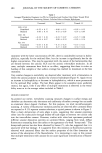
390 JOURNAL OF THE SOCIETY OF COSMETIC CHEMISTS adsorption but cannot detect the buildup observed with microfluorometry. Wettability measurements show that oxidized fibers have a stronger tendency to adsorb and retain surface deposits, reflecting the higher affinity between the cationic polymer and nega- tive charges formed on the fiber surface during oxidation. We have not done micro- fluorometric scanning of oxidized fibers, since uranine proved not to be a suitable fiuo- rochrome for such specimens. The formulation containing 5 % keratin hydrolysate appears to deposit on the scale faces of the fiber surface and not to build up in multiple applications. Deposition of Ker on oxidized fibers results in a considerable increase in surface hydrophilicity after a single treatment, with only a slight further increase after multiple treatments. These results possibly reflect a more uniform distribution of the surface deposits on oxidized hair. REFERENCES (1) Y. K. Kamath, C. J. Dansizer, S. Hornby, and H.-D. Weigmann, Surface wettability scanning of long filaments by a liquid membrane method, Textile Res. J., 57, 205-213 (1987). (2) j. Garcia-Dominguez, M. R. Julia, A. de la Maza, J. M. Pujol, and J. Sanchez, A method for determining the distribution of cationic shrink-resistant resins on wool, J. $oc. Dyers Color., 92, 433-439 (1976). (3) F. R. Rothery and M. A. White, Determination of the presence and distribution of polymers on wool, J. Soc. Dyers Color., 99, 11 (1983). (4) U. Meyer, Selektive Markierung von Filzfreiausrfistungen auf Wolle mit fluoreszierenden Verbin- dungen, Textilveredl., 17, 440-446 (1982). (5) H. Gottschalk, G. Hohm, and H. Kaminski, Verteilung von haarfestigenden Polymeren auf Hu- manhaar, Proc. Internat. Wool Text. Res. Conf., Aachen, 1975, Vol. III, pp. 349-358. (6) Y. K. Kamath, C. J. Dansizer, and H.-D. Weigmann, Wetting behavior of human hair fibers, J. Appl. Polym. Sci., 22, 2295-2306 (1978). (7) I. H. Leavet, CSIRO, Melbourne, Australia, personal communication.
Purchased for the exclusive use of nofirst nolast (unknown)
From: SCC Media Library & Resource Center (library.scconline.org)