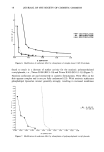
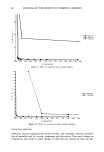
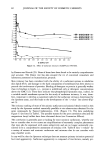
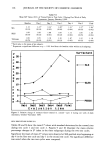
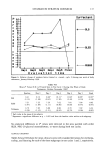
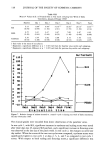
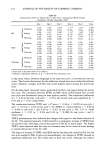
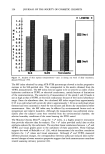
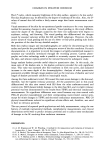
82 JOURNAL OF THE SOCIETY OF COSMETIC CHEMISTS 2 -- toO-' 14 o.tl I I I I I I I I I I I I 0.0 O. o 0.4 0.8 0,8 I,,O t. o t.4 t.8 t.8 o.0 o.o o.4 • SLES/PLUR[OL 5: t .... ß .... SLES/PLUR[OL 3: t • SLES/PLUR[OL •: t --&----SLES/PLUR[OL •: t ß SURFACTANT Figure 12. Effect of surfactant mixtures (SLES/Pluriol PE6400). by Kastner and Frosch (29). None of them have been found to be entirely comprehensive and accurate. The Draize test has also aroused the ire of concerned consumers and laboratory personnel on humanitarian grounds. Skin irritancy has been correlated with the ability of a surfactant system to solubilize skin lipids (8,9), and damage to the lipid components of membranes has been shown to precede the involvement of proteins. Binding of detergent to protein is generally weaker than its binding to lipids, i.e., protein is solubilized only at detergent concentrations above the CMC (12). These facts indicate that phospholipid liposomes may, indeed, be a suitable model membrane system for the study of surfactant irritancy. It was, there- fore, important to develop a numerical index for the surfactant irritancy determined by the liposome assay, and this leads to the development of the "c-value" (see above) (Fig- ure 3). The irritancy ranking of most of the anionic surfactants and anionic blends tested in this study by the liposome method essentially parallels in vivo observations obtained for the same compounds by Toxicol Laboratories, U.K. (Figure 13). The data underlying Figure 13 are listed in Table I. The possible reasons for the poor correlation obtained for magnesium lauryl sulfate have been discussed above (see Counterion Effects). The correlation is generally poor or lacking for most nonionic surfactants, whereby one has to consider that in vivo scores are simplifications of extremely complex phenomena that may also be expressed with some subjectivity and are no longer universally con- sidered to be a comprehensive assessment of irritancy (10). Table II lists "c-values" for a variety of anionic and nonionic surfactants and mixtures that do not correlate with soap chamber scores. It may well be that the liposome technique does not measure primary irritation potential but total aggressivity. Surfactant aggressivity is composed of two factors, namely pri-

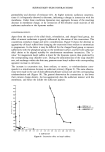
SURFACTANT-SKIN INTERACTIONS 83 S •.5' 0 p 3.0- 2.5- 2.0- ß RUN •. ß RUN 2 iO 20 30 40 50 50 70 80 90 tO0 ttO c-valus Figure 13. C-values vs soap chamber scores of anionics from two separate runs done by the same test laboratory. Table II List of Soap Chamber Indices and "C-Values" Surfactant "C-value" Soap chamber score Pluriol PE6400 4.10 0.30 SLES/Pluriol 3:1 5.48 0.70 Triton-X 102 8.90 0.45 Pluriol PE6400/SLES 1:1 12.21 0.50 C16/18 alcohol (EO15) 643.27 0.40 C16/18 alcohol (EO20) 1953.52 0.20 mary irritation and delipidization. Both are important factors in real-use situations. Liposome damage may occur by two mechanisms, namely: disruption of the phospho- lipid layers by charge interaction (predominant for anionics) and dissolution of the phospholipid layers by solubilization (predominant for nonionics). These mechanisms could be considered analogous to skin irritation and delipidization (detersivity). Soap chamber data do not measure detersivity and there is up to now no reliable in vivo model for it. Lack of correlation of the "c-values" and soap chamber scores for some surfactant systems may not indicate an inherent flaw in the liposome method. The in vivo indices have long been known to give erratic results (3,4,24) and, apart from the subjectivity of the assessments, not all irritation may be measurable by the same criteria. Surfactants that destroy liposomes at low concentration, but only after an initial lag time, may initially bind to the outer surface of the liposomes. A multiphase interaction may occur in this case, whereby the binding step may have a neutral, a shielding, or an irritating character.
Purchased for the exclusive use of nofirst nolast (unknown)
From: SCC Media Library & Resource Center (library.scconline.org)