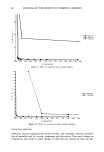
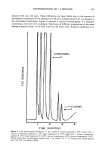
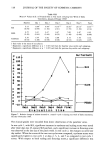
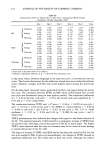
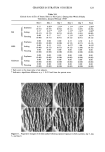
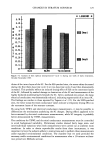
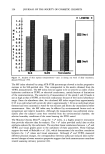
DETERMINATION OF 1,4-DIOXANE 103 dioxane level was 144 ppm. These differences are most likely due to the amount of ethoxylated components in the shampoo as well as to varying amounts of 1,4-dioxane in the ethoxylated surfactants. Figure 4 presents a typical chromatogram of a shampoo containing a low level of 1,4-dioxane. Replicates of different preparations of the same shampoo agreed within 7% of each other (in the worst case). Analyses performed on a ISOBUTANOL 1,4-DIOXANE •. I 1 2 • ,q. TIME (MINUTES) Figure 4. Gas chromatogram of Shampoo A. GC conditions: Initial temperature: 85øC initial time: 2 minutes temperature gradient A: 5øC final temperature A: 95øC final hold: ! minute temperature gradient B: 25øC final temperature B: 300øC injector temperature: 250øC detector temperature: 325øC helium carrier flow: 40 ml/minute injection size: 1 ul column: 12' X ¾8" stainless steel column packed with 15% OV-1 on Supelco WHP.

104 JOURNAL OF THE SOCIETY OF COSMETIC CHEMISTS second column of differing lot number also provided the same results, including the 7% variability in 1,4-dioxane level. In 12 of the 13 shampoos the analyses showed that no interferences were present that would impact upon the determination of the 1,4-dioxane level. However, in the case of Shampoo C, there was an unknown interference that occurred. This interference partially co-eluted with the isobutanol internal standard and provided for a variability of greater than 50%, thus eliminating the shampoo from the study. CONCLUSION An internal standard method utilizing isobutanol as the internal standard has been shown to be capable of accurately analyzing for 1,4-dioxane in a variety of commercial shampoos. The method is linear and provides recoveries between 94 and 105% over a 1,4-dioxane concentration range of 1 to 250 ppm. Thirteen shampoos were analyzed for 1,4-dioxane content. The lowest level of 1,4-dioxane was found in a shampoo containing no ethoxylated materials. The lowest concentration of 1,4-dioxane in an ethoxylate- containing shampoo was 6 ppm and the highest was 144 ppm. REFERENCES (1) C. Hoch-Legeti, M. F. Argus, and J. C. Arcos, Introduction of carcinomas in the nasal cavity of rats by dioxane, Br. J. Cancer, 24, 164-167 (1970). (2) R.J. Kociba, S. B. McCollister, C. Park, T. R. Torkelson, and P. J. Gehring, 1,4-dioxane. I. 2-Year ingestion study in rats, Toxicol. Appl. Pharmacol., 30, 275-286 (1974). (3) NIOSH, Registry of Toxic oefJ$cts of Chemical Substances, 1986 edition, NIOSH Publication No. 87-114, 3, 2082-2083 (1987). (4) D. B. Black, R. C. Lawrence, E. G. Lovering, and J. R. Watson, Gas-liquid chromatographic method for determining 1,4-dioxane in cosmetics, J. Assoc. Off. Anal. Chem., 66, 181-183 (1983). (5) T. J. Birkel, C. R. Warner, and T. Fazio, Gas chromatographic determination of 1,4-dioxane in Polysorbate 60 and Polysorbate 80, J. Assoc. Off. Anal. Chem., 62, 931-936 (1979). (6) J. J. Robinson and E. W. Ciurczak, Direct gas chromatographic determination of 1,4-dioxane in ethoxylated surfactants,J. Soc. Cosmet. Chem., 31, 329-337 (1980). (7) B. A. Waldman, Analysis of 1,4-dioxane in ethoxylated compounds by gas chromatography/mass spectrometry using selected ion monitoring, J. Soc. Cosmet. Chem., 33, 19-25 (1982). (8) S. Scalia, M. Guarneri, and E. Menegatti, Determination of 1,4-dioxane in cosmetic products by high performance liquid chromatography, Analyst, 115, 929-931 (1990). (9) S. C. Rastogi, Headspace analysis of 1,4-dioxane in products containing polyethoxylated surfactants by GC-MS, Chromatographia, 29, 441-445 (1990).
Purchased for the exclusive use of nofirst nolast (unknown)
From: SCC Media Library & Resource Center (library.scconline.org)