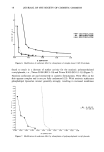
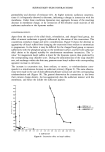
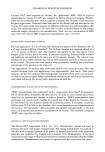
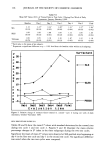
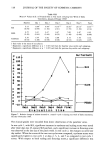
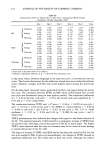
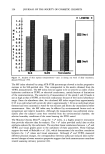
78 JOURNAL OF THE SOCIETY OF COSMETIC CHEMISTS O.Ot 0.0• 0.0,.I 0.04 l{ SURFACTANT Figure 6. Modification of surfactant effect by ethoxylation of straight-chain C16/C18 alcohols. T C tO• ETHOXYLATION .... I .... tS• ETHOXYLATION •0• ETHOXYLAT[ON found to result in a decrease of surface activity for the nonionic polyoxyethylated t-octylphenols, i.e., Triton X100 (EO 9-10) and Triton X102 (EO 12-13) (Figure 7). Nonionic surfactants are used extensively in cosmetic formulations. Their effect on the skin appears complex and is not yet fully understood (22). With nonionic surfactants phospholipid liposomes interact generally strongly, resulting in increased membrane 8.0' 8.5' 8.0' 7.5' 7.0' 6.6' 5.5' 4.5' 4.0- 3.5' 3.0' 8.5' 8.0' 5..5- 1.o- 0,5' 0.0 0. oog 0.05.0 0.05.1 0.05.2 I 0.05.3 0.05.4 0.0i5 SURFACTANT I 0,05.6 I 0.05.7 I 0.05.8 I o.os.g I o. 080 Figure 7. Modification of surfactant effect by ethoxylation of polyoxyethylated t-octyl phenols. •--•9-i0% EO ......... i2-i3% EO

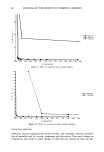
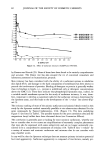
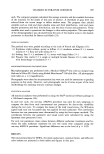
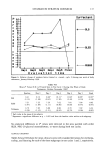
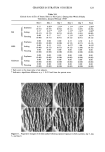
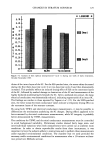
SURFACTANT-SKIN INTERACTIONS 79 permeability and decrease of resistance (23). At higher nonionic surfactant concentra- tions tV2 is frequently observed to decrease, indicating a change in interaction with the membrane. Under these conditions liposomes may aggregate because of the resulting decrease in membrane charge, or by interaction of the ethylene oxide moieties of the surfactant molecules at the liposome surface. COUNTERION EFFECTS Apart from the nature of the alkyl chain, ethoxylation, and charged head group, the effect of anionic surfactants is greatly influenced by the nature of the counterions. The counterions introduce charge and steric considerations. Figure 8 shows the decrease in aggressivity of lauryl sulfate from changing the counterion from sodium to ammonium to magnesium. In the latter it may be difficult for the charged head group to interact sufficiently with the phosphate group on the membrane surface, and for both surfactant alkyl chains to be aligned suitably for simultaneous membrane interaction. The "c- value" for magnesium lauryl sulfate is lower for the liposome system than predicted by the corresponding soap chamber score. During the administration of the soap chamber test, salt exchange within the skin may generate some lauryl sulfate with corresponding apparent increase in irritation. The increase in counterion size, from sodium, to mono-, to triethanolamine corre- sponds to a simultaneous decrease in surfactant irritancy (Figure 9). The same observa- tions were made in the case of dodecylbenzylsulfonate sodium salt and the corresponding triethanolamine salt (Figure 10). The general observation for counterions is: the lower their cationic charge density, the less aggressively does the surfactant interact with the membrane, and hence the milder the surfactant appears. f..4 •..6 •..6 2.O 2.2 2.4 2.6 2.6 $.0 3.2 )• SURFACTANT Figure 8. Counterion effect on lauryl sulfates. •SODIUM LS • MAGNESIUM LS .... • .... AMMONIUM LS
Purchased for the exclusive use of nofirst nolast (unknown)
From: SCC Media Library & Resource Center (library.scconline.org)