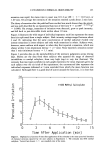
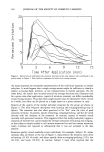
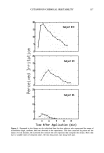
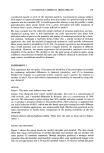
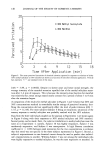
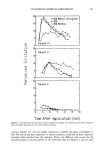
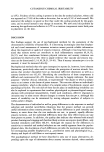
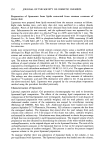
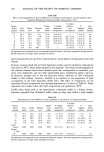
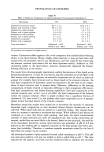
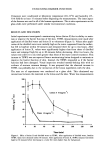
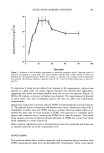
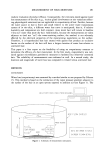
CUTANEOUS CHEMICAL IRRITABILITY 141 O (19 0 L (19 n 20 15 10 o 20 15 lO o 20 15 lO i i i i ,./o•x ß 60% Methyl Salicylate [/"•'o o 30% " " r ø•-:.o30% "enthøl Subject 10 . . i . . a . . i . . m . , m . . Subject 3 , , i , i i • ! I i a I ß ß i . . Subject 6 o o 18 3 6 9 12 15 Time After Application (min) Figure 6. The data oerom the same three subjects depicted in Figure 3 are shown here oeor both concentra- tions of methyl salicylate and the 30% menthol stimulus. contrast, Subject 10, who was highly responsive to methyl salicylate, and Subject 6, who was one of the least responsive to methyl salicylate, remained in their respective positions when menthol was the stimulus. Third, the different time course for the menthol sensation was also present in the individual data for Subjects 3 and 10 after

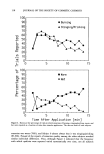
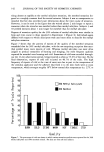
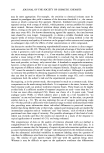
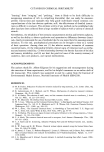
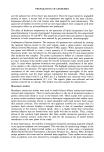
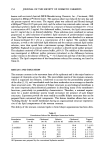
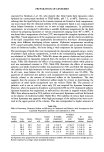
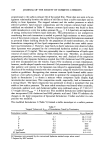
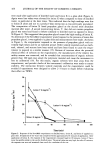
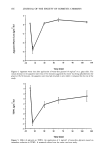
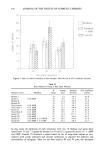
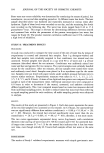
142 JOURNAL OF THE SOCIETY OF COSMETIC CHEMISTS rising almost as rapidly as the methyl salicylate sensation, the menthol sensation lin- gered at a roughly constant level for several minutes. Subject 6 was so unresponsive to menthol that her data provided scant information about the time course of sensation. However, it can be seen in the figure that she waited almost 2 min longer to report a sensation when the stimulus was menthol rather than methyl salicylate. Subjects 3 and 10 yielded latencies about 1 min longer for menthol than for methyl salicylate. Reports of sensation quality for the 30% solution of methyl salicylate were similar in form and time course to those reported in Experiment 1 (Figure 4). Individuals again differed with respect to which descriptors were used most often to describe the methyl salicylate sensation. Figure 7 shows that the pattern of reports of the quality of the menthol sensation resembled that for 30% methyl salicylate, with the not-surprising exception that men- thol yielded many more reports of cold. Whereas methyl salicylate was most often judged to produce sensations of burning and stinging, the most frequent qualities reported for menthol were burning and cold. Sensations of cold were recorded through- out the 12-min observation period, being reported as often as 55.6% of the time. By the final observation, reports of cold still occurred on 40.7% of the trials. The high frequency of reports of cold at the time of onset was due in part to the temperature of the stimulus applicator and the adhesive that fixed it to the skin: both were at room temperature, which averages roughly 10øC below normal skin temperature (ca. 22øC vs lOO E• U E• 90 80 70 60 50: 40 30 20 10 0 BURN [•30• Methyl Salicyla•e •30• Menthol COLD STING WARM HOT TINGLE ITCH Quality Figure 7. The percentage of trials are shown in which various sensation qualities were reported for the 30% methyl salicylate and 30% menthol stimuli. The data are from all nine subjects.
Purchased for the exclusive use of nofirst nolast (unknown)
From: SCC Media Library & Resource Center (library.scconline.org)