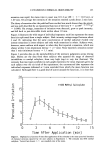
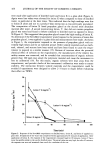
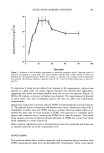
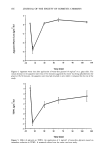
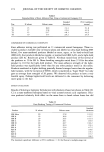
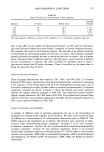
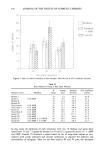
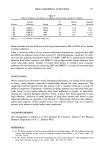
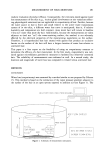
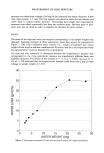
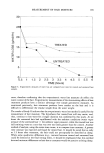
MEASUREMENT OF HAIR MOISTURE 185 15- 10- 0 • I 0.5 1 1.5 2 2.5 3 3.5 4 4.5 5 5.5 6 TIME (hours) Figure 3. Evaporimetric measures of water loss are compared over time for treated and untreated hair samples. sures, therefore confirming that the evaporimetric water loss measures do reflect the water content of the hair. Evaporimetric measurements of the moisturizing effects of hair treatment products have a distinct advantage over simple gravimetric measures. As mentioned previously, hair treatment products leave residue on the hair and it is difficult to differentiate the residue weight from the water weight. The results of Study II indicate that the evaporimetric water loss method is useful for the measurement of hair moisture. The hypothesis that treated hair will stay moist, and, thus, continue to lose water for a longer duration was confirmed by this study. At six hours the untreated hair had equilibrated with the ambient conditions (water vapor pressure of the untreated hair = the ambient vapor pressure), while the treated hair was still emitting water at a rate that was over ten times greater than the control. Another method of analysis, using the entire time course, is to compare time constants. A greater time constant was expected and found for treated hair. It should be noted that as early as 3.5 hours after treatment, the hair could not perceptually be described as damp. While some qualitative differences (e.g., texture) between treated and untreated hair could be detected at the final testing times, it should be emphasized that this method detected moisture differences on hair that a consumer would not perceive as being damp.

186 JOURNAL OF THE SOCIETY OF COSMETIC CHEMISTS While a clear differentiation was found between treated and untreated hair, the mech- anism for the effect was not fully determined. Thus, three possible reasons for these results are 1) a greater degree of water occlusion, 2) a greater degree of water absorption for the treated hair, or 3) both. If, however, reason 2 occurred solely, then we couldn't account for one fact. This fact is that after the treated and untreated hair samples were matched for water loss rate at an initial time (0.5 hr), the treated hair emitted more total water from that point on. If occlusion didn't occur, then once the hair samples were matched for rate of water loss, they would continue to be so matched. Therefore, occlusion seems assured as one explanation, and greater water retention cannot solely explain the results. Yet, we cannot rule out greater water retention. If we had integrated the rate of water loss from initial surface drying, we might have been able to measure the total water loss for each sample, and thus determine if the treated hair absorbed more water. There are several factors that potentially influence the water loss curve, such as the amount of hair sampled, type of hair, sample handling (e.g., towel drying vs air drying), and ambient relative humidity and temperature. However, relative measure- ments utilizing an experimental design and inferential statistical analysis can yield a valid assessment of moisturizing efficacy without the need to establish highly controlled benchmark criteria. Even if sample handling cannot be adequately equated for initial drying after treatment, water loss decay curves can be shifted so that both treatment and control conditions are compared with a similar water loss starting point. Alternatively, a comparison of time constants can be made. The method described in this study is relatively easy to implement when supported by digital hardware and software. (The authors feel that the commercially produced evap- orimeter made by ServoMed would work equally well if additional care is taken to minimize air movement near the sample during testing.) Because the method uses an open system that does not require great restraints on environmental conditions and sample handling, products can be compared under conditions that reflect normal use. It is also possible to apply the methodology to in vivo evaluation, provided that the hair being tested can be positioned (e.g., in subjects with long hair) away from the scalp and that a uniform surface of hair can be maintained. Consequently, longer-term studies (e.g., repeated usage) can be performed under normal conditions. REFERENCES (1) H. Tagami and K. Yoshikuni, Evaluation of the hydration state of the stratum corneum in vitro by electrical measurement, Bioengineer. Skin, 1, 93-99 (1985). (2) J. L. Leveque, "Measurement of Transepidermal Water Loss," in Cutaneous Investigations in Health and Disease, J. L. Leveque, Ed. (Marcel Dekker, New York, 1989), pp. 135-152. (3) R. P. R. Dawber, Physical properties of the hair and nails, Bioengineer. Skin, 2, 1-14 (1986). (4) D. R. Wilson and H. Maibach, "Transepidermal Water Loss: A Review," in Cutaneous Investigations in Health and Disease, J. L. Leveque, Ed. (Marcel Dekker, New York, 1989), pp. 135-152. (5) B. Idson, In vivo measurements of transepidermal water loss, J. Soc. Cosmet. Chem., 29, 573-580 (1978). (6) W. Maw-Sheng, A simple method for measurement of hair volume,J. Soc. Cosmet. Chem., 33, 85-92 (1982). (7) G. E. Nilsson, Measurement of water exchange through skin, Med. Biol. Eng. Comput., 15, 208-218 (1977).
Purchased for the exclusive use of nofirst nolast (unknown)
From: SCC Media Library & Resource Center (library.scconline.org)