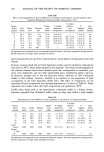
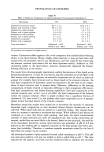
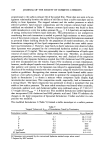
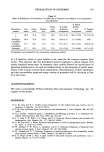
j. Soc. Cosmet. Chem., 43, 169-178 (May/June 1992) Measurement of the adhesive strength of hair-hairspray junctions R. RANDALL WICKETT, JOHN A. SRAMEK, and CYNTHIA M. TROBAUGH, S. C. Johnson Wax, 1525 Howe Street, Racine, WI 53403. Received March 15, 1991. Presented at the SCC Annual Scientific Seminar, Chicago, May 1991. Synopsis A method for measuring the adhesive strength of hairspray bonds joining individual hair fibers has been developed. The method involves application of 0.7 Ixl of hairspray to the overlapping portion of a hair loop and breaking the resulting junction on a tensile tester. Junction strength depends on polymer concentra- tion, polymer type, and formulation variables such as the type of neutralizer used or the presence of plasticizers. Relative humidity may also have a significant effect on junction strength, depending on the polymer system used. Optical microscopy shows that failure of hair-hairspray junctions is usually adhesive failure rather than cohesive failure of the resin itself. Often a replica of the hair cuticle scale is left in the hairspray resin after bond breaking. However, some resins shatter when the bond breaks, still leaving cuticle imprints in pieces of resin, indicating that both cohesive and adhesive failure may have occurred. INTRODUCTION The hold performance of a hairspray is determined by many factors. Some important parameters are the particle size of the spray (1), the tendency of the spray to flow and form junctions (2), and the inherent strength of the hair-hair bonds formed by the spray (3). Methods used to study hairspray on hair swatches have included curl retention at high humidity (4) and a torsional method (5). Rance (3) made direct determinations of adhesion of hair to hairspray resin by mounting the hair, coated with resin, inside a silicone mold and pulling the hair out of the resin after a few days of drying. He found that the glass transition temperature of the resin and the viscosity of the resin solution were important factors in determining adhesive strength. The purpose of this paper is to describe a simple and direct method for determining the strength of bonds formed between hairs by hairspray formulations. We have used a R. Randall Wickett's present address is University of Cincinnati College of Pharmacy, 3223 Eden Avenue, Cincinnati, OH 45267. 169

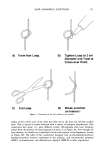
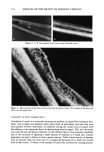
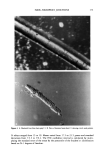
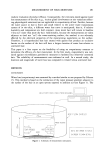
170 JOURNAL OF THE SOCIETY OF COSMETIC CHEMISTS single-fiber knot technique, similar to that used by Baten and Souren (6) for studies of wool-polymer adhesion. Those authors dipped the junction area of a knot made from a loop of wool into polymer solutions to form bonds. We apply a small amount of hairspray solution directly to the knot area, allowing it to be pulled into the knot by Laplace forces. Applying less than a microliter of hairspray to the junction in a simple knot, in a hair loop, may lead to the formation of a surprisingly strong bond. Bond strengths are often on the order of grams to tens of grams and are easily measured on a common tensile tester. The method has been briefly described in the patent literature (7) by one of us (J.A.S.). We also report on microscopic studies of the junctions before and after breaking, using differential interference contrast (Nomarski) optics. The micrographs generally appear to validate the common assumption that the failure of hair-hairspray bonds is adhesive (3) in nature rather than cohesive. However, in one case it appears that both cohesive and adhesive failure may occur simultaneously. MATERIALS AND METHODS Dark brown European virgin hair supplied by DeMeo Brothers, New York, was used for all testing. Extremely fine or coarse hair was rejected, and hair in the medium range was selected by eye. Knots were formed by making a hair loop with a single crossover as illustrated in Figure 1A. After the loop was tightened to approximately a 2-cm diam- eter, 0.7 I-tl of hairspray solution was applied to the junction with a piper. The knots were then aged for two hours at the test conditions of temperature and RH. Unless otherwise specified, tests were run at 20-22øC and 40% RH. After aging, the loops were cut. Hair segments that had sufficiently robust junctions to withstand the cutting process were then placed on an Instron © tensile tester and pulled apart. Typically 20 to 40 replicates were used per treatment group. Photomicrographs were obtain using a Nikon © optical microscope equipped with dif- ferential interference contrast (Nomarski) optics. Figure 2 shows two hairs bound to- gether by hairspray resin in the junction. When commercial aerosol hairsprays were used, the product was sprayed out into a beaker until a sufficient quantity of liquid was obtained for testing. Hairspray resins were tested as solutions in absolute ethanol, and concentrations reported are concentrations of the solid polymer. For _more details on hairspray formulations, see Sramek (7). RESULTS AND DISCUSSION MICROSCOPY A hair-hair junction formed by hairspray resin may fail by either of two mechanisms. Adhesive failure occurs if the hair debonds from the resin, and cohesive failure occurs if the resin breaks. Figure 3 shows typical photomicrographs of hairs after breaking knots formed as described above. Note that the hairspray film remaining on the hair shows a
Purchased for the exclusive use of nofirst nolast (unknown)
From: SCC Media Library & Resource Center (library.scconline.org)