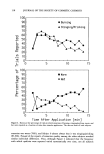
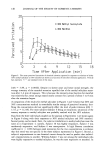
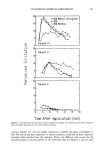
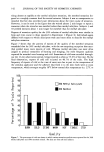
CUTANEOUS CHEMICAL IRRITABILITY 143 ca 32øC). Evidence of this cooling is present in the data for methyl salicylate, where cold was reported on 27.8% of the trials at detection, but on only 8.5 % of trials overall. We instructed the subjects to ignore as best they could the cooling produced by the appli- cator, and to attend instead to any change in sensation. We now avoid this problem by warming the applicator and adhesive to 32øC in a constant-temperature water bath prior to placement on the skin. DISCUSSION Our findings support the use of psychophysical methods for the assessment of the chemosensory irritability of human skin. It is becoming increasingly clear that biophys- ical and visual assessments of cutaneous irritation cannot provide reliable information about the magnitude or quality of sensory irritation. Although it has long been recog- nized that sensory nerves can contribute to local inflammatory responses (8,14,16, 36,37), and that correlations between physical irritation and sensory irritation can sometimes be observed (2,38), there is ample evidence that vascular and sensory reac- tions can be dissociated (1,14,16, 20,21,39-41). Thus if sensory irritation per se is to be assessed, it must be measured directly. Psychophysical methods that rely upon introspective reports do, however, have inherent limitations, particularly when used to evaluate the perception of noxious stimuli. Sen- sations that produce discomfort have an emotional (affective) dimension as well as a sensory (intensive) one (42,43). Identifying the contribution of these components is difficult and controversial (43-45). However, this may be largely irrelevant. For most purposes--whether clinical, industrial, or experimental--the degree to which a subject reacts to an irritant is the datum of prime interest. This reaction defines an individual's sensory irritability, which is the product of a complex series of biochemical, neural, and psychological factors. The role each of these factors plays in establishing irritability can also be explored in experiments that combine physiological or pharmacological manip- ulations with perceptual measurements. Under such conditions, affective responses to irritation may to some extent obscure changes in sensory function per se, although this source of variability can be minimized by testing adequate numbers of subjects in within-subject designs. The demonstration of individual as well as group differences in the responses to methyl salicylate and menthol nevertheless illustrates that the present method can provide useful information about sensory processes. The mean differences in peak intensity and latency to onset show that the two molecules are not, in general, equally effective sensory excitants, and the individual differences show that their effectiveness can vary from person to person. In addition, the quality data indicate that whereas both stimuli produce burning and stinging and therefore likely activate nociceptive (pain) fibers, only menthol stimulates cold fibers (46,47). Although the reasons for the differences in sensitivity to menthol and methyl salicylate are not readily apparent from the psycho- physical data, the elucidation of such differences provides the motivation and direction for investigating possible biophysical (e.g., penetration rates) and physiological (e.g., density and depth of cold fibers vs nociceptors) causes. The psychophysical method we have described is only one of many alternatives de- pending upon the type of information about sensory irritation desired, other methods

144 JOURNAL OF THE SOCIETY OF COSMETIC CHEMISTS may be more appropriate. For example, the sensitivity to chemical irritants must be assessed in paradigms that yield a measure of the detection threshold (i.e., the concen- tration at which a sensation first appears). However, threshold tests typically require repeated testing with a range of stimuli, which presents a serious problem for chemes- thetic stimuli. Because chemical irritation decays slowly and can cause lasting after effects, testing on the same or an adjacent site should not be attempted more frequently than once every 48 h. For known desensitizing agents like capsaicin, the time between tests should be even longer. Consequently, to obtain a reliable threshold value can require weeks of tedious testing (27). The advantage of a scaling method is that the perceived intensity and quality of irritation can be gauged within minutes and compared on subsequent days with the effects of other concentrations or other compounds. An alternative method for measuring suprathreshold sensory irritation is direct magni- tude estimation (see 48, 49). Theoretically, the principal advantage of the latter method is that it generates a ratio scale of perceptual intensity. Such a scale enables analyses of the ratios among subjective ratings i.e., if one stimulus yields a mean rating of 10 and another a mean rating of 100, it is permissible to conclude that the latter stimulus generates a sensation 10 times stronger than the former stimulus. The category scale we have used provides, in theory, only interval data. A drawback to magnitude estimation, however, is that subjects are free to use any range of numbers they desire. Consequently, the responses of different subjects cannot be compared directly. Simply put, the number "10" cannot be assumed to mean the same thing to each subject. Although it is possible to overcome this problem by obtaining magnitude estimates in another sensory modality that can then be used to adjust for differences in number usage (42), such a remedy complicates both the subject's task and the experimental procedure. By requiring, as in the present study, that responses be made on a common scale, direct comparisons can be made among individuals. It is important to be aware, however, that fixed response scales can produce nonlinear response biases. These biases can be largely avoided only if a sufficient number of response categories are used--more than the 5 or 6 that are most often employed (50). Hence our choice of a 21-point scale. Visual analogue scales (VAS), in which subjects place a mark on a line bounded by "no sensation" on one end and some variant of "extremely intense" on the other, can provide similar data (e.g., 51). We are also exploring the use of category partitioning scales (52-54) that provide a sufficiently wide numerical range to reduce nonlinear biases while also providing more information about individual differences in perceived intensity. Rather than being labeled only at their ends, category partitioning scales are marked by intermediate categories such as "moderate" and "very intense," each of which is further partitioned into finer steps of intensity. The possible advantages of this kind of scale, which was recently used (but the results not reported) in a study of the response to topical applications of mustard oil (55), are being evaluated. The interpretation of data on the quality of irritation obtained with our method is straightforward for the grouped data, but problematic for the individual data. It is reasonable to assume that the frequency of reports of particular sensation qualities are an accurate representation of how the "average" individual perceives the chemical stimulus. But the substantial individual variability in sensation labeling raises the question of whether the differences arise from true sensory differences or from differences in seman- tics. The validity of such reports might well vary with the qualities being rated. Whereas it may be difficult to agree on the qualitative attributes that differentiate
Purchased for the exclusive use of nofirst nolast (unknown)
From: SCC Media Library & Resource Center (library.scconline.org)