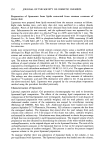
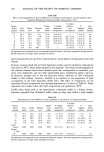
154 JOURNAL OF THE SOCIETY OF COSMETIC CHEMISTS hexane with activated charcoal (MCB Manufacturing Chemists, Inc., Cincinnati, OH) dispersed in Millipore © filtered water. The aqueous phase was replaced the next day and the process repeated twice more. The organic phase was collected and filtered through a Millipore © filter (0.45 •xm-pore size), and the solvent was removed under vacuum. All individual synthetic lipids were dissolved in a mixture of hexane:methanol (9:1 v/v) at a concentration of 0.2 mg/ml. For cholesterol sulfate, however, the lipid concentration was 0.1 mg/ml due to its limited solubility. These solutions were combined in various proportions to yield solutions of synthetic lipid mixtures of predetermined composi- tions. The lipid extracts from mouse stratum corneum were also dissolved in a mixture of hexane:methanol (9:1 v/v) at a concentration of 0.2 mg/ml. The synthetic lipid mixtures, as well as the individual lipid solutions and the stratum corneum lipid extract solution, were then spread from a micrometer syringe (ShaMlow Micrometers Ltd., Sheffield, England) in an amount sufficient to produce a desired initial surface pressure. The subphase consisted of 90 ml acetate buffer, pH 4.0. The stability of the monolayer was investigated at different surface pressures (calculated as the differences between surface tension in the absence of film [qtw = 72.6 dynes/cm] and that of the film-covered surface). The lipid compositions of the formulations selected for screening are listed in Table II. RESULTS AND DISCUSSION The stratum corneum is the outermost layer of the epidermis and is the major barrier to transport of chemicals across the skin. The intercellular matrix of the stratum corneum, which is organized into bilayers, is believed to account for the permeability properties of the skin (2,11), and considerable work has been undertaken in an attempt to describe these structural units. The presence of bilayer structures in any biological membrane is the most important physicochemical parameter in describing many of the membrane's functions, particularly its permeability characteristics. Therefore, a minimal require- ment for a model membrane system would necessitate the presence of such bilayer structures. Liposomes provide the most readily accessible bilayer structures that can be prepared from customized lipid components. This feature therefore allows their use as "building blocks" for model membranes having an organizational structure representa- tive of the lipid compartment of the stratum corneum. The ability of the stratum comeurn lipids to form bilayer organizations has been dem- Table II Formulations Selected for Monolayer Interaction Studies Formulation Ceramides Cholesterol Palmitic Cholesterol Trapped number (wt %) (wt %) acid (wt %) sulfate (wt %) volume 2 40.0 25.0 25.0 10.0 3.7 + 0.5 2 modified 37.7 28.3 17.0 17.0 N/D 5 -- -- 25.0 75.0 5.9 + 0.5 6 43.1 26.9 5.0 25.0 2.1 -+ 0.3 8 33.9 21.2 20.0 25.0 4.0 + 0.2 9 15.4 9.6 50.0 25.0 0.9 -+ 0.0 All liposomes were prepared by the conventional hydration method.

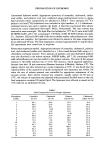
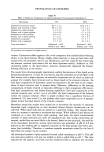
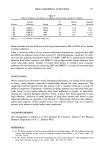
PREPARATION OF LIPOSOMES 155 onstrated by Abraham et al. (6), who showed that these lipids form liposomes when hydrated by conventional methods in TRIS buffer, pH 7.5, at 80øC. However, con- sidering that the lipid bilayers in the stratum corneum are formed at body temperature, one must ensure that the chemical stability of the component lipids is not compromised when bilayer formation is carried out in vitro at high temperatures. In preliminary experiments, we attempted to determine a suitable hydration temperature for the lipid mixture by preparing liposomes at various temperatures ranging from 40 ø to 80øC. It was found that a temperature of at least 55øC was required for complete hydration of the lipid film. Visual appearances of the suspensions were noted, and the chemical stabilities of the lipid components were qualitatively determined by thin-layer chromatography using three different developing solvent systems. Hydration temperatures exceeding 65øC caused noticeable chemical decomposition of ceramides and occasional decompo- sition of cholesterol sulfate, the latter being a vital component for liposome formation. The percentages of lipids that were incorporated into liposomes prepared using a variety of synthetic lipid mixture compositions, as well as the corresponding trapped volumes, are tabulated in Tables IIIa-IIIc. Table IIIc shows the percent cholesterol and palmitic acid incorporated in liposomes prepared from the extracts of mouse skin stratum cor- neum. Table IIIa illustrates the effects of increasing cholesterol sulfate while palmitic acid was maintained constant at 25% Table IIIb illustrates the effects of increasing palmitic acid while cholesterol sulfate was maintained at 25% and Table IIIc illustrates the inability of the lipid mixtures to form liposomes in the absence of cholesterol sulfate. In all cases, mass balance for the total recovery of radioactivity was 92-98%. The quantities of cholesterol and palmitic acid incorporated into liposomes appeared to be directly related to the amount of cholesterol sulfate in the formulation. The data suggests that the presence of cholesterol sulfate might be critical in determining the quantities of other lipids incorporated into the vesicles (Table III). The presence of palmitic acid is not as critical, since only 5% was required for liposome formation. However, when the quantity of palmitic acid exceeded 20% (at 25 % cholesterol sulfate), liposome formation was suppressed, as reflected by a decrease in trapped volume (Table IIIb). Even when as much as 25% palmitic acid was used, liposomes could not be formed in the absence of cholesterol sulfate (Table IIIc). The inability of certain lipid mixtures to form liposomes was apparent when high percentages of the radioactivity were recov- ered in the upper portion of the column. This also corresponded to higher amounts of Table IIIa Effect of Increasing Cholesterol Sulfate on Efficiency of Cholesterol and Palmitic Acid Incorporation Into Liposomal Preparations (palmitic acid maintained at 25%) % Added Formu- Choles- % Added palmitic % Lipo- lation Cera- Choles- Palmitic terol cholesterol acid Trapped somes number mides terol acid sulfate incorporated incorporated volume formed? 1 46.1 28.9 25.0 0.0 2.4 (0.7) 1.9 (0.7) 0.1 (0.0) no 2 40.0 25.0 25.0 10.0 69.4 (4.12) 62.7 (3.8) 3.7 (0.5) yes 3 30.8 19.2 25.0 25.0 74.2 (2.0) 64.7 (3.7) 2.5 (0.2) yes 4 15.4 9.6 25.0 50.0 77.1 (3.1) 73.7 (3.9) 2.4 (0.3) yes 5 0.0 0.0 25.0 75.0 -- 95.4 (6.9) 5.9 (0.5) yes All liposomes were prepared by the conventional hydration method. All values expressed as weight percent. Results expressed as average values (standard deviation).
Purchased for the exclusive use of nofirst nolast (unknown)
From: SCC Media Library & Resource Center (library.scconline.org)