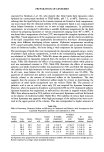
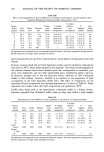
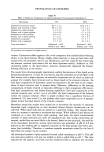
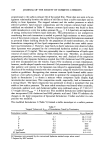
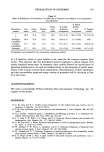
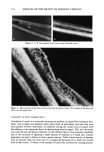
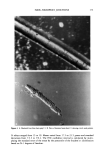
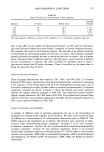
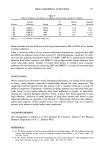
HAIR-HAIRSPRAY JUNCTIONS 177 Table V Effects of Silicone and Amines on Adhesion Results From Acrylic IV Polymer Silicone N Robust Standard Product surfactant Amine robust mean deviation D1 DMCP- 1 PGSA 20 12.6 +6.5 D2 DMCP-2 PGSA 15 18.9 + 8.1 D3 DMCP- 1 LMP 18 26.2 + 13.8 D4 DMCP-2 LMP 20 28.1 + 8.0 LSD95 % = 7.1 by Duncan's multiple range test. adhesive bonds and that addition of the long-chain amines LMP or PGSA led to further increased adhesion. Table V shows the effects of two silicone surfactants (dimethicone copolyols) and LMP and PGSA on adhesion results from acrylate IV. Each formulation contained 3% poly- mer and was partially neutralized with 0.3% AMP. LMP led to significantly stronger adhesion with either copolyol, and DMCP-2 led to directionally higher adhesion with either long-chain amine. Sramek (7) found these results to correlate with consumer preference for the formulation containing LMP and DMCP-2, in terms of increased body and resistance to style disruption by wind. CONCLUSIONS While many factors determine overall hairspray performance, the ability of the product to form a good adhesive junction is undoubtably among the most important. The single-fiber method reported here has proven to be a valuable technique to study the adhesive properties of hairsprays. Commercial sprays marketed as extra-hold were gen- erally found to give higher adhesion than those marketed as regular- or light-hold. Among the common hairspray polymers tested, acrylics were found generally to give high adhesion. Addition of small amounts of long-chain amines was found to give improved adhesion, in agreement with Sramek (7). Microscopy indicates that adhesive, rather than cohesive, failure usually occurs, but cohesive failure may occur simulta- neously with adhesive failure under some conditions. ACKNOWLEDGMENT The micrographs in Figures 2-4 were obtained by Ursula K. Charaf in the Physical Research Department of S. C. Johnson Wax. REFERENCES (1) R. W. Rance, Studies of the factors controlling the action of hair sprays--III: The influence of particle velocity and diameter on the capture of particle by arrays of hair fibers, J. Soc. Cosmet. Chem., 25, 545-561 (1974). (2) R. W. Rance, Studies of the factors controlling the action of hair sprays--I: The spreading of hair spray resin solutions on hair, J. Soc. Cosmet. Chem., 24, 501-522 (1973).

178 JOURNAL OF THE SOCIETY OF COSMETIC CHEMISTS (3) R. W. Rance, Studies of the factors controlling the action of hair sprays•II: The adhesion of hair spray resin to hair fibers, J. Soc. Cosmet. Chem., 25, 297-306 (1974). (4) A. L. Micchelli and F. T. Koehler, Polymer properties influencing curl retention at high humidity, J. Soc. Cosmet. Chem., 19, 863-880 (1968). (5) S. H. Ganslaw and F. T. Koehler, Evaluation of hair fixatives--a new technique utilizing torsional measurements, J. Soc. Cosmet. Chem., 29, 65-78 (1978). (6) B. O. Bateup and I. Souren, Wool/polymer interactions. Part II: Measurement of adhesion between single wool fibers and a polyurethane elastomer, Textile Res. J., 50, 740-746 (1980). (7) J. A. Sramek, Hairspray with improved adhesion/removability upon washing, US patent 4,874,604, Oct. 17, 1989.
Purchased for the exclusive use of nofirst nolast (unknown)
From: SCC Media Library & Resource Center (library.scconline.org)