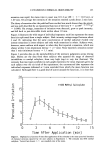
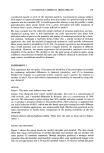
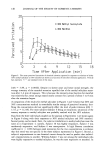
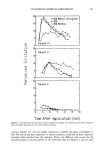
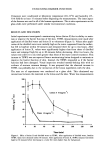
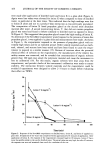
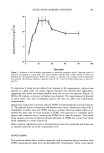
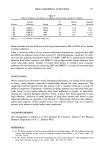
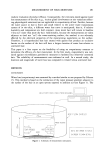
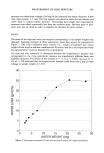
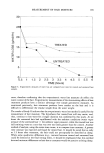
MEASUREMENT OF HAIR MOISTURE 183 measures was taken from a sample (164 mg) of dry untreated hair (mean diameter, 0.058 mm mean length, 5.5 cm). The hair sample was placed in water for one minute and towel dried to remove surface moisture. Alternating hair-weight and evaporimetric measures were taken sequentially less than two minutes apart. Between pairs of mea- sures, hair was air dried in order to expedite the decrease in water content. RESULTS The mean of ten digitized water loss samples corresponding to ten sample weights was obtained. Running averages of three consecutive mean data points are presented in Figure 2. The x-axis represents water content (i.e., weight of hydrated hair minus weight of hair dried in ambient conditions for 20 hours), and the y-axis represents water loss (grams/meter 2 hour) as measured by evaporimetry. At t-test was also computed to determine whether the evaporimetric measure that corresponded to the 2-rag gravimetric measure was significantly different from zero (ambient measure). The results of this analysis (t = 4.11 p 0.001 two-tail nI = 20 n2 = 20) indicated that the evaporimetirc measure could detect the 2 mg of water (change in sample weight of 1.2%). 30- 25- 04 20- E co 15- 0 i- 10- _ 0 5 10 15 2o 25 WATER WEIGHT (mg) Figure 2. Evaporimetric measures of water loss are plotted against hair sample gravimetrics. 30

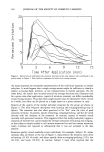
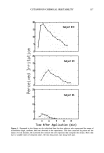
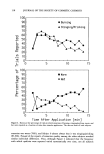
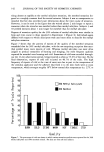
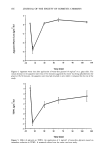
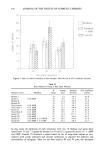
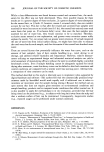
184 JOURNAL OF THE SOCIETY OF COSMETIC CHEMISTS Short-term test-retest reliability was determined by correlating the means of paired, but nonadjacent, ten-second data sampling periods at 13 different water loss levels. The hair sample described above was hydrated and repeatedly measured at various times after hydration. Eight of these levels were recorded on one day, and the remaining five levels were recorded on the following day. The water loss levels ranged from 0.34 to 17.6 grams/meter 2 hour. This range is relevant for determining differences between treated and untreated hair within the parameters of the present investigation (see water loss ranges for Study II). The product moment correlation coefficient was 0.976, indicating a high level of reliability. STUDY II: TREATMENT EFFECTS PROCEDURE A study was conducted to compare the time course of the rate of water loss by means of evaporimetry in treated and untreated hair samples. Four 1-g detergent-washed and dried hair samples were randomly assigned to four conditions: two treated and two untreated. Treated samples were placed in a cup with 90 cc of water and 1 g of hair treatment (described above) for ten minutes. Conditioner was uniformly mixed into water and hair and agitated for two minutes. The control samples were similarly handled except for the conditioner. After ten minutes, all four samples were rinsed three times and uniformly towel dried. Samples were placed in 8-oz styrofoam cups for the entire test. Samples were pat dried with paper towels under uniform pressure between tests to remove surface moisture. Evaporimetric measures were taken at: 0.5, 1, 1.5, 2, 2.5, 3.5, 5.0, 5.5, and 6.0 hours. A mean often digitized data points was computed for each sample at each of the measurement times. Inferential statistical tests were computed at 6.0 hours in order to determine if the treated, untreated, and ambient conditions differed significantly. The t-test compared means based on water-loss measures derived from individual sampling points. In order to reduce biases that may result from selecting an equal sampling period for each condition, all stable sampling periods were subjected to analysis. RESULTS The results of this study are presented in Figure 3. Each data point represents the mean of the two like-samples (two untreated or two treated). At 6.0 hours, the untreated hair was not significantly different from ambient conditions (t = 0.88 p 0.38 nl = 28 n2 = 89). However, the treated hair emitted significantly more water than the un- treated hair (t = 20.5 p 0.001 nl = 89 n2 = 103) therefore, it was more moist. The two curves approximate exponential decay curves (log-linear), with correlations (between time and log of water loss) of 0.748 for treated and 0.921 for untreated hair. A longer time constant (9.7 vs 1.2) for the treated hair indicates that it lost less water over time, even though initially (0.5 hours) both samples of hair lost water at the same rate. DISCUSSION The results of Study I validated evaporimetric measures with simple gravimetric mea-
Purchased for the exclusive use of nofirst nolast (unknown)
From: SCC Media Library & Resource Center (library.scconline.org)