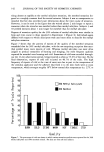
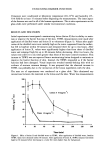
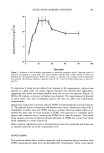
CUTANEOUS CHEMICAL IRRITABILITY 139 contributed equally to each of the reported qualities. Inconsistencies among subjects with respect to reports of sensation quality were also evident in a previous study in which capsaicin was the stimulus (28). It would appear that whereas it may be possible to make generalizations about group trends, how a given individual will label sensations of irritation from a given chemical is more difficult to predict. We may conclude that the relatively simple methods of stimulus application and psy- chophysical scaling used in this experiment can yield quantitative data about how individual subjects perceive the intensity and quality of sensations produced by a chem- ical stimulus. Although it had been shown before that a similar method of stimulus application that used the method of magnitude estimation could provide information about group trends in irritability (24,26-29), the present experiment has demonstrated that a fixed intensity scale can be used to compare directly the responses of different individuals. However, the present experiment did not provide a conclusive test of the reliability of the method. We decided to test the same group of subjects again, using a different concentration of methyl salicylate and a different chemical to determine if the same relative irritabilities would be obtained. EXPERIMENT 2 This experiment had two goals: (1) to assess the reliability of the psychophysical method for evaluating individual differences in chemical irritability, and (2) to determine whether the response to a particular irritant could be used to predict the response to another. In short, Can an individual's chemosensory irritability be assessed by using only one chemical? METHOD Subjects. The same nine subjects were used. Stimuli. Two chemicals were tested: methyl salicylate, this time in a concentration of 30% (wt/vol), and 1-menthol (Haarman & Reimer), also in a concentration of 30% (wt/vol). We discovered in pilot testing that 30% methyl salicylate seemed, to two of us, to produce a sensation similar to that produced by a 60% solution it appeared that our initial selection of 60%, which was also based upon pilot testing but with different methods of stimulus application, was unnecessarily high. Menthol was presented in the same concentration to enable direct comparisons of the sensory irritability of the two chemicals. Stimulus delivery and psychophysical method. These were the same as those used in Exper- iment 1. RESULTS AND DISCUSSION Figure 5 shows the group means for methyl salicylate and menthol. The data clearly show that equal concentrations of methyl salicylate and menthol did not produce the same pattern of cutaneous sensations. Methyl salicylate produced a stronger initial sensation than did menthol, and menthol's sensory effect took significantly longer to be felt the average latency was 2.59 min for menthol versus 1.83 min for methyl salicylate

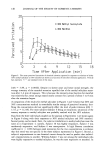
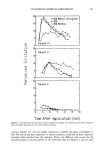
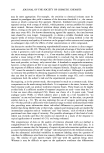
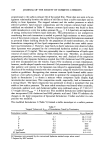
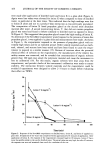
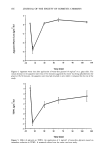
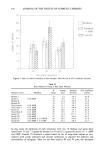
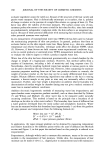
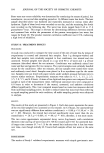
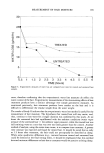
140 JOURNAL OF THE SOCIETY OF COSMETIC CHEMISTS 20 I I I I I 15 10 30X Methyl Salicyla•:e 30% Menthol , ] I • m I • • I m m I , m I • m 0 3 6 9 12 15 18 Time After Application (min) Figure 5. The mean perceived intensities of chemical irritation reported in response to solutions of either 30% methyl salicylate or 30% menthol are shown as a function of time after stimulus application. Vertical bars represent q-/- one standard error of the mean. It(8) = 3.89, p = 0.0046]. Despite its slower onset and lower initial strength, the average intensity of the menthol sensation equalled that of the methyl salicylate sensa- tion after 3-4 min of exposure. This is because the intensity-time function for menthol was relatively flat mean ratings stayed nearly constant for a period of about 3 to 8 min after the sensation began. A comparison of the results for methyl salicylate in Figures 1 and 5 shows that 60% and 30% concentrations resulted in remarkably similar ratings of perceived intensity dou- bling the concentration did not significantly affect the level of peak irritation It(8) = 1.33, p = 0.219]. For most subjects (Subject 6 being an exception), saturation of the sensory response to methyl salicylate was probably reached with the 30% solution. Data from the three individuals singled out for analysis in Experiment 1 are shown again in Figure 6 along with their responses to 30% methyl salicylate and 30% menthol. Several points can be made: First, the relative irritabilities to methyl salicylate were the same as in Experiment 1 namely, Subject 10 was highly responsive, Subject 3 was moderately responsive, and Subject 6 was unresponsive. A high Pearson correlation coefficient (r = 0.89) between peak intensities for the two concentrations is evidence that this trend was not specific to the three subjects represented in Figure 6. Second, a subject's responsiveness to one chemical cannot always be used to predict that individ- ual's responsiveness to another. Whereas Subject 3 was not among the individuals who were highly responsive to methyl salicylate, he was the most responsive to menthol. In
Purchased for the exclusive use of nofirst nolast (unknown)
From: SCC Media Library & Resource Center (library.scconline.org)