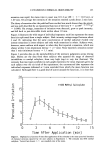
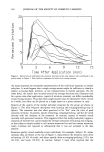
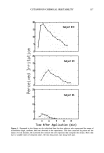
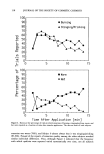
CUTANEOUS CHEMICAL IRRITABILITY 147 (41) (42) (43) (44) (45) (46) (47) (48) (49) (50) (51) (52) (53) (54) (55) S. Carpenter and B. Lynn, Abolition ofaxon reflex flare in human skin by capsaicin,J. Physiol., 310, 69p-70p (1980). H. K. Beecher, The measurement of pain, Pharmacol. Rev., 9, 59-209 (1957). R. H. Gracely, "Subjective Quantification of Pain Perception," in Pain Measurement in Man: Neuro- physiological Correlates of Pain, B. Bromm, Ed. (Elsevier, New York, 1984), pp. 371-387. R. H. Gracely, P. McGrath, and R. Dubnet, Validity and sensitivity of ratio scales of sensory and affective verbal pain descriptors: Manipulation of affect by diazepam, Pain, 5, 19-29 (1978). R. H. Gracely, P. McGrath, and R. Dubnet, Ratio scales of sensory and affective verbal pain descriptors, Pain, 5, 5-18 (1978). H. Hensel and Y. Zotterman, The effect of menthol on thermoreceptors, Acta Physiol. Scand., 24, 27-34 (1951). D. Swandulla, K. Schiifer, and H. D. Lux, Calcium channel current inactivation is selectively mod- ulated by menthol, Neurosci. Lett., 68, 23-28 (1986). L. E. Marks, Sensory Processis (Academic Press, New York, 1974). S. J. Bolanowski and G. A. Gescheider, Ratio Scaling of Psychological Magnituck (Lawrence Erlbaum Associates, Hillsdale, NJ, 1991). A. Parducci and D. H. Wedell, The category effect with rating scales: Number of categories, number of stimuli, and method of presentation, J. oexp. Psychol [Human Percept.] 12, 496-516 (1986). G. Heyer, O. P. Hornstein, and H. O. Handwerker, Skin reaction and itch sensation induced by epicutaneous histamine application in atopic dermatitis and controls, J. Invest. Dermatol., 93, 492- 496 (1989). W. Ellermeier, W. Westphal, and M. Heidenfelder, On the "absoluteness" of category and magni- tude scales of pain, Percept. ?sychophys., 49, 159-166 (1991). O. Heller, H/Srfeldaudiometrie mit dem Verfarhren der Kategorienunterteilung (KU), Psychol. Bei- trage., 27, 478-493 (1985). G. Borg, Psychophysical scaling with applications in physical work and the perception of exertion, Scand. J. Work Environ. Health, 16, 55-58 (1990). G. Heyer, O. P. Hornstein, and H. O. Handwerker, Reactions to intradermally injected substance P and topically applied mustard oil in atopic dermatitis patients, Acta Derm. Venereol. (Stockh.), 71, 291-295 (1991).

j. Soc. Cosmet. Chem., 43, 149-160 (May/June 1992) Development of a model of the lipid constituent phase of the stratum corneum' I. Preparation and characterization of "skin lipid" liposomes using synthetic lipids D. KITTAYANOND, C. RAMACHANDRAN, and N. WEINER, College of Pharmacy, The University of Michigan, Ann Arbor, MI 48109-1065. Received August 25, 1991. Synopsis Liposomes were prepared using four commercially available synthetic lipids, namely, ceramides, choles- terol, cholesterol sulfate, and palmitic acid, which represent the lipid classes found in the stratum corneum. The appropriate conditions for the preparation of liposomes were determined. Hydration of the four lipids, combined at different compositions by conventional hydration methods at 55øC, revealed that the lipid mixtures existed in equilibria that contained free (unentrapped) lipids in addition to liposomes. Variation in lipid composition resulted in suspensions whose composition always differed from that of the starting materials. In all cases, the disparities were reflected in their trapped volume as well as in their bilayer- forming ability. The lipid composition of the liposomes was modified to obtain a final formulation that formed a stable monolayer at a surface pressure similar to that obtained by lipids extracted from mouse stratum corneum. The results suggest that the modified synthetic lipid mixture could be used to form bilayers that are similar in composition and cohesiveness to the lipid bilayers of the stratum corneum. INTRODUCTION A heightened interest in optimizing the efficacy of topical products has necessitated the use of skin samples from human and other animal species to test for uptake into, and penetration through, the skin in both the preformulation and the formulation stages of product development. However, there has been increasing pressure on both the cosmetic and pharmaceutical industries to develop model systems that demonstrate a potential for use in place of the skin, at least in the early stages of testing. The barrier to percutaneous transport resides mostly in the stratum corneum. This barrier is unique in that it is essentially devoid of phospholipids. It is composed of a combination of several lipid species, primarily complex ceramides, cholesterol, choles- terol sulfate, and fatty acids (1-4). These lipids, when extracted from stratum corneum, form stable liposomes when processed by standard techniques (5-6). Liposome have been used extensively as models for biological membranes. They are usually prepared from phospholipids, the major lipid component of almost all biological 149
Purchased for the exclusive use of nofirst nolast (unknown)
From: SCC Media Library & Resource Center (library.scconline.org)