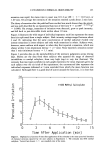
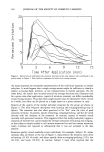
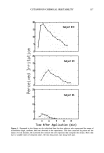
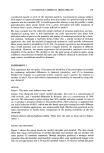
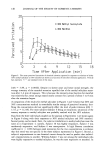
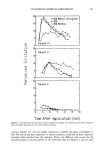
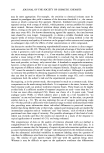
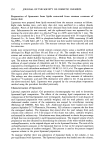
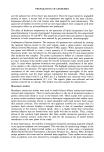
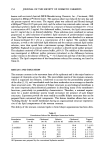
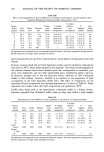
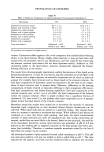
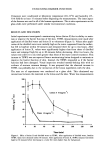
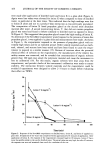
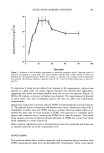
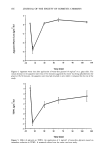
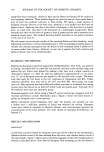
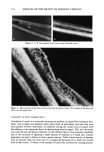
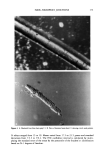
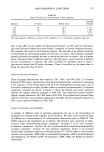
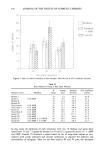
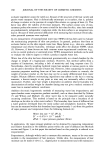
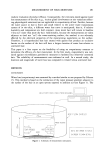
CUTANEOUS CHEMICAL IRRITABILITY 13 5 sensation was rapid the mean time to onset was 101.4 sec (SE = +/- 10.9 sec), or 1.69 min. On average the intensity of the sensation reached a peak about 2 min later. The decay of sensation after the peak had been reached was much slower than the attack, and was well described by an exponential function of the form Y = 22.09 e(-ø' •87x) (r 2 = 0.998). On average, sensations of irritation were detected, grew to peak intensity, and fell back to just-detectible levels within about 10 min. Figure 2 illustrates the wide range of individual responses: each line represents the mean data (six replicates) from a single subject. Peak intensity ratings ranged between about 3 and 19, indicating that the same concentration of methyl salicylate evoked very intense sensations in some subjects and only weak sensations in others. Subjects were, however, more uniform with respect to when they first reported a sensation, which was always within 3 min (maximum latency = 2.7 min). None reported a sensation sooner than 1 min (minimum latency = 1.1 min). Figure 3 provides data on the reproducibility of the intensity judgments across testing days. Shown are the data from three subjects who spanned the range of observed irritabilities to methyl salicylate, from very high (top) to very low (bottom). The intensity function (open symbols) in each graph represents the mean responses given by each subject over the six trials of the experiment the unconnected dots represent the individual responses (obtained at 1-min intervals) from which the mean function was calculated. Although there is a good deal of scatter around the functions, it is clear that 20 I I I I 15 o 60• Methyl Salicylate m, m I m m I m m I m m ,I, m m, 0 3 6 9 12 Time After Application (min) Fi•e 1. Displayed • a function of time after application of the stimulm is the m•n •rceived intensity of chemical irritation repo• by the nine subjects in Experiment 1. The stimulus w• 60% methyl •li•late. Vertical b•s denote +/- one standard error of the mean.

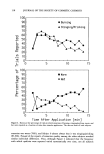
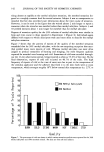
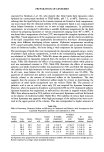
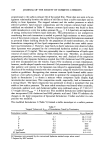
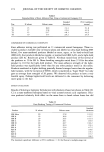
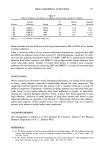
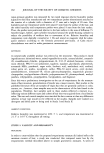
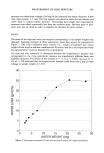
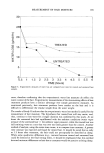
136 JOURNAL OF THE SOCIETY OF COSMETIC CHEMISTS O L 20 15 10 I I I I o o 3 6 9 12 15 Time After Application (min) Figure 2. Shown here are individual time-intensity functions for the nine subjects who contributed to the group means in Figure 1. Each function represents the mean of six testing sessions. the mean responses are reasonable representations of the individual responses to methyl salicylate. It would appear that a single testing session might be sufficient to classify a subject as having high, medium, or low responsiveness to methyl salicylate. On the other hand, the scatter that occurred around the average functions also illustrates that for a given time after application, reports of irritation intensity can differ considerably across testing sessions. Thus data from single sessions may be informative when viewed as a whole less value can be placed on a single report at a given moment in time. Reports of the quality of the methyl salicylate sensation for the group are shown in Figure 4. The most frequent descriptors were burning and stinging/pricking (top of figure). The sensation was also often perceived to be "hot" near the time of peak sensation intensity. In general, reports of burning, stinging/pricking, and hot all varied directly with the intensity of the sensation. In contrast, reports of warmth varied inversely with perceived intensity. This suggests either that methyl salicylate triggers a sensation of warmth that can be masked by stronger sensations of burning and stinging, or that subjects simply tended to call intense sensations hot and less intense sensations warm. Coolness was reported so infrequently that it was not included in the data analysis. Sensation quality varied markedly across individuals. For example, Subject 10, whose intensity data are shown at the top of Figure 3, characterized the sensation most often as burning (35.9% of trials), and about equally often as stinging/pricking (21%), hot (23.2%), and warm (19.9%). In contrast, Subject 3 most often reported that the
Purchased for the exclusive use of nofirst nolast (unknown)
From: SCC Media Library & Resource Center (library.scconline.org)