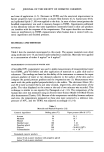
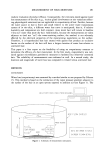
CUTANEOUS CHEMICAL IRRITABILITY 133 EXPERIMENT 1 The first experiment evaluated both a psychophysical method for quantifying the in- tensity of sensory irritation and a novel device for the application of chemicals to the skin in a rigorously controlled fashion. The psychophysical method was based on a 21-point rating scale that provided quantitative data on perceived sensory intensity and enabled the irritability of each subject to a given chemical to be compared directly to that of others and to themselves across experimental sessions. The device for chemical appli- cation was modified from one used previously in this laboratory (27,29). METHOD Subjects. Ten adults (seven females and three males) between the ages of 22 and 32 participated. All ten were laboratory personnel, and all were experienced in psycho- physical tasks. One subject was dropped from the study before completion because she considered any detectable sensation of irritation to be painful. Stimuli. The test stimulus was 60% (wt/vol) methyl salicylate (Sigma Chemical Co.) in a vehicle of 80% ethanol and 20% deionized water (dH20). Stimulus delivery. The subjects were seated in a modified dental chair with their arms positioned comfortably (volar surfaces upward) on padded armrests. The procedure required that the subject be unaware of which arm received methyl salicylate. Because methyl salicylate is highly odorous, it was necessary to eliminate odor as a cue to stimulus location. We did this by pipetting 25 Ixl of the chemical into a small beaker on a table next to the subject. A weak wintergreen odor was therefore present during and after application of both the odorous test solution and the non-odorous control solution. The procedure was as follows: The experimenter located the broadest part of the subject's volar forearm and measured the distance from that point (on the midline) to the wrist. This distance was recorded to insure that the same spot would be stimulated on both arms throughout the study. The chemical stimulus was pipetted onto the skin within a Teflon © ring (1.2 cm I.D., 1.6 cm O.D.) that was affixed to the skin with a bead of denture adhesive (Fixodent, © Richardson-Vicks, Inc.) applied around the outside of its bottom edge. Light pressure was applied to the top of the ring to produce an airtight seal with the skin. Pilot testing established that a 25-ml volume was sufficient to wet the skin within the ring without also producing noticeable pooling. The erythema induced by the methyl salicylate did not spread beyond the ring, demonstrating that no leakage occurred. Immediately after the chemical was applied, the ring was covered with a snug-fitting Teflon cap that prevented evaporation and left a headspace of only 0.21 cm 2. The only perceptible effect of the device alone was a transient sensation of cooling produced by the room-temperature denture adhesive and the Teflon. In each session the test chemical was applied to one forearm and the vehicle to the other in random order. Subjects were tested no more frequently than every 48 hours to avoid possible desensitization effects like those reported for capsaicin (30,31). This was a conservative measure in that desensitization to methyl salicylate has never been reported. Psychophysicalprocedure. The psychophysical method had to be tailored to accommodate the slow development and decay of chemogenic sensations, as well as the strong inhib- itory interactions that can occur between two or more nociceptive stimuli (12,32-35). Accordingly, only a single chemical was applied to one arm during each session, with

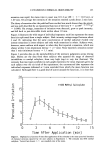
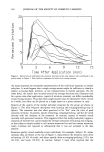
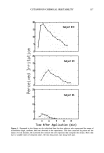
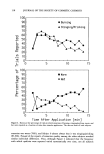
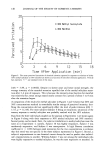
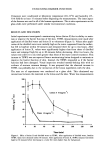
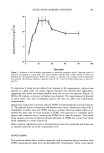
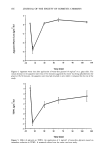
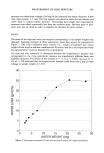
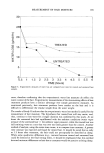
134 JOURNAL OF THE SOCIETY OF COSMETIC CHEMISTS reports of perceived sensory intensity obtained repeatedly over the next several min- utes. After each solution was applied, the experimenter pressed a key, purportedly to start a computer timing program. In fact, only after the test stimulus had been applied was the appropriate key pressed. The subjects were told to report when a cutaneous sensation first appeared at either site. If sensations were perceived at both sites, the subject was told to report only the arm that had the stronger sensation. The control arm therefore served as a baseline against which sensations produced by methyl salicylate could be judged. Once the subject reported a sensation on either arm, a tone was sounded every 60 seconds to indicate that another rating should be made. Rarely, a subject reported a sensation first on the control arm this was noted but not recorded. Because we were interested in measuring the latency to sensation on the test arm, these occasional false alarms were troublesome. We therefore instructed the subjects that if after their first report of sensation on either arm they experienced a stronger sensation on the opposite arm, they should not wait for the tone to report the stronger sensation. Once a sensation was reported at the test site, whether it was the first or second, the experimenter pressed a key to record the latency and to start (or restart) the 60-sec timer. Ratings were then made every 60 seconds for the next twelve minutes. If on any of these trials a subject indicated that the sensation on the control arm was stronger, then a rating of "zero sensation" was entered for the test arm. The subject was required to (1) state on which arm the sensation first occurred, (2) give a numerical estimate of its overall intensity, and (3) report its quality using the fol- lowing descriptors: cool/cold, warm, hot, itch, sting/prick, and burn. These terms were selected on the basis of their common usage in the literature as descriptors of chemical irritation, and on the results from previous work in our laboratory with methyl salicylate (29). The thermal descriptors were considered self explanatory written definitions of itch, sting/prick, and burn were provided. Itch was described as "the sensation that evokes a desire to scratch" sting and prick were defined as "sharp sensations similar to those produced by an insect bite or a pin-prick, which may be constant or intermittent" burn was described as "the sensation produced by extreme temperatures or by chemical irritants, which may or may not be associated with a thermal sensation (either hot or cold)." Overall intensity was rated on a 21-point scale anchored with "nothing" [0] and "ex- tremely strong" [20]. A category scale was chosen instead of a direct estimation tech- nique such as magnitude estimation so that the ratings from different subjects could be compared directly. Each subject was tested six times at intervals of at least two days, and the arm that received the test stimulus was varied randomly with the constraint that each arm was tested three times. RESULTS AND DISCUSSION Figure 1 shows the mean perceived intensity of chemical irritation reported for a 60% solution of methyl salicylate as a function of time. The onset and rise of the chemical
Purchased for the exclusive use of nofirst nolast (unknown)
From: SCC Media Library & Resource Center (library.scconline.org)