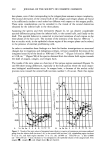
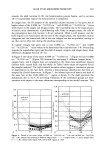
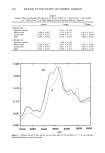
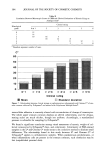
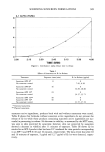
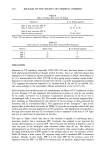
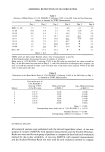
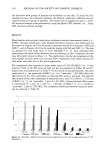
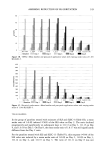
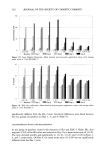
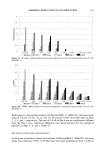
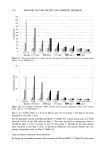
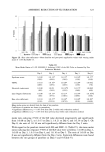
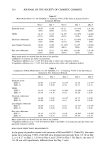
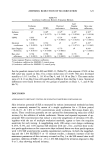
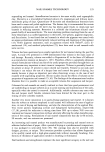
304 JOURNAL OF THE SOCIETY OF COSMETIC CHEMISTS Table II Correlation Between Microscopic Scores of CSSB and Clinical Evaluations of Xerosis Using an Analogue Scale a Clinical rating Histological grade 0 & 1 2 3 4 5 6 12 14 10 16 5 18 14 7 12 6 a Numbers represent number of cases. C* BO so 40 •o •o lO o 0-1 1-2 2-3 3-4 4-5 5-6 Clinical rating I• Mean [• Standard deviation Figure 7. Relationship between clinical ratings on epiluminescence photographs and Chroma C* of stra- tum corneum collected by D-Squame © and stained with Polychrome Multiple Stain ©. intercellular adhesion is unevenly altered with accumulation of clumps of corneocytes. The whole upper stratum corneum displays an altered cohesiveness, and the desqua- mating scales are much thicker, though not uniform. Accordingly, a standardized pressure is advisable for sampling by D-Squame ©. We found a significant correlation among visual assessment of xerosis, weight of col- lected corneocytes by D-Squame © discs, and colorimetry. Colorimetry of PMS-stained samples in the L* and Chroma C* mode seems to be a sensitive method to disclose small differences. The relationship found in this study between L* and Chroma C* of D-Squame © applies to orthokeratotic samples. When parakeratosis predominates, or when inflammatory cells are present in the stratum corneum, such correlation may be lost (unpublished personal data).

COLORIMETRIC ASSESSMENT OF XEROSIS 305 In previous works we had found that CSSB were satisfactory for most routine work, enjoying a good correlation with clinical evaluations of pathological conditions and bringing unique information concerning the pattern and type of xerosis (1,4). For dry skin, however, a rough correlation that did not reach statistical significance was seen between visual assessment and microscopic scores of CSSB. The lack of significance was due to the fact that microscopic grades 0, 1, and 2 were rated clinically as normal without further distinction. On the other hand, grades 4 and 5 appeared indistinguish- able by visual inspection of the skin alone. Colorimetric measurements of D-Squame © offer an accurate method for quantitative assessment of dry skin. The combination of CSSB and colorimetry of D-Squame © therefore offers the advantages of typing and rating dry skin. These methods are appli- cable to various studies of xerotic skin--for example, to assess the effect of moisturizers, influence of age, etiopathogenesis, etc. REFERENCES (1) C. Pi6rard-Franchimont and G. E. Pi•rard, Les x•roses: Structure de la peau r&che, Int. J. Cosmet. Sci., 6, 47-54 (1984). (2) G. E. Pi•rard, What do you mean by dry skin? Dermatologica, 179, 1-2 (1989). (3) J. Serup, A. Winther, and C. Blichmann, A simple method for the study of scale pattern and effects of a moisturizer. Qualitative and quantitative evaluation by D-squame tape compared with parameters of epidermal hydration, Clin. Exp. Dermatol., 14, 277-282 (1989). (4) C. Pi•rard-Franchimont and G. E. Pi•rard, Assessment of aging and actinic damages by cyanoacrylate skin surface strippings, Am. J. Dermatopathd., 9, 500-509 (1987). (5) M. F. Lukacovic, F. E. Dunlap, S.C. Michaels, M. O. Visscher, and D. D. Watson, Forearm wash test to evaluate the clinical mildness of cleansing products, Jo Soc. Cosmet. Chem., 39, 355-366 (1988). (6) H. Pehamberger, A. Steiner, and R. Wolff, In vivo epiluminescence microscopy of pigmented skin lesions. I. Pattern analysis of pigmented skin lesions, J. Am. Acad. Dermatol., 17, 571-583 (1987). (7) H. P. Soyer, J. Smolle, S. HiSdl, H. Pachernegg, and H. Keri, Surface microscopy. A new approach to the diagnosis of cutaneous pigmented tumors, Am. J. Dermatopathol., 11, 1-10 (1989). (8) J. Serup and T. Agner, Colorimetric quantification of erythema--A comparison of two colorimeters (Lange Micro Color and Minolta Chroma Meter CR~200) with a clinical scoring scheme and laser- doppler flowmetry, Clin. Exp. Dermatol. 15, 267-272 (1990). (9) F. Deleixhe-Mauhin, C. Pi•rard-Franchimont, and G. E. Pi•rard, Introduction au monde de la couleur en m•decine, Rev. Med. Liege, 46, 607-612 (1991).
Purchased for the exclusive use of nofirst nolast (unknown)
From: SCC Media Library & Resource Center (library.scconline.org)