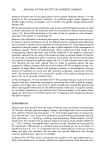
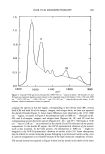
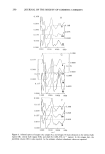
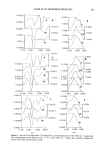
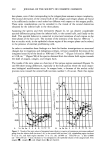
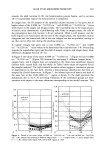
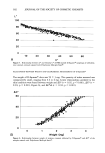
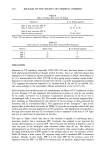
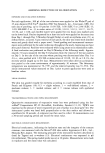
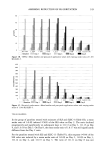
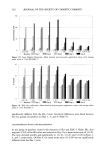
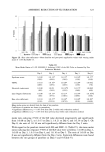
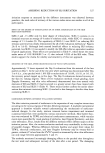
292 JOURNAL OF THE SOCIETY OF COSMETIC CHEMISTS hair phases, even if that corresponding to the telogen phase assumes a major complexity. The second derivatives of the central bulb of the catagen and telogen phases are found to be sufficiently similar to each other but different with respect to the anagen profile. These same considerations can be extended to the trends of the second derivatives obtained for the inferior bulb in the three phases. Analyzing the spectra and their derivatives (Figure 4), we can observe considerable spectral differences going from the inferior bulb, to the central bulb, and finally to the shaft. This spectral behavior is connected to structural variations of each region in the three phases of the hair cycle. The increase of the intensity of the band at 1080 cm- t, due to nucleic acids, in the epithelial column region of the catagen phase can be related to the presence of external proliferating cells. In order to rationalize these findings as a basis for further investigations on structural changes due to exogenous and endogenous stresses, we have considered the ratios of the integrated areas (A) of the bands at 1080 and 1540 cm- t (Figure 5A) and at 1080 and at 1238 cm- • (Figure 5B) of the spectra obtained from the inferior bulb region towards the shaft of anagen, catagen, and telogen hairs. The trends of the ratio values as a function of the various regions examined (Figures 5A and 5B) show strong differences, especially in the bulb portion where the most impor- tant biological modifications occur. In anagen hairs, a decrease of the nucleic acids/ proteins ratio toward the central bulb (sections number 1-8) occurs. From this region 0,35 '• 0,3 •C E 0,2 • A la 3a 5a 2 4 6 8 10 12 14 B la 3a 5a 2 4 6 8 10 12 14 Figure 5. Trends of the ratio values of integrated areas relative to spectra of contiguous microareas analyzed going from the inferior bulb (sections 1-4), to the central bulb (sections 5-8), suprabulbar region (sections 9-12 or 14), and shaft region (sections 13 or 15). (A): (A1080 cm-•)/(A1540 cm-•) (B): (A1080 cm-•)/(A1238 cm-•) ratio. Sections la-5a correspond to the epithelial column of the catagen bulb. Two anagen (O), catagen (I), and telogen hairs (&) are reported.

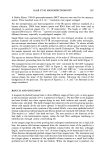
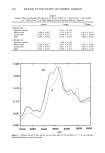
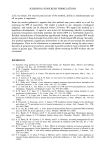
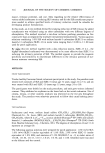
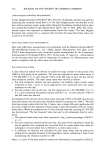
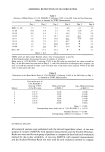
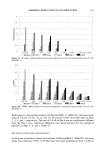
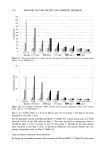
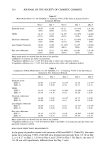
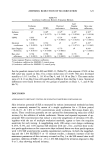
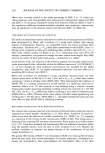
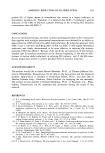
HAIR FT-IR MICROSPECTROSCOPY 293 towards the shaft (sections 8-10), the keratinization process begins, and in sections 10-15 (suprabulbar region) the keratinization is completed. In catagen hair, the IR analysis of the epithelial column (sections la-5a) gives rise to higher values of the A1080 cm- •/A1540 cm- • and A1080 cm- •/A1238 cm- • ratios with respect to the anagen and telogen trends. This is probably due to the large amount of nucleic acids characteristic of proliferating cells. Early in catagen phase, the cells of the presumptive hair club (section 1-8) are nucleated, DNA is still present, and the bulb begins to be keratinized. By the end of the catagen phase, the epithelial column disappears and the keratinized club of the new telogen hair has an epithelial coating or sac that can be often lost during the plucking process. A "naked" telogen hair gives rise to low A1080 cm-•/A1540 cm -• and A1080 cm- •/A1238 cm- • ratios values in the keratinized hair club (sections 1-8). Proceeding towards the suprabulbar region and the shaft of anagen, catagen, and telogen hairs, these differences disappear (section 10-15). In Figure 6 the values of the ratios A1080 cm-•/A1540 cm-• (Figure 5A) and A1080 cm-•/A1238 cm-• (Figure 5B) obtained by analyzing 9 different anagen hairs, 7 catagen hairs, and 6 telogen hairs are compared in the three most significant regions (inferior bulb, central bulb, and hair shaft). In Table I these values are reported for all the samples analyzed. The high standard deviation values suggest a continuous process of degeneration in the hair bulb, whereas a discontinuous classification has been at- tempted by clinical observation. In Figure 7, the infrared spectra of matrix and shaft of the same hair in the 3100-2800 cm-• region is shown. In the shaft spectrum the absorptions due to the C-H stretching vibrations of the methylene groups are more intensive with respect to the same vibrations corresponding to the methyl motions. This 0,7' 0,6 '•0,5 •0,4 ',r-- • 0,2 0,1 ß epithelial ß column ß ß ß ß ß ß - .-- .,..'-.. ', "" 33..-: : ,'.- .._...-_..:.. ...... .-._' T =.... • 1,8 ß epithelial .' column ß c ß ß " ' ' "'" ' ""' 3L.-: o A lB CB S B lB CB S Figure 6. Trends of the ratios values (A1080 cm-•)/(A1540 cm-z)-(A) and (A1080 cm-z)/(A1238 cm- z) (B), obtained by analyzing 9 different anagen hairs ( ), 7 catagen hairs (.-.), and 6 telogen hairs ( .... ). IB, inferior bulb region CB, central bulb region S, shaft.
Purchased for the exclusive use of nofirst nolast (unknown)
From: SCC Media Library & Resource Center (library.scconline.org)