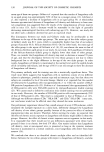
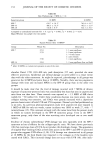
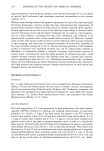
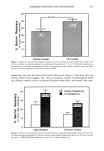
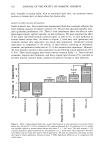
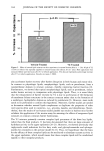
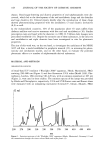
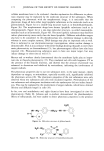
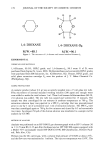
j. Soc. Cosmet. Chem., 47, 177-184 (May/June 1996) Rapid quantitative determination of 1,4-dioxane in cosmetics by gas chromatography/mass spectrometry DEMING SONG, SHIDE ZHANG, WENWEN ZHANG, and KENNETH KOHLHOF, Clinical Research Associates, 50 Madison Avenue, New York, NY, 10010. Accepted for publication June 19, 1996. Synopsis Dioxane is a potential carcinogen. Determination of the level of dioxane present in cosmetics is of impor- tance. A highly sensitive and accurate gas chromatography/mass spectrometry method for the rapid quan- titative analysis of dioxane in cosmetics is described. Dioxane was extracted from a sample by hexane and methylene chloride (80:20, v/v) and then transferred to a C 8 solid-phase extraction (SPE) cartridge and eluted by acetonitrile. An aliquot of this solution was analyzed by gas chromatography/mass spectrometry with electron impact ionization (El) and a selected ion monitoring (SIM) (dioxane m/z = 88) mode. The quantitative limit was set to be 0.1 ppm (0.1 •xg/g for cosmetics) with an injection volume of 2 ptl. The isotopically labeled dioxane-d 8 (m/z = 96) was used as an internal standard. INTRODUCTION 1,4-Dioxane is an anticipated carcinogen (1,2) and a possible by-product in the pro- duction of polyethoxylated surfactants that are widely used in cosmetic emulsions such as lotions and shampoos (3,4). 1,4-Dioxane could be formed during the polymerization of ethylene oxide to produce the polyoxyethylene portion of the emulsifiers (5). Dioxane is water-soluble and has a boiling point of 10 IøC. Accordingly, once dioxane forms in water-soluble cosmetics, it is not easily eliminated. Hence the potential problems associated with 1,4-dioxane have been brought to the attention of the cosmetic industry, and 1,4-dioxane has been the object of tests in various kinds of cosmetic products (6-9). Several methods of GC (6,7), HPLC (8), and GC/MS (9) have been presented for the testing of 1,4-dioxane in cosmetics. These methods have their limitations. GC or GC/MS methods suffer from unsatisfactorily low accuracy and reproducibility (6). The HPLC method suffers from low sensitivity: 6.5 ppm (p•g/g) (8). In comparison, our method provides a higher sensitivity (0.1 ppm) and shorter analysis time (6 min) than any of the present methods. Moreover, the use of the isotopically labeled compound dioxane-d 8 as an internal standard in our method has greatly improved the accuracy and reproducibility in both intra-assay and inter-assay. The structures of dioxane and diox- ane-d 8 are shown in Figure 1. 177

178 JOURNAL OF THE SOCIETY OF COSMETIC CHEMISTS / \ D 1,4- DIOXANE 1,4- DIOXANE-D 8 M.W.=88.1 M.W.=96.1 Figure 1. The structures of 1,4-dioxane and internal standard dioxane-d 8. EXPERIMENTAL CHEMICALS AND MATERIALS 1,4-Dioxane, 99.9%, HPLC grade, and 1,4-dioxane-d 8, 98.5 atom % of D, were purchased from Sigma (St. Louis, MO). Dichloromethane and acetonitrile HPLC grades were purchased from EM Industries, Inc. (Gibbstowne, NJ). Hexane, HPLC grade, and solid phase extraction cartridge C 8 were the product of J. T. Baker Chemical Co. (Phillipsburg, NJ). SAMPLE PREPARATION A cosmetic product (about 0.4 g) was accurately weighed into a 15-ml glass test tube. Fifty microliters of internal standard working solution (200 ppm) and enough water were added to make the total volume 1 mi. Then 6 ml hexane:dichloromethane (80:20, v/v) solution was added. The test tube was capped and vortexed for 15 minutes. The sample was then centrifuged for ten minutes at ambient temperature at 700 g. The extraction solution layer was pipetted to a SPE C 8 cartridge that was preconditioned prior to use by 1 ml of acetonitrile and 1 ml of extraction solution. The SPE C 8 tube was then centrifuged again at 700 g for five minutes and eluted by 0.5 ml acetonitrile two times. An aliquot (50 •1) of the elution solution was transferred to a sample vial for analysis by GC-MS. METHOD OF ANALYSIS Analysis was performed on an HP 5890 II gas chromatograph with an HP-5 column (30 m x 0.25 mm ID, 0.25-•m film thickness) and an HP 5989 MS engine equipped with a Model 7673 autosampler (model HP DOS G1034C MS ChemStation, Hewlett Pack- ard, Palo Alto, CA). Helium was the GC carrier gas, with a column head pressure of 30 KPa at about 25øC, and the flow rate was maintained at 1 ml/min. The injector temperature was 130øC. The
Purchased for the exclusive use of nofirst nolast (unknown)
From: SCC Media Library & Resource Center (library.scconline.org)