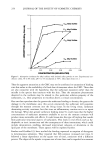
j. Soc. Cosmet. Chem., 48, 253-274 (September/October 1997) Review of properties of surfactants that determine their interactions with stratum corneum LINDA D. RHEIN, SmithKline Beecham, 1500 Littleton Rd., Parsippany, NJ 07054. Accepted for publication November 1 O, 1997. INTRODUCTION Surfactants have unique properties in solution that impact their interaction with sur- faces, with skin being one of those surfaces frequently contacted. Numerous investigators have studied the interaction of surfactants with intact stratum corneum, the horny (keratinaceous) membrane on the outermost part on the skin. Since roughly 70% of the dry weight of stratum corneum is proteinaceous, one therefore might foresee the op- portunity for considerable interaction with sites on the protein. Certain surfactants have been known to denature the secondary structure of proteins (1). Interactions of surfac- tants with insoluble proteins comprising stratum corneum are less well studied. Two parameters are considered in this review in relation to surfactant interactions with stratum corneum: (a) binding to the membrane and (b) membrane swelling. Within these contexts, the impact of surfactant solution properties, the role of pH, and inter- actions in mixed surfactant systems with stratum corneum are discussed with relevance to skin irritation. BINDING Because surfactants produce certain undesirable effects such as irritation in the tradi- tional sense (erythema, edema, and scaling) and perceived effects on the skin such as tightness and dryness, it is plausible that they are in fact binding in some manner to the structure. The binding of alkyl sulfate type of surfactants to human callus was investi- gated by Imokawa and Mishima (2). Figure 1 shows the surfactant sorption isotherms of the homologous series of alkyl sulfates to callus measured in vitro. It is apparent that they follow Langmuir's model, suggesting a limited number of saturable binding sites. However, it was further observed that the apparent saturation of the isotherms occurs at approximately the critical micelie concentration (CMC) for each surfactant. Because the concentration of surfactant monomers becomes constant above the CMC, this would limit the number of monomers (or submicellar species) available to bind to the callus. 253

254 JOURNAL OF THE SOCIETY OF COSMETIC CHEMISTS 1.6 C12 Alkyl Sulfate •_• 1.2 C14 Alkyl Sulfate • Sulfate • 0.8 • 0.4 C 8 Alkyl Sulfate ! I 0 0.01 0.02 0.03 0.04 0.05 CONCENTRATION {MOLES\LITER) Figure 1. Adsorption isotherms for alkyl sulfates with isolated callus powder in vitro. Experimental con- ditions: callus, 48 to 80 mesh, pH 7.0, 6-h incubation at 40øC. Data taken from ref. 2. Thus the apparent saturation at the CMC may not be attributed to saturation of binding sites but rather to the availability of a fixed dose of monomer above the CMC. These data are also consistent with the hypothesis that the surfactant monomer rather than the micelie is the species that interacts with the skin. Thus the saturation phenomenon observed in the isotherm may be related to this particular solution property of the surfactants, i.e., their propensity to micellize above a critical concentration. One can then speculate that the greater the surfactant binding to keratin, the greater the damage to the membrane once this occurs extensively the surfactant will penetrate through the stratum corneum into the living tissue. In the living tissue, surfactant denaturing activity continues, but this time an inflammatory reaction sets in to repair the damage. What does greater surfactant binding mean? It could mean that the higher concentrations of surfactant monomer available to act on the stratum corneum will produce more noticeable end effects. It could mean also the type of binding that results from particular structural aspects of surfactants. This leads to end effects such as hy- drophobic or ionic interactions and the consequences of these interactions, which could include denaturation, swelling, decreased intercorneal cohesion, or alterations in the lipid part of the membrane. These aspects will be explored further. Faucher and Goddard (3) have studied the binding expressed as sorption of detergents to keratinaceous substrates. They reported that SLS sorption increased over time. It followed a linear dependence on the square root of time, consistent with a diffusion process. The slopes of the uptake vs square root of time lines can be regarded as a measure
Purchased for the exclusive use of nofirst nolast (unknown)
From: SCC Media Library & Resource Center (library.scconline.org)