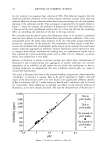
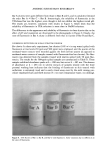
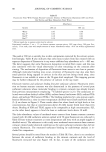
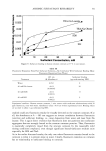
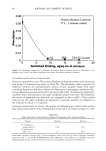
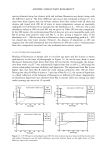
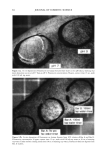
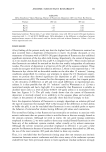
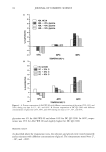
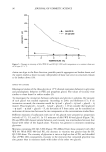
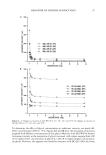
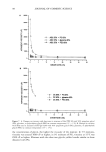
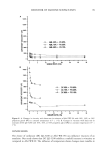
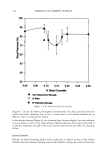
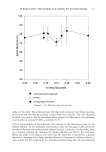
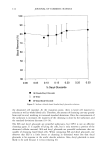
86 JOURNAL OF COSMETIC SCIENCE bound to the keratin proteins of the stratum corneum, e.g., pure sodium dodecyl sulfate (3,21), sodium laurate, Bar B (high glycerin, TEA-based soap), and Bar C (pure soap) (1). Therefore, whatever values were reported in reference 2 must have been highly sensitive to the detailed experimental procedures employed. We will return to this point shortly. We are now in a better position to understand what the fluorescein rinsing assay actually measures and propose why it does not correlate with measurements of the actual binding of surfactants to skin and the damage that they can produce. When slurries containing fluorescein are applied to and rinsed from the surface of the skin, fluorescein will track changes that take place in the aqueous phase of the surfactant mixture. Since fluorescein does not partition into surfactant micelies or other association structures, it cannot report on their location. If a limited amount of cool water is used to rinse the slurry under minimal agitation, a finely dispersed precipitate of fluorescein can get trapped in the crevices and folds in the skin surface. Since TEA soaps have high pH and fluorescein is highly soluble in these solutions (see Figures 6-8), the bulk of the soap solution will have a tendency to be rinsed off more quickly from a surface in this type of test, even though the surfactant has a considerable molecular interaction with skin and is strongly bound to the corneum proteins on a molecular scale. Any differences between formu- lations are driven primarily by pH, buffer strength, and type of base rather than sur- factant residue, i.e., the test measures fluorescein residue, not surfactant residue. Even though the differences reported in reference 2 are an artifact of the probe used, it is appropriate to comment on the rinsing conditions employed. Although exaggerated tests are often very useful in predicting product performance attributes, e.g., lather (22) and mildness (19), we believe that the test conditions are very unrealistic and can provide a misleading measure of the rinsability of cleansing compositions in everyday use. The procedure described in reference 2 employs the minimum volume of cool water ("room temperature") that is required "not to leave a visible residue on the skin" and is performed without rubbing or any agitation. These conditions are very different from those commonly employed by consumers in the cleansing process. For example, habits studies (23) indicate that an average U.S. shower lasts approximately 4-5 minutes, with water at a temperature of about 32-43øC, pumped at a rate of about 6.5 liters per minute. Similarly, an average face wash lasts about 30-45 sec, with the majority of people using water at a temperature in the range of between 32øC and 43øC and rarely below 27øC. Although the amount of water used, and its flow rate, are far below the values quoted for showering, considerable rubbing take place during the rinse. The above analysis indicates that a more realistic measure of rinsing might, in fact, be the surfactant residue that is strongly bound to the skin (e.g., stratum corneum) since it resists even the vigorous rinsing that is commonly found in practice. If this measure of residue were employed, then Bar A has a significantly lower surfactant residue than either Bar B or Bar C, as has previously been shown (3). Spectroscopic studies suggesting this conclusion will be published in the future (24). SUMMARY AND CONCLUSIONS Fluorescein does not track the binding of surfactants to skin and, thus, cannot measure intrinsic interactions between a cleansing composition and skin. Since fluorescein does

ANIONIC SURFACTANT RINSABILITY 87 not partition into micelies, it also cannot track the location of surfactants. Thus, the assay actually measures the way fluorescein, applied to skin from water or a cleansing bar slurry, is rinsed under highly unrealistic conditions using a limited amount of cool water with no mechanical agitation, i.e., it is a fluorescein rinsing assay! Not only do differ- ences in fluorescein retention disappear under more realistic rinsing conditions, the differences between products primarily arise from differences in pH because of fluores- cein's solubility characteristics. Thus, the conclusions by Wortzman et aL (2) on the superior finsability of the TEA-soap bar over the isethionate bar are derived from an artifact of their test method, and has little to do with surfactant rinsability, let alone mildness. In fact, the test is actually misleading since soaps leaves more aurfact•nta bound to skin than do isethionate-based bars because of soap's stronger interaction with stratum comeurn proteins. ACKNOWLEDGMENTS The authors thank Ms. Marion Margosiak for the photographs, Ms. Patricia Liberati for supplying habits information, and Dr. Paul Sharko for useful discussions. REFERENCES (1) S. Mukherjee, M. Margosiak, K. P. Ananthapadmanabhan, K. K. Yu, and M.P. Aronson, Interactions of cleansing bars with stratum corneum proteins: An in vitro fluorescent spectroscopic study, J. Soc. Cosmet. Chem., 46, 301-320 (1995). (2) M. S. Wortzman, R.A. Scott, P.S. Wong, N.J. Lowe, and J. Breeding, Soap and detergent bar rinsability, J. Soc. Cosmet. Chem., 37, 89-97 (1986). (3) K.P. Ananthapadmanabhan, K. K. Yu, C.L. Meyers, and M. Aronson, Binding of surfactants to stratum corneum, J. Soc. Cosmet. Chem., 47, 185-200 (1996). (4) D. D. Strube, S. W. Koontz, R. I. Murahata, and R. F. Theiler, The flex wash test: A test method for evaluating the mildness of personal washing products, J. Soc. Cosmet. Chem., 40, 297-306 (1989). (5) J. K. Thomas, Radiation-induced reactions in organized assemblies, J. Soc. Cosmet. Chem., 80(4), 283-299 (1980). (6) R. Zana, Ed., Surfactant Solutions, Surfactant Science Series, Vol. 22 (Marcel Dekker, New York, 1987). (7) K. Kalyanasundaram and J. K. Thomas, Environmental effects of vibronic band intensities in pyrene toohomer fluorescence and their application in studies of miceliar systems,J. Soc. Cosmet. Chem., 99(7), 2O39 (1977). (8) K.P. Ananthapadmanabhan, E. D. Goddard, N.J. Turro, and P.L. Kuo, Fluorescence probes for critical micelie concentration, Langmuir, 1(13), 352 (1985). (9) N.J. Turro, M. Aikawa, and A. Yekta, A comparison of intermolecular and intramolecular excimer formation in detergent solutions, J. Am. Chem. Soc., 101,772 (1979). (10) P. Chandar, P. Somasundaran, and N.J. Turro, Fluorescence probe studies on the structure of the adsorbed layer of dodecyl sulfate at the alumina-water interface. J. Colloid. Interface Sci., 117(1), 31 (1987). (11) P. Chandar, P. Somasundaran, K. C. Waterman, and N.J. Turro, Variation in nitroxide chain flex- ibility within sodium dodecyl sulfate hemimicelles, J. Phys. Chem., 91, 150 (1987). (12) P. Mukerjee and K.J. Mysels, A re-evaluation of spectral change method of determining critical micelle concentration,J. Phys. Chem., 77, 2937 (1955). (13) P. Mukerjee and K.J. Mysels, Critical micelle concentration of aqueous surfactant systems, National Bureau of Standards, NSRDS-NBS, 36 (1971). (14) J. Slavik, Anilinonaphthalene sulfonate as a probe of membrane composition and function, Blochim. Biophys. Acta, 694, 1-25 (1982). (15) D. A. Kolb and G. Weber, Cooperativity of binding of anilinonaphthalene sulfonate to serum albumin induced by a second ligand, Biochemistry, 14, 4476•,499 (1980).
Purchased for the exclusive use of nofirst nolast (unknown)
From: SCC Media Library & Resource Center (library.scconline.org)