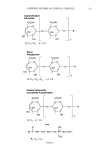
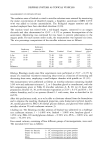
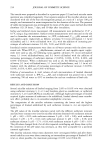
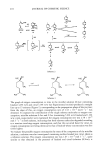
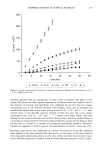
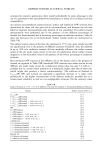
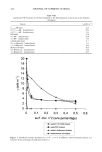
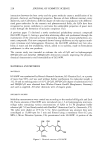
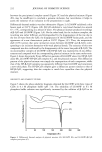
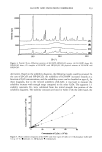
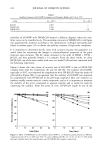
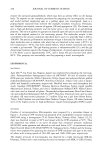
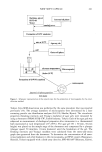
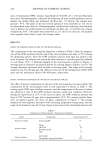
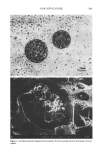
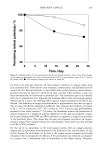
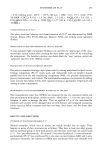
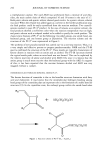
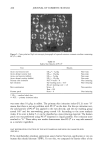
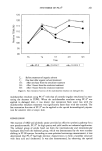
218 JOURNAL OF COSMETIC SCIENCE ,,OHO H + •HH•O Geraniel 65:•5 Neral la lb (•OC21-b OH 4 •. T •ispm 3a OH • •OH 3b 3• Scheme 2 OH OH OH Scheme 3 The graph of oxygen consumption vs time in the miceIlar solution LC-Lec containing linalool 4.0% w/w and citral 1.0% w/w (see Experimental section) produced a straight line up to 15 minutes (Figure 1), corresponding to the propagation phase of the reaction from the slope of this, an oxygen consumption rate of 1.32 x 10 -8 mol l-•s -1 was obtained. To separate the contribution of the single odorous molecules to oxygen con- sumption, miceIlar solutions L-Lec and C-Lec (containing 5.0% w/w linalool and 1.0% w/w citral, respectively) were examined the oxygen consumption rate was 2.78 x 10 -8 mol I- • s- • in both systems, indicating that both odorous molecules degraded according to a reaction involving oxygen consumption, and that this occurred faster for citral, its oxygen consumption rate being identical to that of linalool whose concentration was five times higher. To evaluate the possible oxygen consumption by some of the components of the miceliar solution, a solution was also investigated containing neither linalool nor citral, taken as a reference solution. The oxygen consumption rate was 1.67 x 10 -8 mol 1 -• s -1, quite similar to that obtained in the presence of linalool and citral (solution LC-Lec) it

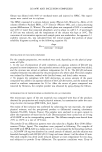
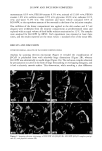
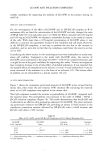
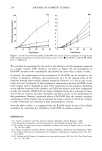
DISPERSE SYSTEMS AS TOPICAL VEHICLES 219 250 200 '5o 100 5O i i i i i i 0 5 10 15 20 25 30 35 time (min) e LC-Lec []-C-Lec --•-L-Lec x Ref o LC --•-Li Figure 1. Oxygen consumption by oxidation of odorous molecules in different miceliar solutions at 45.0 ø + 0.1øC (AIBN 0.25% w/w). therefore appeared that no degradation of either citral or linalool took place in that system. The protective effect against degradation of odorous molecules might be due to the presence of lecithin this hypothesis was confirmed by the fact that the oxygen consumption rate in LC (miceliar solution with linalool, citral, and no lecithin) was considerably higher than in any other system studied (2.21 x 10 -7 mol 1 -• s-Z). Also, linalool alone in the miceliar solution without lecithin (L) gave rise to an oxygen consumption rate of 8.33 x 10 -8 tool 1 -• s -z, almost three-times higher than that obtained in the miceliar solution with lecithin. Soya lecithin, therefore, might behave as a naturally occurring molecule with antioxidant properties, as may also be deduced from the fact that it is used in a number of commercial antioxidant products. Moreover, linalool also appeared to protect against the autooxidation of citral in some way (14). Rheology experiments were performed to evaluate the behavior of miceliar solutions when applied to the skin, and also after dilution by eccrine sweat, or the water derived from insensible perspiration present on the skin surface and after partial water evapo- ration. Miceliar solutions of linalool A and B (with surfactant mixtures 1 and 2, respec-
Purchased for the exclusive use of nofirst nolast (unknown)
From: SCC Media Library & Resource Center (library.scconline.org)