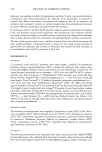
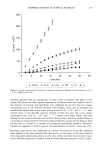
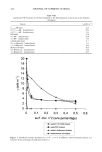
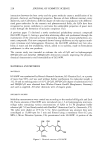
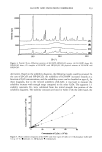
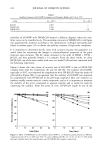
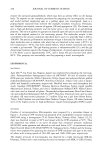
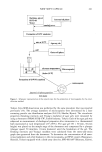
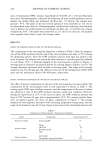
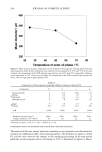
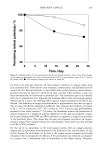
220 JOURNAL OF COSMETIC SCIENCE tively) also showed an evident NewtonJan behavior after dilution with water and after different evaporation times. On the contrary, the rheograms obtained in steady-state conditions evidenced a pseu- doplastic, slightly thixotropic behavior of miceliar solution D (surfactant mixture 3) (Figure 2), indicating a certain structuring of the system, probably due to the presence of two alkyl glucosides. At higher shear rates, the system tended to become Newtonian: The pseudoplastic thixotropic behavior was maintained also after 15- and 30-minute evaporation, while longer evaporation times produced a Newtonian system. After dilu- tion, the miceliar solution assumed Newtonian characteristics, also maintained after different evaporation times. The addition of several humectants to miceliar solution D was aimed to improve water retention so that pseudoplasticity and thixotropy, useful for spreadibility of the product, would be maintained as long as possible. Unfortunately, the addition of 3.0% w/w glycerol, 1.0% w/w PCA, or 3.0% w/w xylitol originated systems that were NewtonJan as such and after evaporation. The addition of 2.0% w/w laureth-2 to the miceliar solution containing 1.0% w/w PCA determined a pseudoplastic behavior with thixot- ropy, also maintained after 15- and 30-minute evaporation (Figure 3). An analogous rheological behavior was noted after substituting laureth-2 with methyl gluceth-10. 18- I I I 60 80 100 0 20 40 shear rate (s A ,,. u -B-I --•- 15' ev u X 15' ev I [] 30'evu 0 30'evl Figure 2. Rheograms at 25 ø + 0. iøC of miceliar solution D just prepared and after evaporation. u = upper curve. 1 = lower curve.

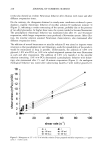
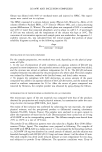
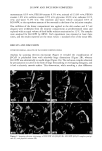
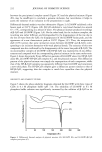
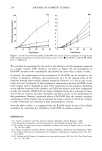
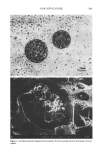
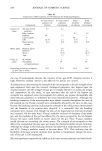
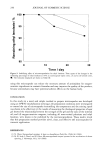
DISPERSE SYSTEMS AS TOPICAL VEHICLES 221 18 16 14 12 10 8 6 4 2 0 0 I I I 20 40 60 80 100 shear rate (s -•) ^ 24hu -•-24 h I v ß •. 15'ev.u X 15'ev.I 1• 30'ev.u 0 30'ev.I Figure 3. Rheograms at 25 ø + 0.1øC of micellar solution D in the presence of 2.0% w/w laureth-2 and 1.0% w/w PCA just prepared and after evaporation. u = upper curve. 1 = lower curve. Lastly, the addition of 0.50% w/w PEG-120 methyl glucose dioleate to micellar solu- tions containing 1.0% or 2.0% w/w PCA determined a pseudoplastic behavior, also maintained after 30-minute evaporation (Figure 4). An increase in the structuring of micellar solutions could, of course, have been obtained by employing the common thickening agents of aqueous phase. Rather, we preferred to consider substances that, in some cases, depending on their amphyphilic structure, probably locate at the core/bulk interface, partially modifying it. Thus it was possible to evaluate whether the presence of a different composition of the interface could influence the rheology of the system. Moreover, the addition of the above-mentioned substances allowed us to eliminate ethanol from the formulations, thus increasing their mildness. As the micellar solutions containing 0.50% w/w PEG-120-methyl glucose dioleate and 2.0% w/w PCA were found to possess the best rheological properties, they were further examined to evaluate microbial growth by means of a challenge test. The results ob- tained with the plate count method are reported in Table VI, expressed in colony- forming units (c.f.u.) of viable microorganisms per gram. It may be seen that, under storage at room temperature, the c.f.u. at all times are below 10 per gram of product. Results of the challenge test indicate the following: at 24 hours the rapidity of the action
Purchased for the exclusive use of nofirst nolast (unknown)
From: SCC Media Library & Resource Center (library.scconline.org)