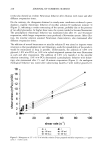
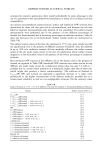
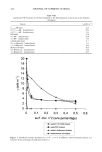
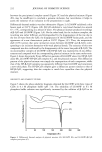
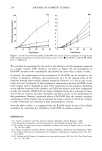
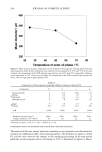
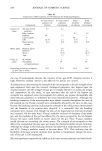
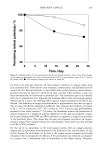
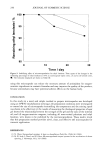
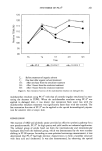
236 JOURNAL OF COSMETIC SCIENCE 100' (A) '80. 0 0 10 20 30 40 50 18 (B) 14 12 10 8 i0 10 •0 3'0 4'0 gO Time(Hours) Time(Hours) Figure 7. In vitro skin permeation profiles of LG106W alone and its inclusion complexes in water (A) and O/W emulsion (B) through on excised hairless mouse skin at 32øC. O, LG106W ¸, [3-CyD •r, HP-[3- CyD V, DM-[3-CyD. We extended the experiment by the study of the influence of CyD complexes contained in a simple cosmetic O/W emulsion. As shown in Figure 7B, the permeability of LG106W increased with complexation and showed the same order as those in water. In general, the enhancement of skin permeation of LG106W can be ascribed to the increase in solubility, diffusion, and concentration of it in the aqueous phase of the emulsion through water-soluble complex formation. However, it is not so easy to elu- cidate the exact mechanism of skin permeation enhancement because LG106W in the CyD complex may be displayed by some other components of the emulsion, depending on the stability constant of the complex, and CyDs also interact with some components of skin. For example, DM-[3-CyD can extract cholesterol from skin, reducing the func- tion of skin as a barrier, and may eventually contribute in part to the enhancement of skin permeation. However, optimized release of LG106W from the cosmetic emulsion containing its CyD complex may be obtained by using a vehicle in which the complex is barely dissociated and maintains a high thermodynamic activity. From the above results, it is suggested that the [3-CyDs might be one of the reliable candidates for improving the availability of LG106W in cosmetic products. REFERENCES (1) J. Szejtli, Cyc/odextrins and Their Inclusion Complexes (Alkad•miai Kiad6, Budapest, 1982). (2) D. Dunchine, Cyclodextrins and Their IndustriM Uses (Les Editions de Sant•, Paris, 1987). (3) W. Saenger, Cyclodextrin inclusion compounds in research and industry, Angew. Chem. Int. Ed. Eng/., 19, 344-362 (1980). (4) J. Szejtli, Cyc/odextrin Technology (Kluwer Academic Publishers, Dordrecht, The Netherlands, 1988). (5) K. Uekama, Pharmaceutical applications of cyclodextrin complexations, Yakugaku Zasshi, 101,857- 873 (1981). (6) K. Uekama and M. Otagiri, Cyclodextrins in drug carrier systems, CRC Crit. Rev. Ther. Drug Carrier Sys., 3, 1-40 (1987).

LG106W AND INCLUSION COMPLEXES 237 (7) (8) (9) (10) (ll) (12) (13) (14) 05) (16) (17) (18) H. H. Lee, Development of whitening agents by synthesis of polyhydroxy aromatic compounds, 3rd ASCS Scientific Conference, Taipei, 1997. T. Higuchi and J. L. Lach. Investigation of some complexes formed in solution by caffeine. IV: Interaction between caffeine and sulfathiazole, sulfadiazine, p-aminobenzoic acid, benzocaine, pheno- barbital and barbital, J. Am. Pharm. Assoc., Sci, Edn., 43, 349-354 (1954). T. Higuchi and K. A. Connors. Phase-solubility techniques, Adv. Anal. Chem. Instr., 4, 117-212 (1965). R. Lotan and D. Lotan, Stimulation of melanogenesis in a human melanoma cell line by retinoids, Cancer Res., 40, 3345-3350 (1980). T. Mossman, Rapid colorimetric assay for cellular growth and survival: Application to proliferation and cytotoxity assays, J. Immunol. Meth., 65, 55-63 (1983). K. Uekama, Enhanced dissolution and oral bioavailability of ct-tocopheryl esters by dimethyl-[3- cyclodextri,n complexation,J. Inc. Phenom., 6, 167-174 (1988). J. Szejdi, E. Bolla-Pusztai, and M. Kajatar, The [3-cyclodextrin inclusion complex of menadione (Vitamin ,K3), Pharmazie, 37, 725-728 (1982). J. Szejtli, E. Bolla-Pusztai, M. Tardy-Lengyel, P. Szab6, and T. Ferenczy, Preparation, properties and biological activity of [3-cyclodextrin inclusion complex of menadione, Pharmazie, 38, 189-193 (1983). Takeda Chemical Industries Limited, Cyclodextrin inclusion compound of 2-n-octyl-4-octyl- isothiazoline-3-one useful as a fungicide having long-lasting effect, Japanese Patent 1505 77 (1983). Sunstar Inc., Nonirritating cosmetics, Japanese Patent 10323 (1984). Sun Star Dentifrice, Dentifrice composition without lowering the potency, Japanese Patent 1101115 (1976). Sun Star Dentifrice and Daiichi Kogyo Seiya (S. Hashimoto, K. Inoue, and T. Watanabe), Toothpaste compositions containing sucrose fatty ester foaming agents and cyclodextrin to prevent decrease in foaming ability without inactivating enzymes present, Japanese Patent 2034941 (1977).
Purchased for the exclusive use of nofirst nolast (unknown)
From: SCC Media Library & Resource Center (library.scconline.org)