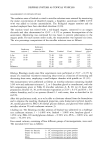
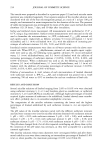
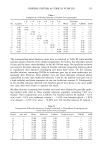
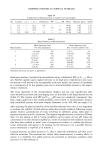
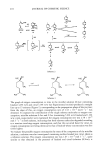
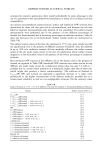
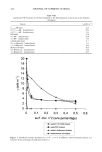
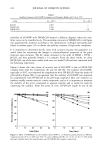
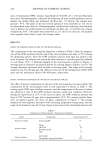
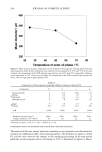
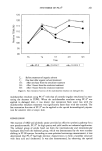
234 JOURNAL OF COSMETIC SCIENCE Table I Stability Constant of LG106W Complexes in Phosphate Buffer (pH 7.0) at 25øC CyDs K•:•(M -•) K•:2(M -•) [3-CyD 3,897 HP-[3-CyD 3,964 DM-[3-CyD 6,186 2.0 solubility of LG106W with DM-[3-CyD showed a different diagram, where the solu- bility curve can be classified as Ap. The ascending curvature of DM-[3-CyD in the figure was quantitatively analyzed according to the optimization technique previously pub- lished in another paper (12) to obtain the stability constant of high-order complexes. It is important to determine the Kc value with accuracy, because this parameter is a useful index for estimating the changes in physicochemical properties of the guest molecule upon inclusion. The Kc values increased in the order of DM-[3 HP-[3 [3-CyD, and they generally formed a 1:1 complex. From the above results, we chose HP-[3-CyD, one of the most widely used ones, as a model CyD and then continued with the following experiment. Figure 6 shows the time course of recovery rate of LG106W in free or HP-[3-CyD complex form with the temperature (A) and the pH (B). The stability of LG106W, especially at 50øC, was improved by complexation with HP-[3-CyD. From the results of pH stability (Figure 6B), it was apparent that the stability of LG106W was improved by complexation with HP-[3-CyD in the pH range employed. Skin care cosmetics in markets usually contain water as a main component, and so it is important to maintain the stability of the active compound in aqueous solution and to search for tools for improving the stability. From this point of view, HP-[3-CyD might be one of the lOO• r..D 60 40 • 20 (A) 40' 20' 0 0 4'0 ='0 a'0 io ø0 4'0 i0 10 i0 Time (Days) Time (Days) Figure 6. Effect of HP-[3-CyD on the stability of LG106W in 1,3-butylene glycol solution at different temperatures (A): 25øC, O 40øC, W] 50øC, V and at different pH (B): 4.5, O 6.5, [-] 8.5, V. The closed and open symbols show the material alone and the HP-[3-CyD complex, respectively.

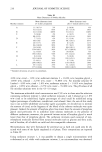
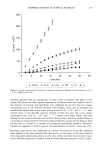
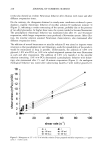
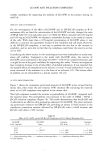
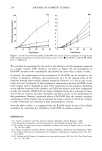
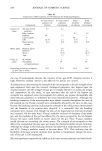
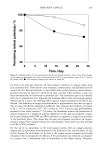
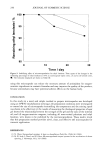
LG106W AND INCLUSION COMPLEXES 235 reliable candidates for improving the stability of LG106W in the product during its shelf life. EFFICACY AND CYTOTOXICITY For the investigation of the effect of LG106W and its HP-[3-CyD complex on B-16 melanoma cells, we fixed the concentration of the LG106W and only changed the ratio of H P-[3-CyD (5 % w/w and molar ratio 1:1) (Table II). When cultured with 0.02 mg/ml and 0.05 mg/ml of LG106W, we obtained a remarkable decrease in the melanin content of the cells. With more than a 0.05-mg/ml concentration of LG106W alone, it was difficult to continue the experiment because of low solubility and cell death. However, in the HP-[3-CyD complexes, it was easy to perform the test due to the increase in solubility, and we were able to find that the complexes could lower the toxicity on that cell as well. Considering the above results, in vitro toxicological tests were undertaken to study more about cell viability. Compared to the result with LG106W alone, the toxicity of LG106W can be attenuated in the range of 0.0047 - 0.012% by complex formation, and it might be one of the good candidates for improving skin safety. Various investigations have revealed a decrease in the irritant effect of included substances. It was reported that the harmful effects of stimulation on the skin by 2-n-octyl-4-octyl-isothizolein-3-one are vastly decreased if the substance is in the form of an inclusion (15). The irritant effect of perfume can be diminished in a similar manner (16-18). IN VITRO SKIN PERMEATION Figure 7 shows the cumulative penetrated amounts of LG106W across excised hairless mouse skin, when water (A) and cosmetic O/W emulsion (B) containing the material alone or its CyD complexes were applied to the mouse skin. The CyD complexes revealed the increase in permeability of LG106W, compared with the material alone. The permeability was increased in the order of DM-[3 HP-[3 [3-CyD inclusion complexes (Figure 7A). This result demonstrates that the [3-CyD and its derivatives are effective skin permeation enhancers for LG106W. The most outstand- ing penetration enhancer was DM-[3-CyD, providing an almost 23-fold increase in the cumulative permeation amount, followed by HP-[3-CyD, with a 6-fold increase, and [3-CyD, with about a 30% increase. Table II Effect of LG 106W and Its HP-[3-CyD Complexes on B-16 Mouse Melanoma Cells LG106W LG106W Complex Complex Conc. (mg/ml) alone (5 % w/w) (1:1) 0.02 +* + + 0.05 ++, 20%** ++(+), 40% ++(+), 40% 0.10 -- ++(+), 20% ++(+), 20% * +, slight whitening effect + +, moderate whitening effect + + +, significant whitening effect. ** Cell viability.
Purchased for the exclusive use of nofirst nolast (unknown)
From: SCC Media Library & Resource Center (library.scconline.org)