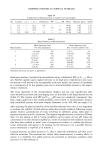
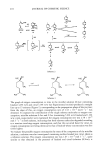
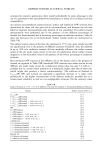
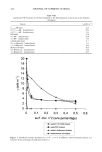
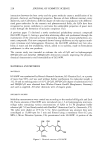
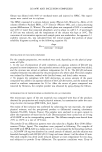
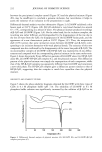
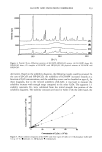
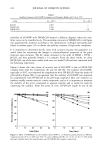
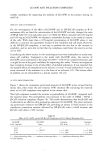
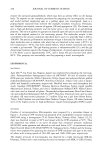
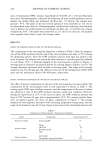
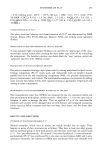
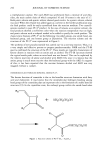
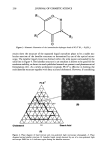
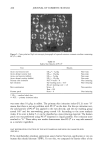
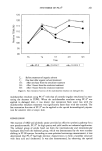
SYNTHESIS OF PC-9 s 257 part in hydrogen bonding with the hydroxyl group of another molecule. However, it was observed that when the pseudoceramide, PC-9 s was dissolved in a hydrophobic solvent such as chloroform (a liquid state), hydrogen bonding among the molecules weakened greatly or completely disappeared. The FT-IR spectra of PC-9 s in a solid state (KBr) and a liquid state (chloroform) was used to determine the existence of intermolecular hy- drogen bonds. The reaction of AKD and 2-aminoethanol resulted in the ring-opening reaction of IB-lactone and the new bond formation of a IB-keto group (1717.13 cm-•) and an amide bond (1649.15 cm -•) shown in the KBr pellet, where the hydroxyl group of its head group shows a hydrogen bond with the amide bond. With PC-9 s dissolved in chloroform (a liquid state), it was observed that the wave number of the amide bond was shifted into the higher wave number (1662.72 cm-•), which meant that the intermo- lecular hydrogen bonds disappeared in the chloroform, which was certified by the wave number shifting of the amide bond (A u = 13.57 cm -•) (Figure 2). This demonstrates that there is an intermolecular hydrogen bond among molecules, which plays an im- portant role in lameliar structure formation. Besides the intermolecular hydrogen bond- ing, there is the strong possibility to also form intramolecular hydrogen bonds. It was reported that an intramolecular hydrogen bond occurred in the six-member ring very easily (20). As a theoretical drawing, Figure 3 illustrates an intramolecular hydrogen bonding of PC-9 s. PHASE DIAGRAM OF THE LIPID MIXTURE AND ITS OBSERVATION Figure 4 shows the phase diagram of a PC-9S/stearic acid/cholesterol complex system and a typically characteristic cross-polarized picture at a point within the phase diagram. The P½.•(KBr) PC-9={CHCI3) 170•-• t6E 2.72 L leto 1600 Figure 2. FT-IR spectrum of PC-9 s in the crystal state (KBr) and liquid state (chloroform).

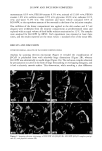
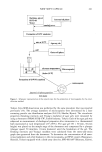
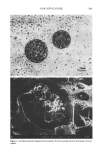
258 JOURNAL OF COSMETIC SCIENCE R R•' • '"Rs 0 Figure 3. Schematic illustration of the intramolecular hydrogen bond of PC-9 s (R• = RoCH2). results show the structure of the separated liquid crystalline phase to be a stable mo- lecular associate of the lameliar structures as determined by use of the optical micro- scope. The lameliar liquid crystal was formed within the wide region surrounded by the solid line in Figure 4. The lameliar structure in an emulsion is known to be good for the emulsion stability, as shown in much published research on cosmetic and pharmaceutical formulations (21). As a newly synthesized ceramide, PC-9 s is effective in forming the multilamellar structure together with fatty acid and cholesterol. However, if considering / A/ V / ", /\/\/V", / \/\/'x o.s Stearic Acid Figure 4. Phase diagram of lipid mixture and cross-polarized light microscopic photograph. A. Phase diagram having lameliar structure. B. Lameliar liquid crystal observed by use of a cross-polarized light microscope. Bold line in A indicates region having the lameliar structure.
Purchased for the exclusive use of nofirst nolast (unknown)
From: SCC Media Library & Resource Center (library.scconline.org)