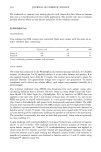
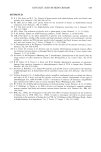
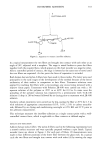
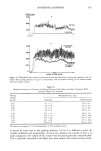
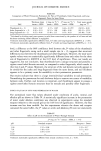
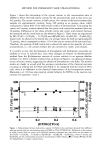
INTERFIBER ADHESION 355 FORCE 30 = 20- IO 0 -IO -20 NYLON -6- J R 400 = FIBER POSITION Figure 4. Adhesion force curves for JR-400-treated nylon-6 fibers at different positions along the fiber. Table II Adhesion Forces Between Pairs of Untreated and JR-400-Treated Human Hair Fibers (contact force -2 mg) Tension (g) 4 10 Student t Treatment Untreated 0 0 JR-400 17.2 + 6.4 12.5 + 4.2 n.s. Each entry is an average of 20 measurements at the 95% confidence level. n.s., not significant in adhesion forces with position must be attributed to the nonuniform distribution of the polymer on the surface of the hair, repeatedly observed in wettability measurements (2). To confirm these observations, measurements were repeated on four pairs of hair fibers pretreated with a dilute surfactant solution (Tr-X-100) to promote a more uniform spreading of polymer JR-400. Adhesion forces for these fibers are given in Table III. The data in Table III show large variations in the forces of adhesion from pair to pair. This may be due to different levels of pick-up of the polymer or to differences in the areas of contact as a result of the ellipticity of the fiber cross section. Surprisingly, a 0.3-ks rinse in water eliminates adhesion in all four pairs. A second polymer treatment after the rinse again gives rise to an increase in adhesion. A third treatment with JR-400 at 60øC for 0.9 ks, followed by a single dip in water, gave no adhesion forces for all four pairs. Earlier work on the substantivity of JR-400 using wettability measurements (2) has clearly shown that some of the polymer is retained after rinsing with water, even if the treatment was carried out at 20øC, and that substantivity of the polymer reaches a maximum if the treatment is carried out at 60øC. A comparison of the data in the first and second part of Table III shows that the pretreatment with a surfactant did not have any effect on the resulting adhesion forces.

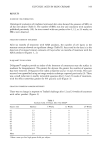
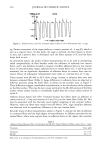
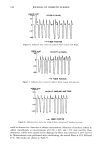
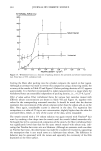
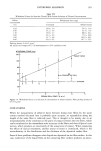
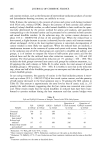
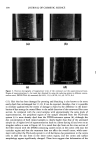
356 JOURNAL OF COSMETIC SCIENCE FORCE (_E' N ) •---•_ $0- I0 0 -I0 -t0 -20 JR-400 UNTR. •FIBER POSITION Figure 5. Adhesion force curves for untreated and JR-400-treated human hair fibers. Efj•ct of liquid surface films on interfiber adhesion. The effects of liquids on interfiber adhesion was studied with the liquids Nujol ©, glycerol, and Vaseline © hair tonic (Chese- brough Ponds). These liquids were chosen because of their rheological properties and their differences in polarity as well as for the fact that they are used commercially, especially in ethnic hair care. Nujol, or petrolatum, is a hydrocarbon, i.e., a mineral oil fraction (b.p. 260-330 C), which has a viscosity similar to that of glycerol, but a totally different polarity. Vaseline hair tonic is also a mineral oil fraction, of considerably lower boiling point and viscosity. Recorder tracings during contact (2-mg contact force) and separation of liquid-treated fibers show various phenomena that were not observed with JR-400-treated fibers. Figure 6 shows the traces for nylon-6 treated with Nujol. The return to zero after fiber separation is not instantaneous, as observed with JR-400. The film does not break at the maximum force at C, but stretches prior to failure, leading to a reduction in contact perimeter and a consequent reduction in force until it finally breaks, probably at D. The rate of return to zero varies considerably with the position along the fiber. This seems to suggest variations in thickness of the liquid film, where the viscosity of the liquid is responsible for the slow return to zero force after the maximum. A spontaneous increase
Purchased for the exclusive use of nofirst nolast (unknown)
From: SCC Media Library & Resource Center (library.scconline.org)