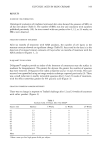
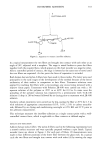
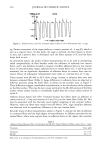
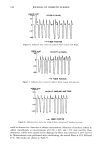
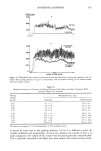
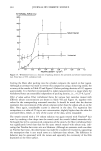
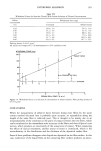
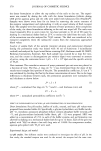
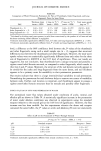
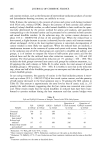
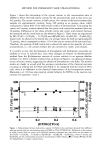
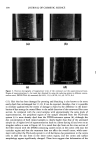
INTERFIBER ADHESION 357 Table III Adhesion Forces Between Pairs of Untreated and JR-400-Treated Human Hair Fibers at 20øC Force (pN) Pretreatment: Tr-X100, tension 10 g, contact force -2 mg, 1% JR-400: Fiber Pair (#) Untr. JR-400 Rinsed • JR-400 II JR-400 III b 1 0 17.8ñ5.1 0 24.1ñ11.4 0 2 0 7.5ñ4.2 0 1.3ñ1.1 0 3 0 1.6ñ1.3 0 5.2ñ3.2 0 4 0 1.0ñ1.0 0 2.0ñ1.3 0 Nopmtreatmentwi3 •-X-lOO, treatment•meO. 9•,no•me: JR-400,20øC JR-400,60øC 5 0 2.4ñ0.4 4.2ñ1.3 6 0 1.6ñ0.7 1.4ñ0.7 a H20, 0.3 ks. b JR-400 treatment at 60øC, no pretreatment, one dip in water. in the force upon contact between the two A fibers indicates the quick coalescence of the liquid films on the fiber surfaces and the formation of a liquid lens at the point of contact. These effects are also seen with glycerol (Figure 7). Both these liquids have a relatively high viscosity, but their surface tensions differ considerably. Vaseline hair tonic, on the other hand, does not show the slow separation as clearly (Figure 8), because of its lower viscosity. Vaseline hair tonic and Nujol on human hair (Figures 9 and 10) behave in the same way as on nylon-6 fibers. Forces of coalescence are indicative of relatively thick films on the fiber substrate. A summary of these data is given in Table IV. An attempt was made to determine the contact perimeter by a microscopic technique. In a measurement with nylon-6 fibers, the upper fiber was coated with glycerol containing a dye. On contact, this left an imprint on the untreated lower fiber that approximated a rectangle with smooth corners. The perimeter of the imprint could not be measured very accurately (approximate value 180 lam), because it is on a curved surface. The forces of adhesion were calculated based on this perimeter and on the surface tensions of the liquids and are compared with experimental values in Table IV. The agreement is good, except for glycerol. This may suggest that in this case the contact perimeter at the point of separation of the fibers was probably much smaller than the measured value. In the case of hair, adhesion forces are guided by the same principles, but contact perimeters could vary considerably, depending on the nature of the fiber cross section and the orientation of the fibers. For instance, a large contact perimeter is formed if two highly elliptical fibers contact on their flat sides. Efj•ct of sebum treatments. Synthetic sebum is used extensively to simulate effects that occur during in vivo buildup of sebum between shampoos. The interfiber adhesion experiments reported here were performed in an effort to establish whether differences

3 5 8 JOURNAL OF COSMETIC SCIENCE FORCE [•N) c IO -IO NYLON-6- NUJOL • FIBER POSITION Figure 6. Adhesion force curves for nylon-6 fibers treated with Nujol. FORCE (•.._N) I0 0 -I0 -20 - NYLON-6-GLYCEROL '-'•FIBER PosmoN Figure 7. Adhesion •rcecurves •rnylon-6 fiberstreated with glycerol. FORCE(..•u.N) I0 - ø t -!0 I NYLON-6- VASELINE HAIR TONIC -• FIBER POSITION Figure 8. Adhesion force curves for nylon-6 fibers treated with Vaseline hair tonic. could be observed as a function of sebum concentration. Solutions of synthetic sebum in carbon tetrachloride at concentrations of 0.5%, 1.0%, and 1.5% were used for these treatments, which were carried out by dipping the fibers into solutions at 20øC for 0.9 ks. Measurements were performed after conditioning the treated fibers at 65% RH and 21 øC. The results are shown in Table V.
Purchased for the exclusive use of nofirst nolast (unknown)
From: SCC Media Library & Resource Center (library.scconline.org)