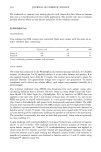
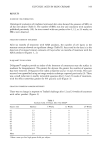
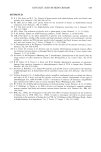
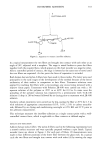
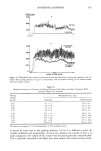
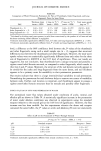
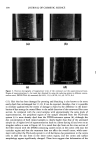
INTERFIBER ADHESION 363 FORCE 2O0 400 O J Untreated 4OO 3OO b - 2 % Sebum, perreed ' I 2% Seburn, no perrn •- ,'-, 5 mm • Length of fiber moved Figure 13. Withdrawal force curves for untreated human hair fibers after waving and treatment with 2% sebum. Fiber packing density 0.25 g/cm 3. (a) untreated, with and without waving (b) 2% sebum-treated, with and without waving. Table VI Withdrawal Forces as a Function of Packing Density of Hair Before and After Treatment With Synthetic Sebum (1% solution) Packing density (g/cm 3) Withdrawal force (mg) Untreated Sebum-treated 0.03 4.1 + 1.3 33.0 + 6.1 0.05 2.8 + 0.9 35.4 + 9.0 0.08 5.2 + 1.9 35.1 + 4.8 0.13 9.8 + 6.5 36.9 + 6.5 0.18 24.5 + 3.9 38.0 + 5.9 0.29 41.9 + 12.4 92.4 + 18.8 0.36 39.3 + 6.6 135.6 + 16.3 0.44 33.7 + 4.8 91.7 + 18.2 0.64 45.0 + 6.5 120.7 + 23.5 All entries are averages of 15-20 measurements at 95% confidence level. It should be noted that at low packing densities (0.15) it is difficult to pack the cylinder uniformly and reproducibly. At these low densities the amount of hair is so small compared to the volume of the cylinder that the packing becomes irreproducible. This is especially noticeable if the fibers have been treated with sebum and are sticky.

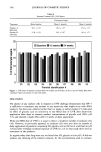
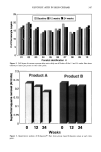
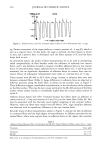
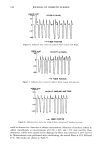
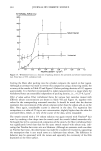
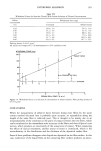
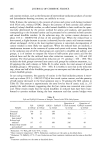
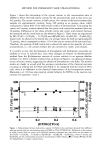
364 JOURNAL OF COSMETIC SCIENCE WITHDRAWAl FORCE (rag) .. t60 t20 - i0C- 80- o oJ o.2 o.5 Sebum treated Untreated I I I I I I 1 0.4 0.5 0.6 0.7 O.B 0,9 4.0 PACKING DENSITY (g/cm 3) Figure 14. Withdrawal forces as a function of packing densities for untreated and sebum-treated human hair. Error bars at 95% confidence level. Cutting the fibers after packing into the cylinder compacts the swatch in that region. Although an attempt was made to reverse this compaction using a dissecting needle, the accuracy of the results in Table VI and Figure 14 below packing densities of 0.15 appears questionable. It is therefore recommended to make measurements in a range where the withdrawal forces are essentially independent of packing density, i.e., 0.25-0.3 g/cm 3. Efj•ct of sebum add-on. Fiber withdrawal forces for various hair swatches treated with different sebum concentrations are shown in Table VII and Figure 15, together with values for the corresponding untreated swatches. It should be noted that the abscissa represents the concentration of the sebum solution rather than the sebum add-on on the fiber. Once again, considerable scatter is observed in the data. The regression line extrapolates to a value of 45 mg at zero concentration, slightly higher than the value for untreated fibers, which, in view of the scatter of the data, seems reasonable. The swatch treated with a 3% sebum solution was again treated with Vaseline © hair tonic by combing a few drops into the swatch until the swatch looked somewhat oily. Although this led to a pronounced compaction of the swatch, the fiber withdrawal force was significantly lower than that for the same swatch treated with sebum only, indi- cating that Vaseline hair tonic acts as a lubricant. Although no extensive work was done on Vaseline hair tonic, this observation was made for a number of treatments, supporting the assumption that it acts much more as a lubricant than sebum. The difference in behavior may be associated with the nature and especially the continuity of the film deposited on the fiber surface.
Purchased for the exclusive use of nofirst nolast (unknown)
From: SCC Media Library & Resource Center (library.scconline.org)