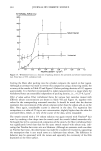
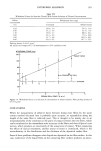
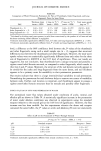
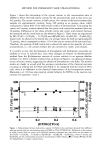
INTERFIBER ADHESION 365 Table VII Withdrawal Forces for Swatches Treated With Sebum Solutions of Various Concentrations concentration (%) Withdrawal force (mg) Untreated Sebum-treated 0.25 29.8 + 3.6 50.2 + 11.4 0.50 33.2 + 5.0 42.4 + 11.9 1.50 29.8 + 2.7 88.8 + 20.2 2.00 34.3 + 4.0 75.6 + 18.0 3.00 33.7 + 4.8 102.0 + 28.3 4.00 45.0 _+ 6.5 107.7 _+ 25.3 Packing density: 0.4-0.5 g/cm 3. All entries are averages of 15-20 measurements at 95% confidence level. WITHDRAWAL FORCE (rng } {20 - {00 - 80- 6O 4O 2_0- $e b.••um •reoted tonic Untreated 0 1 2 5 4 5 SEBUM SOLN. CONC. ( % w/v } Figure 15. Withdrawal forces as a function of concentration of sebum solution. Fiber packing density of 0.4-0.5 g/cm 3. CONCLUSIONS While the measurement of adhesive forces between human hair fibers by the point contact method discussed here is probably quite accurate, its repeatability along the length of the same fiber is relatively poor. This is thought to be mainly due to an irreproducibility of the conditions at the point of contact between the two fibers, which can be attributed to the nonuniform scale structure of the fibers and their elliptical cross section, which produces an uncertainty of the actual area of contact. When measuring the effects of topical treatments, another source of errors is introduced, which is the nonuniformity in the distribution and the thickness of the deposited surface film. Some of these problems disappear when liquids are deposited on the fiber surface. In this case, coalescence of the liquid films on the contacting fiber surfaces produces an attrac-

366 JOURNAL OF COSMETIC SCIENCE tive force upon contact and the resulting capillary forces contribute to the force of separation. While the reproducibility of the measurements is good, the uncertainty regarding the area of contact remains. In our efforts to establish correlations between adhesive interactions and compressibility parameters, it appeared that the single-point contact method did not provide an ad- equate parameter and we decided to test a multipoint contact method with fibers aligned parallel to each other. The dynamic pull-out method, using an appropriate packing density, provides an empirical adhesion parameter, i.e., the "withdrawal force," which can help in the prediction of compressibility behavior, as will be shown in a subsequent paper (3). ACKNOWLEDGMENTS The authors would like to thank Mrs. C. J. Dansizer and Mrs. Hannelore Mark for their diligent contributions to the experimental work discussed here. The work reported was carried out as part of the Core-Technolog Project, The a4odification of Human Hair Properties by Surface Treatments, at TRI/Princeton. The authors would like to thank the corporate participants in this project for their support. REFERENCES (1) A. Kul and P. A. Smith, Appl. Polymer Symp., 18(Part II), 1467 (1971). (2) Y. K. Kamath, C.J. Dansizer, and H.-D. Weigmann, J. AppL Polymer Sci., 29, 1011 (1981). (3) Y. K. Kamath and H.-D. Weigmann, in preparation. (4) E. F. Denby and M. W. Andrews, Textile Res. J., 35, 913 (1965).
Purchased for the exclusive use of nofirst nolast (unknown)
From: SCC Media Library & Resource Center (library.scconline.org)